
纳木错大气、湖水和鱼体中持久性有机污染物浓度数据集(2012-2014)
收藏国家青藏高原科学数据中心2021-04-19 更新2024-03-01 收录
下载链接:
https://data.tpdc.ac.cn/zh-hans/data/68d29a56-c6af-42bb-ace9-0ea728b460b3
下载链接
链接失效反馈官方服务:
资源简介:
纳木错2012-2014年观测的大气、湖水和鱼体中持久性有机污染物的浓度,包括:大气气态有机氯农药(OCPs)和多氯联苯(PCBs)浓度的时间序列;大气气态多环芳烃(PAHs)浓度的时间序列;大气颗粒态PAHs浓度的时间序列;湖水中溶解态持久性有机污染物(POPs)的浓度;湖水悬浮颗粒物中POPs的浓度;纳木错裸鲤体内POPs的浓度。
数据集所包含的数据均为实测数据。
(1)大气样品由纳木错多圈层综合观测站的大气主动采样器采集,采样器的流量为60 L/min,隔天采集,每半个月为1个样品,采样体积约为600 m³。每个样品包括吸附颗粒态POPs的玻璃纤维滤膜(GFF,0.45 μm,Whatman)和收集气态POPs的聚氨酯泡沫(PUF,7.5×6 cm)。
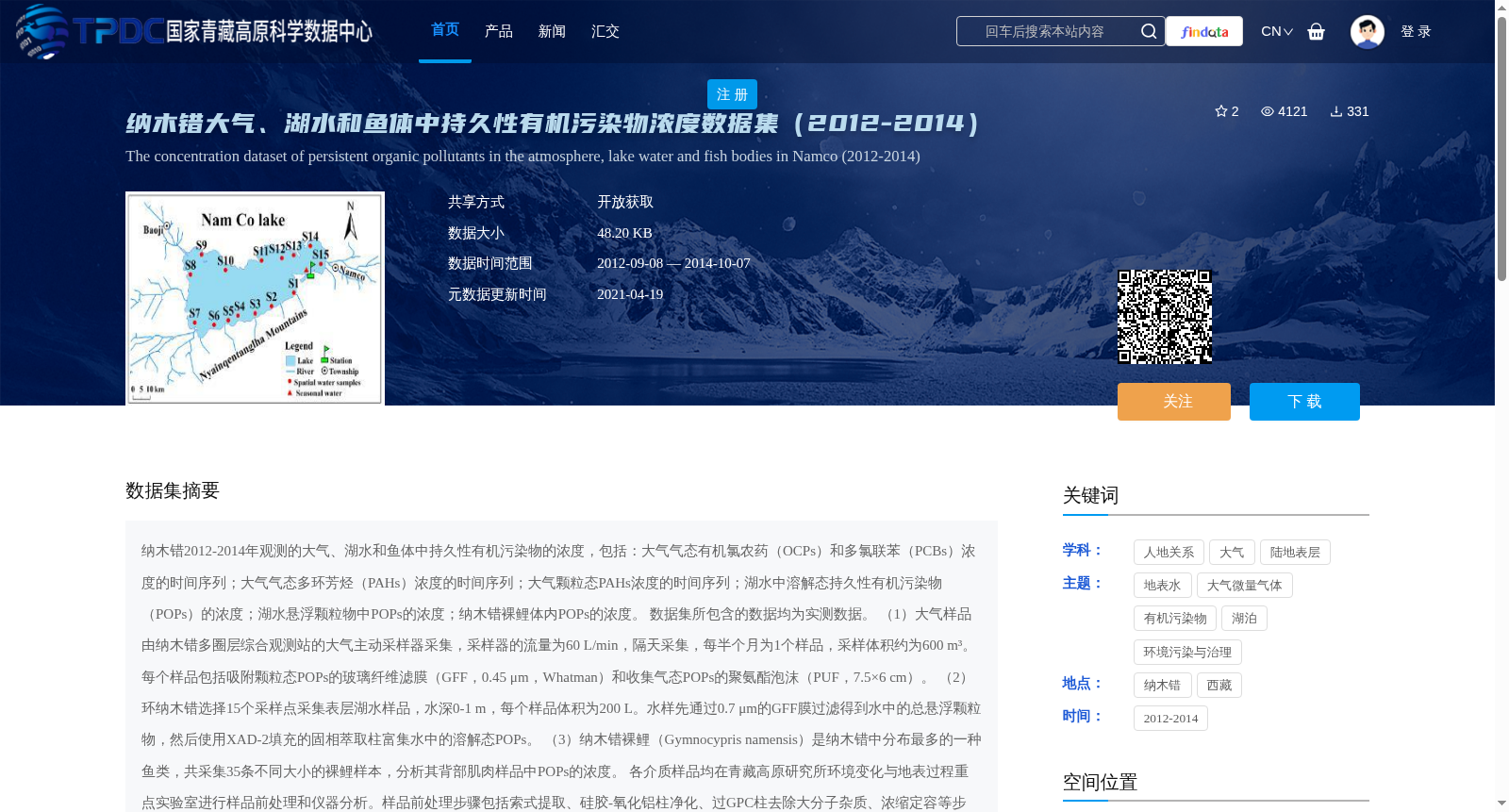
(2)环纳木错选择15个采样点采集表层湖水样品,水深0-1 m,每个样品体积为200 L。水样先通过0.7 μm的GFF膜过滤得到水中的总悬浮颗粒物,然后使用XAD-2填充的固相萃取柱富集水中的溶解态POPs。
(3)纳木错裸鲤(Gymnocypris namensis)是纳木错中分布最多的一种鱼类,共采集35条不同大小的裸鲤样本,分析其背部肌肉样品中POPs的浓度。
各介质样品均在青藏高原研究所环境变化与地表过程重点实验室进行样品前处理和仪器分析。样品前处理步骤包括索式提取、硅胶-氧化铝柱净化、过GPC柱去除大分子杂质、浓缩定容等步骤。分析测试仪器为美国热电公司生产的气相色谱-质谱联用仪(GC-MS, Finnigan-Trace GC/PolarisQ)。分离OCPs和PCBs的色谱柱为CP-Sil 8CB毛细柱(50 m×0.25 mm×0.25 μm),分离PAHs的色谱柱为DB-5MS毛细柱(60 m×0.25 mm×0.25 μm)。
采样和实验室分析过程均遵循严格的质量控制措施,设置了实验室空白和野外空白。化合物的方法检出限为野外空白中相应化合物浓度的平均值加3倍标准偏差;若野外空白中未检出该化合物,则以工作曲线最低浓度的10倍信噪比代替为方法检出限。低于方法检出限的数据被认为是未检出,标注为BDL;用斜体标注的数据为用1/2倍方法检出限代替。PAHs的回收率在65-92%之间,OCPs的回收率在64-112%之间,样品浓度未使用回收率进行校正。
This dataset contains measured concentrations of persistent organic pollutants (POPs) in the atmosphere, lake water and fish bodies observed at Nam Co from 2012 to 2014, including: time series of atmospheric gaseous organochlorine pesticides (OCPs) and polychlorinated biphenyls (PCBs) concentrations; time series of atmospheric gaseous polycyclic aromatic hydrocarbon (PAH) concentrations; time series of atmospheric particulate-phase PAH concentrations; concentrations of dissolved POPs in lake water; concentrations of POPs in lake water suspended particulate matter; and concentrations of POPs in Gymnocypris namensis collected from Nam Co.
All data included in this dataset are measured data.
(1) Atmospheric samples were collected using an active atmospheric sampler at the Nam Co Multi-sphere Comprehensive Observation Station, with a flow rate of 60 L/min. Sampling was conducted every other day, with one sample collected every half month, and the sampling volume was approximately 600 m³. Each sample consisted of a glass fiber filter (GFF, 0.45 μm, Whatman) for adsorbing particulate-phase POPs and a polyurethane foam (PUF, 7.5×6 cm) for collecting gaseous POPs.
(2) Surface lake water samples were collected at 15 sampling sites around Nam Co, with a water depth of 0–1 m, and each sample had a volume of 200 L. Water samples were first filtered through a 0.7 μm GFF membrane to obtain total suspended particulate matter in the water, then dissolved POPs in the water were enriched using XAD-2 packed solid-phase extraction cartridges.
(3) Gymnocypris namensis, the most abundant fish species native to Nam Co, had 35 individuals of varying sizes collected, and their dorsal muscle samples were analyzed for POP concentrations.
All media samples were subjected to sample pretreatment and instrumental analysis at the State Key Laboratory of Environmental Change and Surface Processes, Institute of Tibetan Plateau Research. The sample pretreatment procedures included Soxhlet extraction, silica-alumina column purification, gel permeation chromatography (GPC) column removal of macromolecular impurities, concentration and volume fixation, etc. The analytical instrument was a gas chromatography-mass spectrometry (GC-MS, Finnigan-Trace GC/PolarisQ) manufactured by Thermo Fisher Scientific (formerly Thermo Electron Corporation). The chromatographic column for separating OCPs and PCBs was a CP-Sil 8CB capillary column (50 m × 0.25 mm × 0.25 μm), and the chromatographic column for separating PAHs was a DB-5MS capillary column (60 m × 0.25 mm × 0.25 μm).
Strict quality control measures were followed throughout the sampling and laboratory analysis processes, with laboratory blanks and field blanks set up. The method detection limit (MDL) for each compound was calculated as the mean concentration of the corresponding compound in the field blanks plus 3 times the standard deviation; if the compound was not detected in the field blanks, the 10-times signal-to-noise ratio of the lowest concentration of the working curve was used as the MDL instead. Data below the MDL were considered not detected and marked as BDL (Below Detection Limit); data marked in italics were replaced with 1/2 times the MDL. The recovery rates of PAHs ranged from 65% to 92%, and those of OCPs ranged from 64% to 112%. No recovery correction was applied to the sample concentrations.
提供机构:
王小萍
创建时间:
2018-07-18
搜集汇总
数据集介绍
背景与挑战
背景概述
该数据集包含2012-2014年纳木错地区大气、湖水和鱼体中持久性有机污染物的浓度数据,涵盖了多种污染物类型,数据采集和分析过程严格,适用于环境污染和生态健康研究。
以上内容由遇见数据集搜集并总结生成


