JobNego; ResNego
收藏资源简介:
JobNego和ResNego是由印度理工学院团队构建的创新型谈判对话数据集,分别聚焦工作面试和野营资源分配两大高价值场景。数据集通过ChatGPT生成初始语料,采用三阶段构建流程:首先生成包含任务角色和约束条件的105个工作面试场景及1,030个资源分配场景;其次定义12种情感类别和对应谈判策略;最后通过ENS-CoT机制生成带有情感推理链的对话。数据集创新性地标注了情感感知的谈判策略推理过程,为开发可解释的情感智能谈判系统提供关键训练资源,可应用于人机交互、心理咨询等高情感参与度领域。
JobNego and ResNego are innovative negotiation dialogue datasets constructed by a team from the Indian Institute of Technology, targeting two high-value scenarios: job interviews and camping resource allocation respectively. The datasets are developed via a three-stage construction pipeline, with the initial corpus generated by ChatGPT. The first stage generates 105 job interview scenarios and 1,030 resource allocation scenarios that include task roles and constraints; the second stage defines 12 emotion categories and their corresponding negotiation strategies; the third stage generates dialogues with emotion reasoning chains through the ENS-CoT mechanism. The datasets innovatively annotate emotion-aware negotiation strategy reasoning processes, offering key training resources for building interpretable emotion-aware intelligent negotiation systems, and can be applied to high-emotion-involvement fields such as human-computer interaction and psychological counseling.
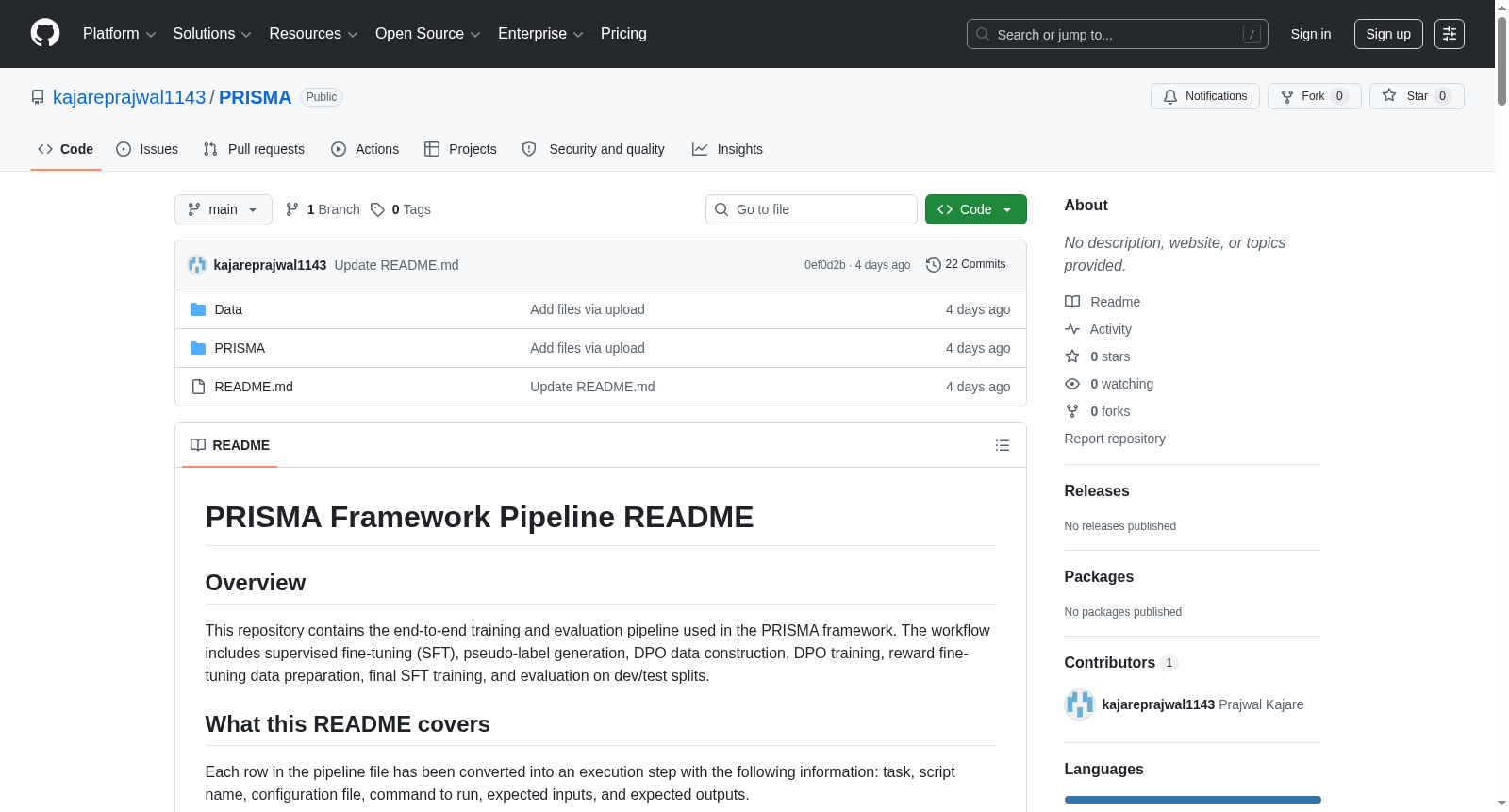
PRISMA 数据集概述
数据集基本信息
- 数据集名称:PRISMA 框架训练与评估数据集
- 数据格式:GSM8K JSONL 格式
- 内容类型:数学推理问题与解答(用于监督微调、偏好数据构建及奖励微调)
- 数据状态:包含样本数据集,完整数据集需申请获取
数据集获取
- 样本数据集:已包含在本代码仓库中。
- 完整数据集:需通过指定链接申请获取。
- 获取链接:https://ai-nlp-ml.github.io/resources.html
数据集在训练流程中的作用
数据集是 PRISMA 框架端到端训练与评估流程的核心组成部分,具体用于以下阶段:
1. 基础监督微调
- 输入数据:GSM8K 训练数据(
gsm8k/train.jsonl)。 - 用途:对预训练的 LLaMA 模型进行初始微调。
- 输出:微调后的模型权重(位于
/DPO-ST-P/dpo-st-cop/ft_models/llama-2/sft-0)。
2. 伪标签生成与偏好数据构建
- 输入数据:
- 基础 SFT 模型。
gsm8k/train.jsonl(黄金数据)。
- 生成过程:为每个训练样本生成多个(例如5个)伪标签解答。
- 中间输出:伪标签文件(如
model_outputs_nego_all/llama-2/sft-0/train/seed_{i}-t_0.7.json)。 - 最终产出:
- 初始 DPO 数据(
model_outputs_nego_all/llama-2/sft-0/train/train_dpo_data.jsonl)。 - 处理后的 DPO 训练/评估数据(
train_dpo_processed.jsonl,eval_dpo_processed.jsonl)。
- 初始 DPO 数据(
3. DPO 模型训练
- 输入数据:处理后的 DPO 训练与评估数据。
- 用途:训练直接偏好优化模型。
- 输出:DPO 训练后的 LLaMA 模型。
4. 奖励微调数据准备
- 输入数据:DPO 模型生成的伪标签数据(
train_dpo_data.jsonl)。 - 处理脚本:
utils/make_rft_data-1.py。 - 输出:RFT 训练数据集(
/model_outputs_nego_all/llama-2/dpo-1/train/train_rft_processed.jsonl)。
5. 最终监督微调
- 输入数据:由 RFT 处理流程生成的、包含标注数据和伪标签数据的混合数据集。
- 输出:最终微调模型。
6. 模型评估
- 评估数据:GSM8K 开发集(
gsm8k/dev.jsonl)和测试集(gsm8k/test.jsonl)。 - 评估流程:在最终模型上生成贪婪解码结果,并与黄金答案对比。
- 结果输出:评估结果保存于
results/llama-2.json。
关键文件路径摘要
- 训练数据:
gsm8k/train.jsonl - 评估数据:
gsm8k/dev.jsonl,gsm8k/test.jsonl - 基础 SFT 模型输出:
/DPO-ST-P/dpo-st-cop/ft_models/llama-2/sft-0 - SFT 伪标签输出:
model_outputs_nego_all/llama-2/sft-0/train/ - DPO 数据:
model_outputs_nego_all/llama-2/sft-0/train/train_dpo_data.jsonl - 处理后的 DPO 数据:
model_outputs_nego_all/llama2/sft-0/train/train_dpo_processed.jsonl,eval_dpo_processed.jsonl - DPO 模型伪标签输出:
model_outputs_nego_all/llama-2/dpo-1/train/ - RFT 训练数据:
/model_outputs_nego_all/llama-2/dpo-1/train/train_rft_processed.jsonl - 最终评估结果:
results/llama-2.json