
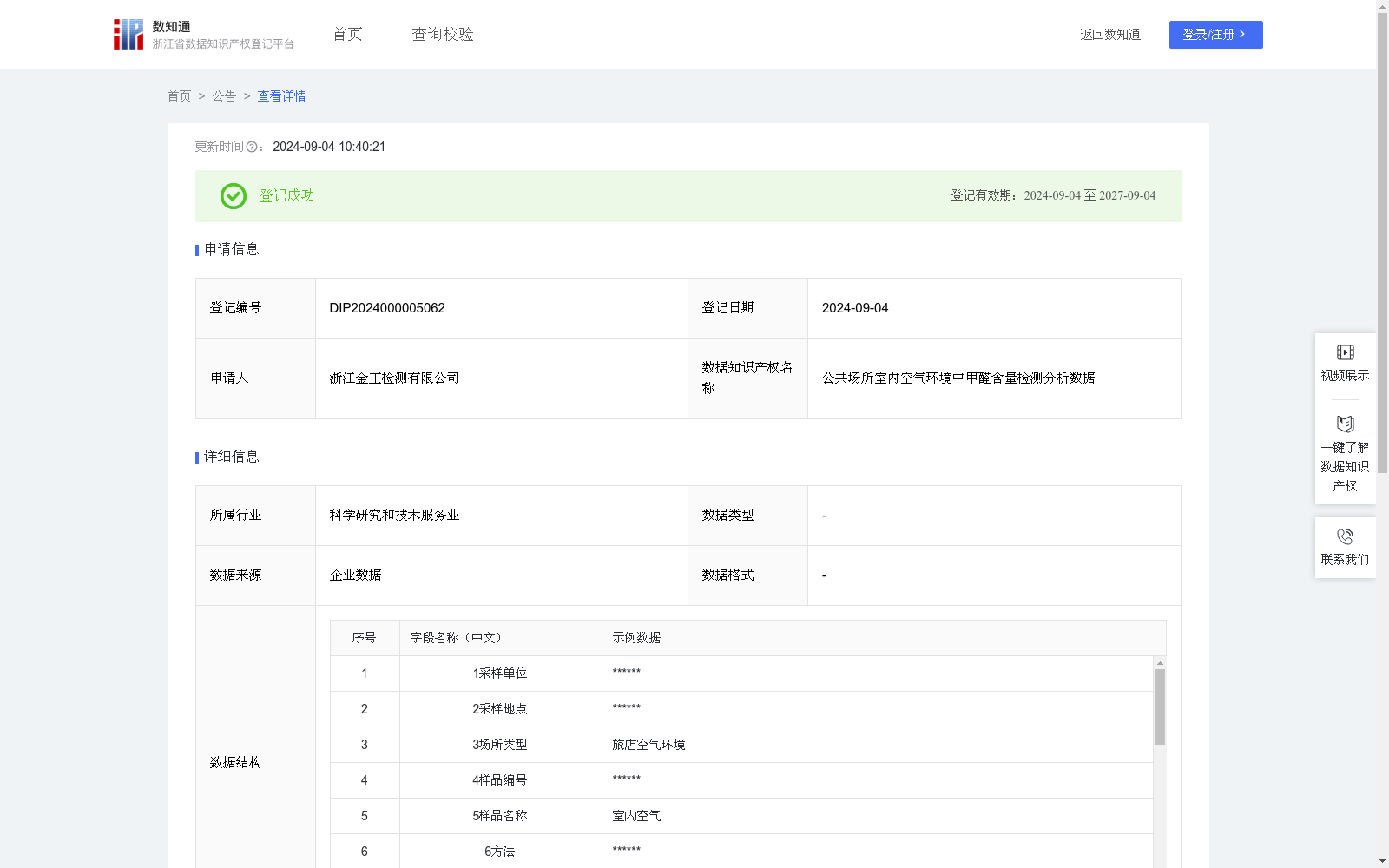
公共场所室内空气环境中甲醛含量检测分析数据
收藏浙江省数据知识产权登记平台2024-09-04 更新2024-09-05 收录
下载链接:
https://www.zjip.org.cn/home/announce/trends/57777
下载链接
链接失效反馈官方服务:
资源简介:
室内空气的污染来源主要是甲醛等物质,甲醛挥发时间长,作用隐蔽,潜伏性强,甲醛污染可能对人体健康产生慢性影响。通过对不同类型公共场所室内空气环境中甲醛进行测定,对数据进行归集分析,能够进一步了解不同类型公共场所室内空气环境中甲醛是否符合标准,同时能够更加准确的了解各场所室内空气环境风险情况,为监管和解决室内环境卫生安全提供数据支持,也为企业进行室内空气质量预测和控制提供参考。1、数据采集:根据要求在公共场所采样单位采集空气样品后,送入实验室进行甲醛含量测定,记录检测值。2、数据处理:X=(x1+x2)/2,保留3位小数;依据GB 37488设定标准值,当X≤标准值时,判定合格;否则判定不合格;Q=A/N*100%;参考GB/T 18883,比对甲醛含量是否≥0.08mg/m3,若X≥0.08,则记为Y,否则记为N;Z=B/N*100%保留两位小数;R=X/0.08;对不同类型场所甲醛合格程度进行评级:当Q≥98%,场所评级为S,当Q≥95%,场所评级为A;当Q<95%,场所评级为B;对采样地进行风险评价:当R<0.6,风险评价=LR;当0.6≤R≤1.0时,风险评价=MR;当R>1.0时,风险评价=HR。3、数据应用:对公共场所室内空气环境中甲醛含量进行检测分析,可以了解公共场所室内环境空气质量情况以及需监测关注的场所类型和风险区域。场所评级能够了解区域内不同类型场所甲醛含量的总体情况,并对B级场所进行重点关注;风险评价能对采样地空气环境中甲醛含量进行风险评估,评价为HR的单位需加强对室内空气质量的预测和控制。为监管和解决室内场所卫生安全提供数据参考。
The main pollution sources of indoor air include substances such as formaldehyde. Formaldehyde has a long volatilization period, hidden effects, and strong latency, and its pollution may exert chronic adverse health impacts on humans. By measuring formaldehyde concentrations in the indoor air environments of various types of public places and conducting aggregate analysis of the collected data, we can further verify whether formaldehyde levels in the indoor air of different public places meet the relevant standards, more accurately grasp the indoor air environmental risk status of each site, provide data support for the supervision and resolution of indoor environmental health and safety issues, and offer references for enterprises to predict and control indoor air quality.
1. Data Collection: After collecting air samples at public place sampling units in accordance with specified requirements, the samples are sent to the laboratory for formaldehyde content determination, and the detected values are recorded.
2. Data Processing: Calculate the average value X = (x₁ + x₂)/2, rounded to 3 decimal places; Set the standard limit according to GB 37488. If X ≤ the standard limit, the sample is judged as qualified; otherwise, it is judged as unqualified. Calculate Q = (A/N) × 100%; Refer to GB/T 18883 to compare whether the formaldehyde content is ≥ 0.08 mg/m³. If X ≥ 0.08, mark the result as Y; otherwise, mark it as N. Calculate Z = (B/N) × 100%, rounded to 2 decimal places. Calculate R = X / 0.08; Grade the formaldehyde qualification degree of different types of places: When Q ≥ 98%, the place rating is S; when Q ≥ 95%, the place rating is A; when Q < 95%, the place rating is B. Conduct risk assessment for the sampling site: When R < 0.6, the risk assessment result is LR; when 0.6 ≤ R ≤ 1.0, the risk assessment result is MR; when R > 1.0, the risk assessment result is HR.
3. Data Application: Detecting and analyzing the formaldehyde content in the indoor air environments of public places can help understand the indoor air quality status of public places, as well as the types of places and risk areas that require monitoring and attention. The place rating can reflect the overall formaldehyde content status of different types of places in the region, and priority attention should be paid to Class B places; the risk assessment can evaluate the risk of formaldehyde content in the air environment of sampling sites, and units with HR assessment results need to strengthen the prediction and control of indoor air quality. This work provides data references for the supervision and resolution of health and safety issues in indoor places.
提供机构:
浙江金正检测有限公司
创建时间:
2024-08-06
搜集汇总
数据集介绍
特点
该数据集由浙江金正检测有限公司提供,包含674条公共场所室内空气环境中甲醛含量的检测数据,每年更新。数据用于评估不同类型场所的甲醛合格率和风险等级,为室内空气质量监管和企业控制提供参考。
以上内容由遇见数据集搜集并总结生成



