
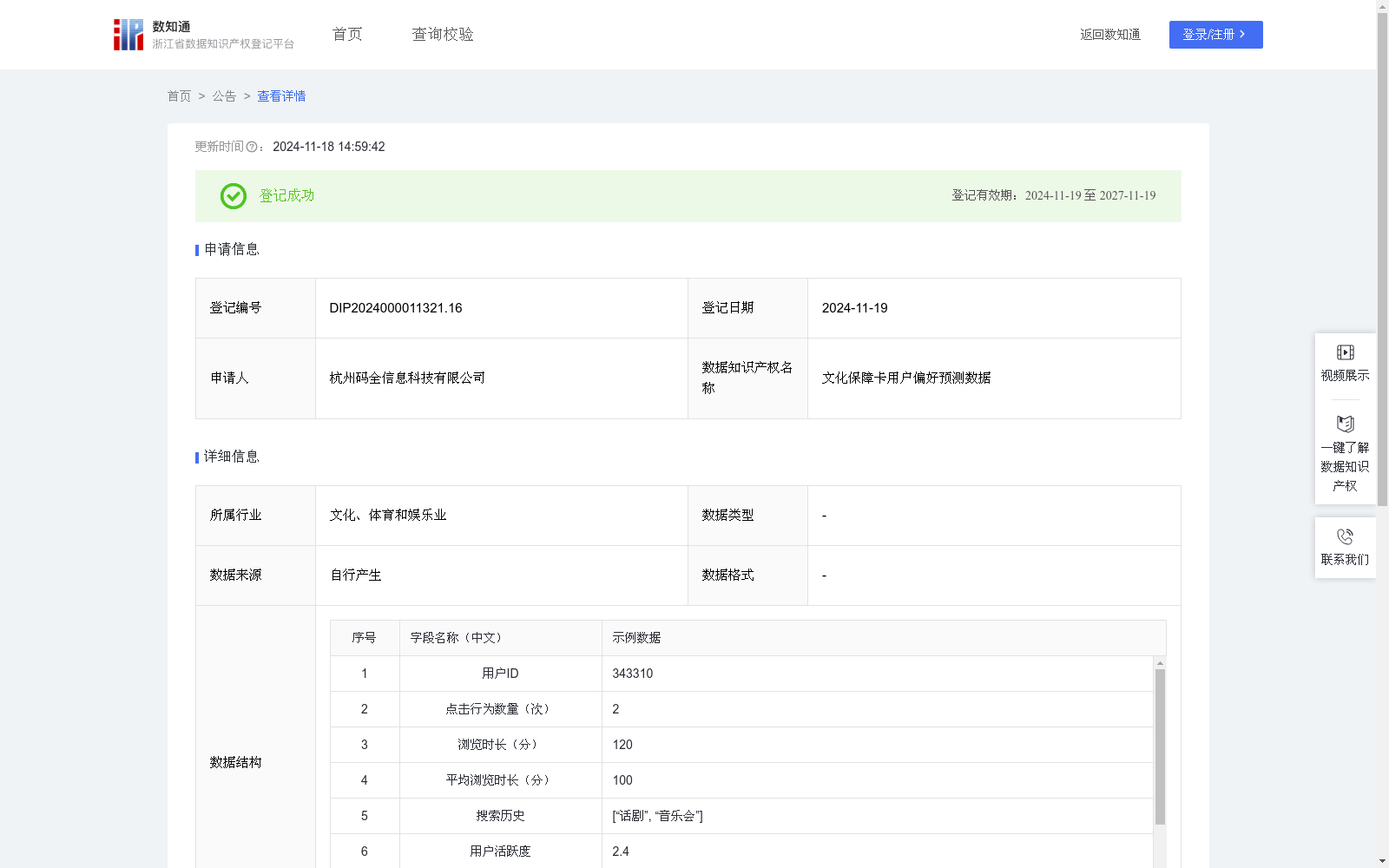
文化保障卡用户偏好预测数据
收藏浙江省数据知识产权登记平台2024-11-18 更新2024-11-19 收录
下载链接:
https://www.zjip.org.cn/home/announce/trends/85894
下载链接
链接失效反馈官方服务:
资源简介:
通过分析用户的历史行为数据,预测用户对文化活动和产品的偏好,为个性化推荐提供依据。利用预测结果为服务商优化文化产品的营销策略,提高营销活动的针对性和效果。为文化服务提供商或文化管理部门的文化活动的策划和组织提供数据支持,根据用户偏好设计更受欢迎的活动内容。步骤1,数据处理。从公司文化保障卡服务系统中自动抽取关键字段,包括用户ID、点击行为数量、浏览时长、平均浏览时长、搜索历史,清洗和标准化数据格式,保证数据质量。
步骤2,特征工程。基于用户的浏览时长和点击频率计算用户活跃度,计算公式为:用户活跃度=浏览时长/平均浏览时长×点击行为数量;使用信息熵来衡量用户偏好的多样性,信息熵越低,表明用户偏好越集中,其中计算公式为:偏好的多样性=−∑(各类偏好频率×log(各类偏好频率))。
步骤3,模型训练。选择随机森林算法作为预测模型,使用用户的历史搜索、点击和购买数据作为训练特征,用户偏好作为目标变量。使用交叉验证方法评估模型的性能。
步骤4,应用训练好的模型对每个用户的文化活动偏好进行预测,输出偏好概率。
This dataset predicts users' preferences for cultural activities and products by analyzing their historical behavioral data, thereby providing a basis for personalized recommendation. Leveraging the prediction results, it helps service providers optimize marketing strategies for cultural products, enhancing the targeting and effectiveness of marketing campaigns. Additionally, it offers data support for cultural service providers or cultural management departments to plan and organize cultural activities, enabling the design of more popular event content based on user preferences. Step 1: Data Processing. Automatically extract key fields from the company's cultural security card service system, including "user ID", number of click behaviors, browsing duration, average browsing duration, and search history. Clean and standardize the data format to ensure data quality. Step 2: Feature Engineering. Calculate user activity based on their browsing duration and click frequency, with the formula: User Activity = (Browsing Duration / Average Browsing Duration) × Number of Click Behaviors. Use information entropy to measure the diversity of user preferences, where lower information entropy indicates more concentrated user preferences. The formula is: Preference Diversity = −∑(Frequency of each preference category × log(Frequency of each preference category)). Step 3: Model Training. Select the random forest algorithm as the prediction model. Use users' historical search, click and purchase data as training features, and user preferences as the target variable. Use cross-validation to evaluate the model's performance. Step 4: Model Application. Apply the trained model to predict the cultural activity preferences of each user, and output the preference probabilities.
提供机构:
杭州码全信息科技有限公司
创建时间:
2024-10-14
搜集汇总
数据集介绍
特点
文化保障卡用户偏好预测数据包含558条用户行为记录,涵盖点击、浏览、搜索等10个关键字段,用于预测用户文化偏好。通过随机森林算法建模,支持个性化推荐、营销优化及活动策划等应用场景。
以上内容由遇见数据集搜集并总结生成



