
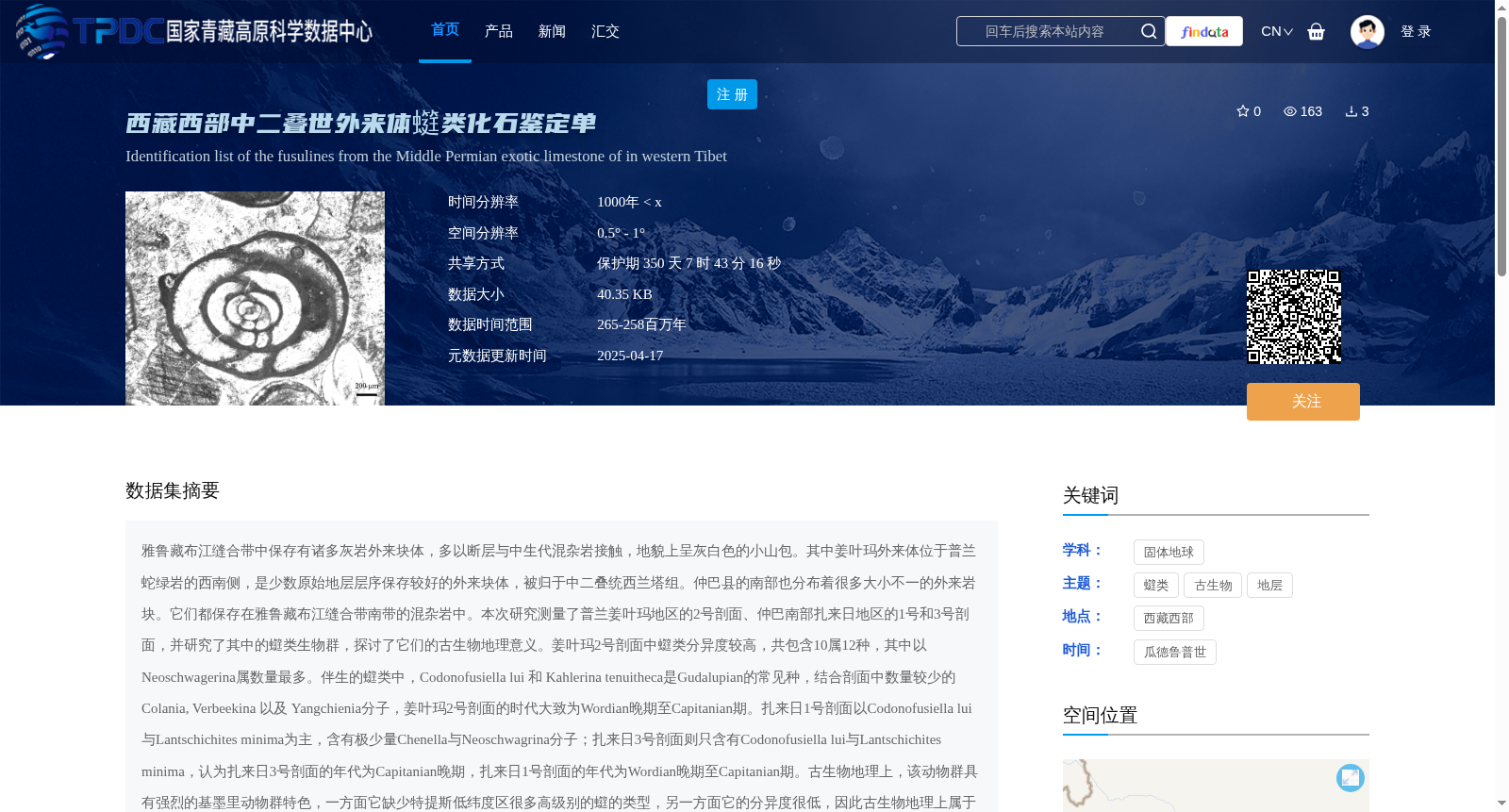
西藏西部中二叠世外来体䗴类化石鉴定单
收藏国家青藏高原科学数据中心2025-04-17 更新2025-04-05 收录
下载链接:
https://data.tpdc.ac.cn/zh-hans/data/c192402f-edc7-456c-bb27-61e8e28a2fc4
下载链接
链接失效反馈官方服务:
资源简介:
雅鲁藏布江缝合带中保存有诸多灰岩外来块体,多以断层与中生代混杂岩接触,地貌上呈灰白色的小山包。其中姜叶玛外来体位于普兰蛇绿岩的西南侧,是少数原始地层层序保存较好的外来块体,被归于中二叠统西兰塔组。仲巴县的南部也分布着很多大小不一的外来岩块。它们都保存在雅鲁藏布江缝合带南带的混杂岩中。本次研究测量了普兰姜叶玛地区的2号剖面、仲巴南部扎来日地区的1号和3号剖面,并研究了其中的䗴类生物群,探讨了它们的古生物地理意义。姜叶玛2号剖面中䗴类分异度较高,共包含10属12种,其中以Neoschwagerina属数量最多。伴生的䗴类中,Codonofusiella lui 和 Kahlerina tenuitheca是Gudalupian的常见种,结合剖面中数量较少的Colania, Verbeekina 以及 Yangchienia分子,姜叶玛2号剖面的时代大致为Wordian晚期至Capitanian期。扎来日1号剖面以Codonofusiella lui与Lantschichites minima为主,含有极少量Chenella与Neoschwagrina分子;扎来日3号剖面则只含有Codonofusiella lui与Lantschichites minima,认为扎来日3号剖面的年代为Capitanian晚期,扎来日1号剖面的年代为Wordian晚期至Capitanian期。古生物地理上,该动物群具有强烈的基墨里动物群特色,一方面它缺少特提斯低纬度区很多高级别的䗴的类型,另一方面它的分异度很低,因此古生物地理上属于基墨里生物区。但它保存的位置是位于雅鲁藏布江缝合带的南带,说明它不是原生的,而是由北带仰冲而来,即雅鲁藏布江缝合带的南北两支属于同一条带。同时,外来体中这样的生物群面貌指示其古地理位置应位于拉萨地块与特提斯喜马拉雅带之间的海山上,说明此时新特提斯已经有一定的宽度。
Numerous allochthonous limestone blocks are preserved in the Yarlung Zangbo Suture Zone (YZSZ), most of which are in fault contact with Mesozoic mélanges and appear as pale-gray hillocks in topography. The Jiangyema allochthon, located southwest of the Purang ophiolite, is one of the few allochthonous blocks with well-preserved primary stratigraphic sequence, and is assigned to the Middle Permian Xilanta Formation. A large number of allochthonous blocks of varying sizes are also distributed in the southern part of Zhongba County. All these blocks are preserved in the mélanges of the southern belt of the YZSZ. In this study, we measured Section 2 in the Jiangyema area of Purang, as well as Sections 1 and 3 in the Zhalairi area, southern Zhongba County, investigated their fusuline foraminiferal biotas, and discussed their paleobiogeographic implications. Section 2 of Jiangyema has a relatively high fusuline diversity, comprising 10 genera and 12 species in total, with the genus *Neoschwagerina* being the most abundant. Among the associated fusulines, *Codonofusiella lui* and *Kahlerina tenuitheca* are common species of the Guadalupian. Combined with the relatively rare taxa of *Colania*, *Verbeekina* and *Yangchienia* in the section, the age of Section 2 of Jiangyema is roughly constrained to the late Wordian to Capitanian Stage. Section 1 of Zhalairi is dominated by *Codonofusiella lui* and *Lantschichites minima*, with extremely rare individuals of *Chenella* and *Neoschwagerina*. Section 3 of Zhalairi only contains *Codonofusiella lui* and *Lantschichites minima*, so its age is considered to be late Capitanian, while the age of Section 1 of Zhalairi is late Wordian to Capitanian Stage. Paleobiogeographically, this fusuline fauna has strong affinities with the Cimmerian fauna: on one hand, it lacks many high-level fusuline taxa from the low-latitude Tethys realm; on the other hand, its diversity is relatively low, so it belongs to the Cimmerian bioprovince. However, its occurrence in the southern belt of the YZSZ indicates that it is not autochthonous, but was obducted from the northern belt, meaning that the northern and southern branches of the Yarlung Zangbo Suture Zone belong to the same single suture zone. Meanwhile, the faunal composition of these allochthonous blocks indicates that their paleogeographic location was on seamounts between the Lhasa Terrane and the Tethyan Himalaya, suggesting that the Neo-Tethys Ocean had a certain width at that time.
提供机构:
张以春
创建时间:
2024-12-16
搜集汇总
数据集介绍
背景与挑战
背景概述
该数据集包含西藏西部中二叠世外来体䗴类化石的鉴定信息,研究地点包括普兰姜叶玛和仲巴南部扎来日地区,时间范围为265-258百万年。数据集通过分析䗴类生物群,探讨了其古生物地理意义,揭示了该地区中二叠世的生物多样性和古环境特征。
以上内容由遇见数据集搜集并总结生成


