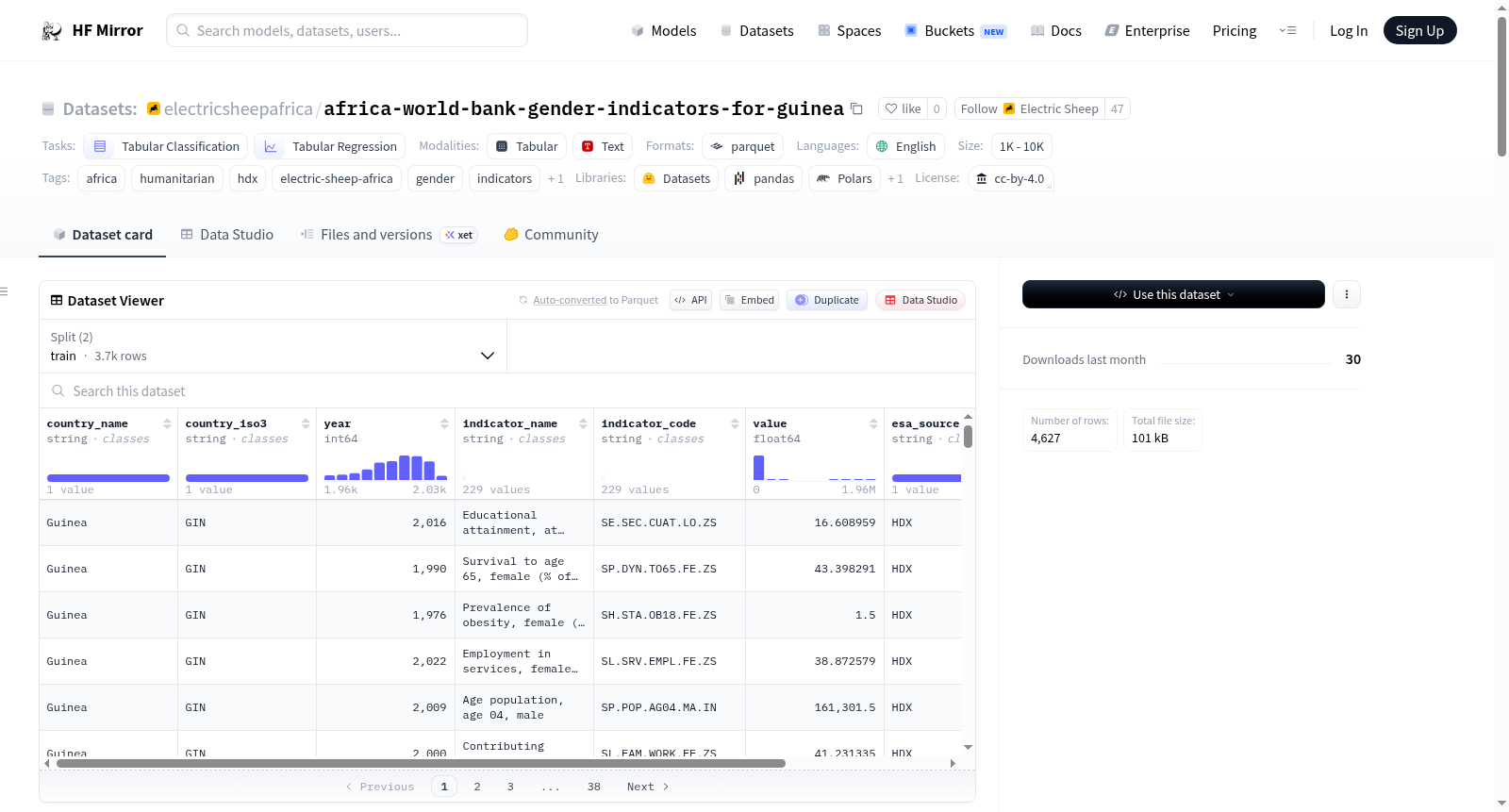
electricsheepafrica/africa-world-bank-gender-indicators-for-guinea
收藏资源简介:
--- annotations_creators: - no-annotation language_creators: - found language: - en license: cc-by-4.0 multilinguality: - monolingual size_categories: - 1K<n<10K source_datasets: - original task_categories: - tabular-classification - tabular-regression task_ids: [] tags: - africa - humanitarian - hdx - electric-sheep-africa - gender - indicators - gin pretty_name: "Guinea - Gender" dataset_info: splits: - name: train num_examples: 3701 - name: test num_examples: 925 --- # Guinea - Gender **Publisher:** World Bank Group · **Source:** [HDX](https://data.humdata.org/dataset/world-bank-gender-indicators-for-guinea) · **License:** `cc-by` · **Updated:** 2026-03-27 --- ## Abstract Contains data from the World Bank's [data portal](http://data.worldbank.org/). There is also a [consolidated country dataset](https://data.humdata.org/dataset/world-bank-combined-indicators-for-guinea) on HDX. Gender equality is a core development objective in its own right. It is also smart development policy and sound business practice. It is integral to economic growth, business growth and good development outcomes. Gender equality can boost productivity, enhance prospects for the next generation, build resilience, and make institutions more representative and effective. In December 2015, the World Bank Group Board discussed our new Gender Equality Strategy 2016-2023, which aims to address persistent gaps and proposed a sharpened focus on more and better gender data. The Bank Group is continually scaling up commitments and expanding partnerships to fill significant gaps in gender data. The database hosts the latest sex-disaggregated data and gender statistics covering demography, education, health, access to economic opportunities, public life and decision-making, and agency. Each row in this dataset represents country-level aggregates. Data was last updated on HDX on 2026-03-27. Geographic scope: **GIN**. *Curated into ML-ready Parquet format by [Electric Sheep Africa](https://huggingface.co/electricsheepafrica).* --- ## Dataset Characteristics | | | |---|---| | **Domain** | Public health | | **Unit of observation** | Country-level aggregates | | **Rows (total)** | 4,627 | | **Columns** | 8 (2 numeric, 6 categorical, 0 datetime) | | **Train split** | 3,701 rows | | **Test split** | 925 rows | | **Geographic scope** | GIN | | **Publisher** | World Bank Group | | **HDX last updated** | 2026-03-27 | --- ## Variables **Geographic** — `country_name` (Guinea), `country_iso3` (GIN), `year` (range 1960.0–2025.0). **Outcome / Measurement** — `value` (range 0.0–1963865.0). **Identifier / Metadata** — `indicator_name` (Age population, age 03, female, Age population, age 05, female, Age population, age 00, male), `indicator_code` (SP.POP.AG03.FE.IN, SP.POP.AG05.FE.IN, SP.POP.AG00.MA.IN), `esa_source` (HDX), `esa_processed` (2026-04-11). --- ## Quick Start ```python from datasets import load_dataset ds = load_dataset("electricsheepafrica/africa-world-bank-gender-indicators-for-guinea") train = ds["train"].to_pandas() test = ds["test"].to_pandas() print(train.shape) train.head() ``` --- ## Schema | Column | Type | Null % | Range / Sample Values | |---|---|---|---| | `country_name` | object | 0.0% | Guinea | | `country_iso3` | object | 0.0% | GIN | | `year` | int64 | 0.0% | 1960.0 – 2025.0 (mean 2000.11) | | `indicator_name` | object | 0.0% | Age population, age 03, female, Age population, age 05, female, Age population, age 00, male | | `indicator_code` | object | 0.0% | SP.POP.AG03.FE.IN, SP.POP.AG05.FE.IN, SP.POP.AG00.MA.IN | | `value` | float64 | 0.0% | 0.0 – 1963865.0 (mean 36735.6533) | | `esa_source` | object | 0.0% | HDX | | `esa_processed` | object | 0.0% | 2026-04-11 | --- ## Numeric Summary | Column | Min | Max | Mean | Median | |---|---|---|---|---| | `year` | 1960.0 | 2025.0 | 2000.11 | 2003.0 | | `value` | 0.0 | 1963865.0 | 36735.6533 | 41.4125 | --- ## Curation Raw data was downloaded from HDX via the CKAN API and converted to Parquet. Column names were lowercased and standardised to snake_case. Common missing-value markers (`N/A`, `null`, `none`, `-`, `unknown`, `no data`, `#N/A`) were unified to `NaN`. The dataset was split 80/20 into train and test partitions using a fixed random seed (42) and saved as Snappy-compressed Parquet. --- ## Limitations - Data originates from World Bank Group and has not been independently validated by ESA. - Automated cleaning cannot correct for misreported values, definitional inconsistencies, or sampling bias in the original collection. - Refer to the [original HDX dataset page](https://data.humdata.org/dataset/world-bank-gender-indicators-for-guinea) for the publisher's own methodology notes and caveats. --- ## Citation ```bibtex @dataset{hdx_africa_world_bank_gender_indicators_for_guinea, title = {Guinea - Gender}, author = {World Bank Group}, year = {2026}, url = {https://data.humdata.org/dataset/world-bank-gender-indicators-for-guinea}, note = {Repackaged for machine learning by Electric Sheep Africa (https://huggingface.co/electricsheepafrica)} } ``` --- *[Electric Sheep Africa](https://huggingface.co/electricsheepafrica) — Africa's ML dataset infrastructure. Lagos, Nigeria.*
annotations_creators: - 无标注 language_creators: - 现有资源采集 language: - 英语 license: cc-by-4.0 multilinguality: - 单语言 size_categories: - 1000 < 样本量 < 10000 source_datasets: - 原始数据集 task_categories: - 表格分类 - 表格回归 task_ids: [] tags: - 非洲 - 人道主义 - HDX - 非洲电羊(Electric Sheep Africa) - 性别 - 指标 - GIN pretty_name: "几内亚 - 性别指标" dataset_info: splits: - name: 训练集 num_examples: 3701 - name: 测试集 num_examples: 925 # 几内亚 - 性别指标 **发布方:** 世界银行集团 · **来源:** [人道主义数据交换(HDX)](https://data.humdata.org/dataset/world-bank-gender-indicators-for-guinea) · **许可:** `cc-by` · **最后更新:** 2026-03-27 --- ## 摘要 本数据集包含来自世界银行[数据门户](http://data.worldbank.org/)的公开数据。人道主义数据交换(HDX)平台上还提供了一份[整合版国家数据集](https://data.humdata.org/dataset/world-bank-combined-indicators-for-guinea)。 性别平等本身就是核心发展目标,同时也是明智的发展政策与稳健的商业实践。它与经济增长、商业发展及良好的发展成果密不可分。性别平等能够提升生产力,为下一代创造更优前景,增强韧性,并让治理机构更具代表性与实效性。2015年12月,世界银行集团董事会审议通过了《2016-2023年性别平等战略》,该战略旨在解决长期存在的性别数据缺口,并提出进一步聚焦于获取更多、更优质的性别数据。世行集团正持续加大投入并拓展合作,以填补性别数据的重大缺口。本数据库收录了最新的分性别统计数据与性别指标,涵盖人口统计、教育、健康、经济机会获取、公共生活与决策参与以及个人自主权等领域。 本数据集的每一行均代表国家级汇总数据。该数据集在HDX平台的最后更新时间为2026-03-27。地理覆盖范围:**GIN**。 *本数据集由[非洲电羊(Electric Sheep Africa)](https://huggingface.co/electricsheepafrica)整理为适配机器学习的Parquet格式。* --- ## 数据集特征 | | | |---|---| | **领域** | 公共卫生 | | **观测单元** | 国家级汇总数据 | | **总行数** | 4,627 | | **列数** | 8(2个数值型,6个分类型,0个日期时间型) | | **训练集划分** | 3,701条数据 | | **测试集划分** | 925条数据 | | **地理覆盖范围** | GIN | | **发布方** | 世界银行集团 | | **HDX最后更新时间** | 2026-03-27 | --- ## 变量说明 **地理类** — `country_name`(国家名称:几内亚),`country_iso3`(国家ISO3代码:GIN),`year`(年份范围:1960.0–2025.0)。 **结果/测量类** — `value`(数值范围:0.0–1963865.0)。 **标识符/元数据类** — `indicator_name`(指标名称:0-3岁女性人口数、0-5岁女性人口数、0岁男性人口数),`indicator_code`(指标代码:SP.POP.AG03.FE.IN、SP.POP.AG05.FE.IN、SP.POP.AG00.MA.IN),`esa_source`(数据来源:HDX),`esa_processed`(数据处理日期:2026-04-11)。 --- ## 快速上手 python from datasets import load_dataset ds = load_dataset("electricsheepafrica/africa-world-bank-gender-indicators-for-guinea") train = ds["train"].to_pandas() test = ds["test"].to_pandas() print(train.shape) train.head() --- ## 数据结构 | 列名 | 数据类型 | 空值占比 | 取值范围/示例值 | |---|---|---| | `country_name` | 字符串(object) | 0.0% | 几内亚 | | `country_iso3` | 字符串(object) | 0.0% | GIN | | `year` | 64位整数(int64) | 0.0% | 1960.0 – 2025.0(均值:2000.11) | | `indicator_name` | 字符串(object) | 0.0% | 0-3岁女性人口数、0-5岁女性人口数、0岁男性人口数 | | `indicator_code` | 字符串(object) | 0.0% | SP.POP.AG03.FE.IN、SP.POP.AG05.FE.IN、SP.POP.AG00.MA.IN | | `value` | 64位浮点数(float64) | 0.0% | 0.0 – 1963865.0(均值:36735.6533) | | `esa_source` | 字符串(object) | 0.0% | HDX | | `esa_processed` | 字符串(object) | 0.0% | 2026-04-11 | --- ## 数值型变量统计摘要 | 列名 | 最小值 | 最大值 | 均值 | 中位数 | |---|---|---|---|---| | `year` | 1960.0 | 2025.0 | 2000.11 | 2003.0 | | `value` | 0.0 | 1963865.0 | 36735.6533 | 41.4125 | --- ## 数据整理流程 原始数据通过CKAN API从HDX平台下载,并转换为Parquet格式。列名统一转换为小写并标准化为蛇形命名法(snake_case)。将常见的缺失值标记(`N/A`、`null`、`none`、`-`、`unknown`、`no data`、`#N/A`)统一替换为`NaN`。本数据集以固定随机种子(42)按照80/20的比例划分为训练集与测试集,并以Snappy压缩格式保存为Parquet文件。 --- ## 数据集局限性 - 本数据集源自世界银行集团,未经过非洲电羊(ESA)的独立验证。 - 自动化清洗流程无法修正原始数据收集阶段的错报值、定义不一致或抽样偏差问题。 - 如需了解发布方的方法论说明与注意事项,请参阅[原始HDX数据集页面](https://data.humdata.org/dataset/world-bank-gender-indicators-for-guinea)。 --- ## 引用格式 bibtex @dataset{hdx_africa_world_bank_gender_indicators_for_guinea, title = {几内亚 - 性别指标}, author = {世界银行集团}, year = {2026}, url = {https://data.humdata.org/dataset/world-bank-gender-indicators-for-guinea}, note = {由非洲电羊(Electric Sheep Africa,https://huggingface.co/electricsheepafrica)重新打包以适配机器学习场景} } --- *[非洲电羊(Electric Sheep Africa)](https://huggingface.co/electricsheepafrica) — 非洲机器学习数据集基础设施。尼日利亚拉各斯。*