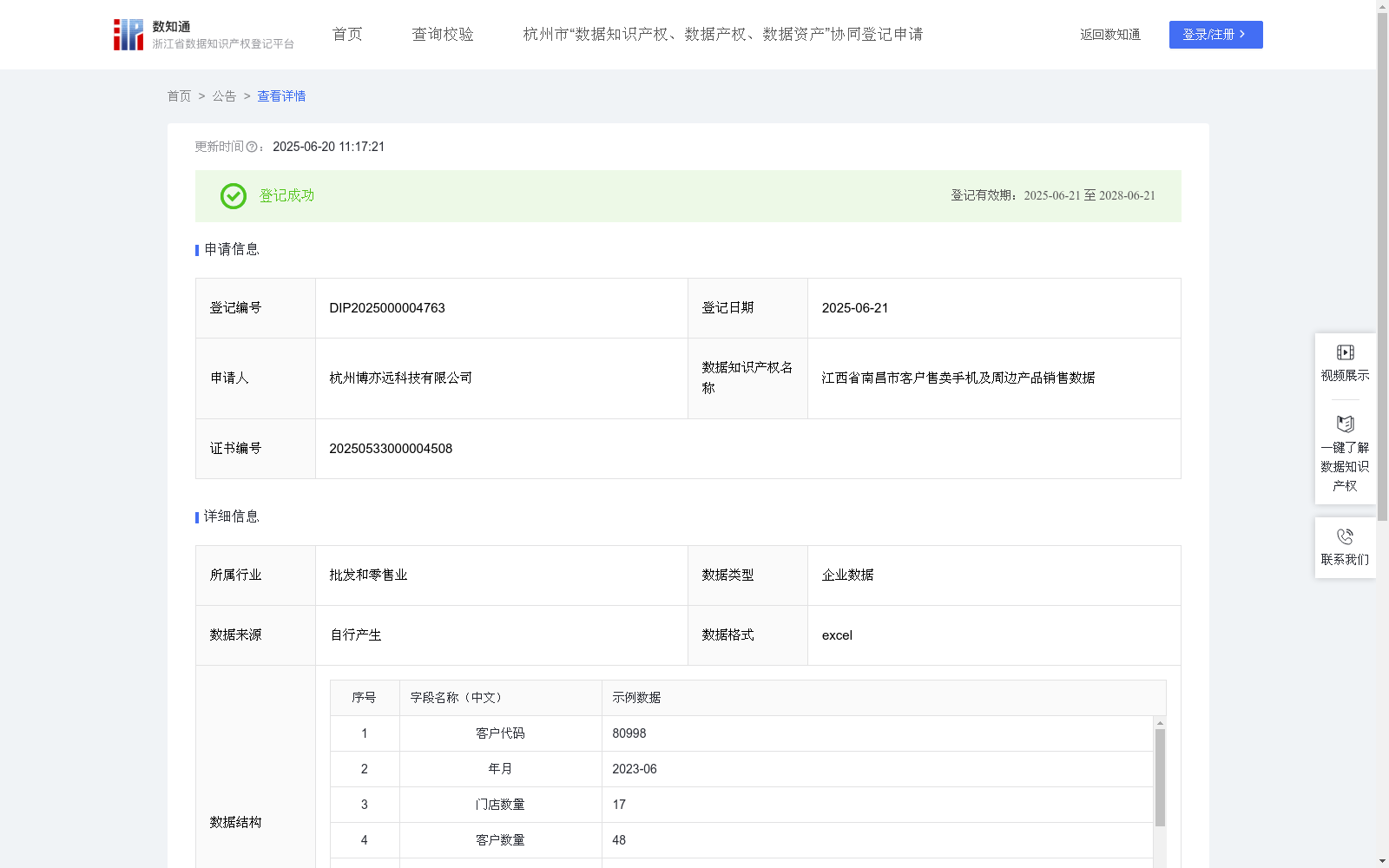
江西省南昌市客户售卖手机及周边产品销售数据
收藏资源简介:
通过收集和分析江西省南昌地区客户通过博远销售软件,售卖手机及手机周边产品一些销售数据进分析,了解客户每个月销售数据情况,总销售额,及销售利润,各门店对基于大数据分析管理软件的了解客户购买力水平和消费偏好,从而制定进货计划,减小库存压力,减小资金积压。1.通过收集到江西省南昌地区客户的基础数据,分析销售情况, 2.数据处理:销售额/销量=平均价,通过利润/销量=平均利润,利用单价大于1000元的销量/销量=单价大于1000元的销量占比,利用单价大于1000的销售额/销售额=单价大于1000元的销售额占比,如果单价大于1000元的销量占比超过60%,主营业务标记为手机,否则标记为手机周边产品。如果单价大于1000元的销售额占比超过90%销售额支撑标记为手机,否则标记为非手机。
This dataset is constructed by collecting and analyzing sales data of mobile phones and their peripheral products sold by customers in Nanchang, Jiangxi Province via the Boyuan Sales Software. The analysis aims to figure out the monthly sales status, total sales revenue and sales profit of customers, and help each store grasp customers' purchasing power and consumption preferences through big data analysis-based management software, so as to formulate inventory procurement plans, reduce inventory pressure and alleviate capital backlog. 1. Collect basic customer data in Nanchang, Jiangxi Province to analyze the sales situation; 2. Carry out data processing as follows: - Calculate the average selling price: total sales revenue / total sales volume; - Calculate the average unit profit: total sales profit / total sales volume; - Calculate the proportion of sales volume of products with unit price exceeding 1000 yuan: (sales volume of products with unit price > 1000 yuan) / total sales volume; - Calculate the proportion of sales revenue of products with unit price exceeding 1000 yuan: (sales revenue of products with unit price > 1000 yuan) / total sales revenue; - Main business marking rule: if the proportion of sales volume of products with unit price > 1000 yuan exceeds 60%, the main business is marked as "mobile phones"; otherwise, it is marked as "mobile phone peripheral products"; - Sales revenue support marking rule: if the proportion of sales revenue of products with unit price > 1000 yuan exceeds 90%, the sales revenue support is marked as "mobile phones"; otherwise, it is marked as "non-mobile phones".