typo-results
收藏资源简介:
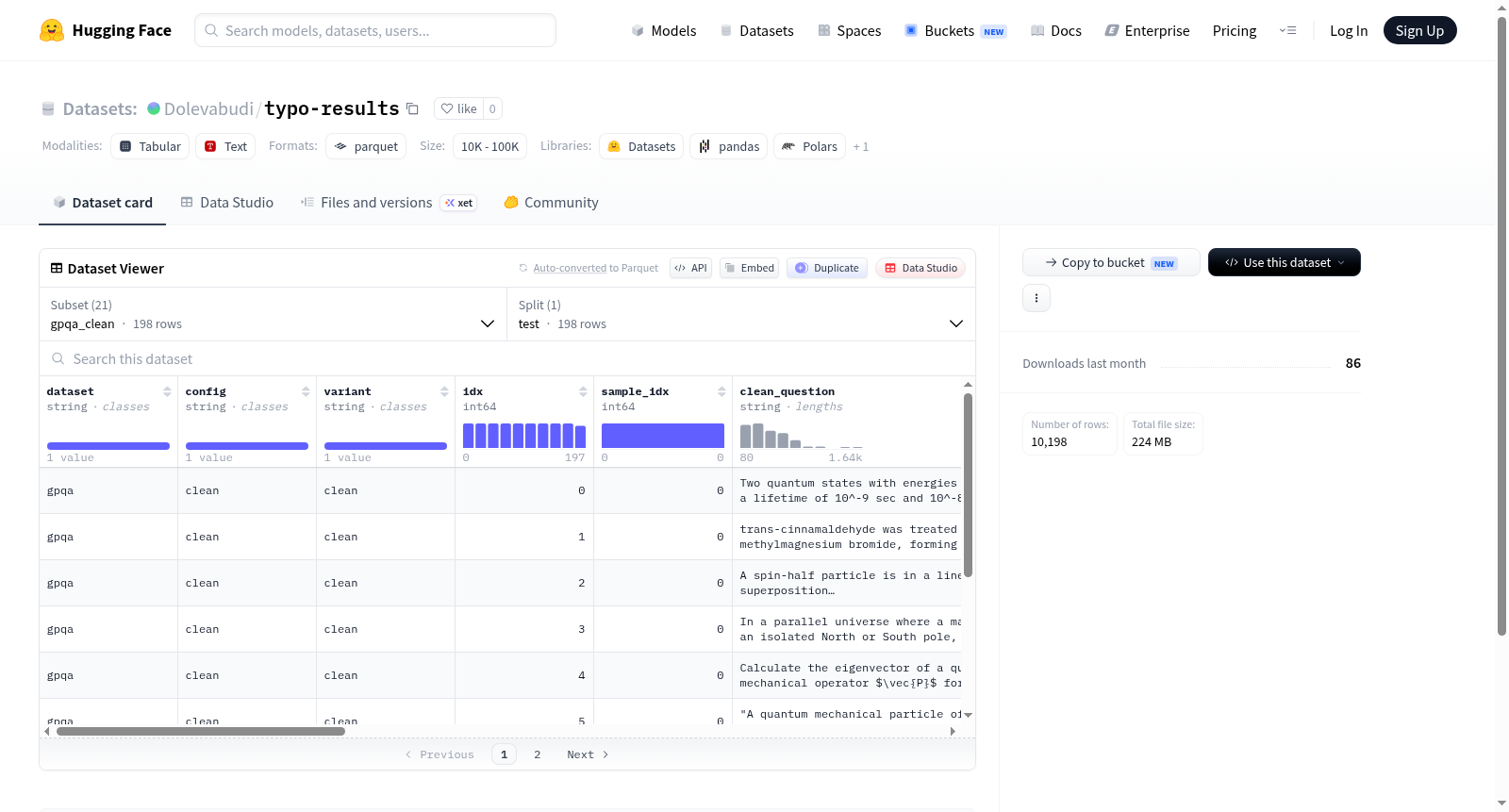
该数据集是一个用于评估语言模型在数学推理任务中对拼写错误鲁棒性的基准测试集,基于GPQA和GSM8K数据集构建,包含多种配置变体。核心数据包括原始数学问题(clean_question)、故意引入特定比例拼写错误的问题(typo_question,存在于部分配置)、提示词(prompt)、标准答案(gold_answer)以及语言模型生成的答案(generation)、推理过程(reasoning)和最终答案文本(final_answer_text)。此外,数据集还记录了模型生成过程的详细元数据,如提示令牌数(n_prompt_tokens)、生成令牌数(n_gen_tokens)、生成成本(cost_usd)和延迟(latency_s)。部分配置专门针对拼写错误分析,提供了错误类型统计字段,如目标真实单词比例(target_real_ratio)、实际真实单词比例(real_ratio)、总错误数(num_total)、真实单词错误数(num_real)、非单词错误数(num_nonword)以及使用的拼写错误技术列表(typo_techniques)。数据集包含20个配置,主要分为clean(无拼写错误)和typo(含拼写错误)两大类,其中typo类配置通过名称中的数字(如typo25, typo50, typo75和real10, real40, real70)表示拼写错误的比例和真实单词在错误中的比例。所有配置仅包含测试集(test),样本数量为198(针对gpqa_clean)或500(针对gsm8k相关配置)。该数据集适用于研究语言模型的数学推理能力、对输入噪声(特别是拼写错误)的鲁棒性、模型生成效率(成本与延迟)以及错误分析。
This dataset is a benchmark for evaluating the robustness of large language models (LLMs) to spelling errors in mathematical reasoning tasks. It is built upon the GPQA and GSM8K datasets and includes multiple configuration variants. The core data consists of: original mathematical questions (clean_question), questions with intentional spelling errors introduced at a specified proportion (typo_question, available in some configurations), prompts, gold standard answers (gold_answer), model-generated answers (generation), reasoning processes (reasoning), and final answer texts (final_answer_text). Additionally, the dataset records detailed metadata from the model generation process, including the number of prompt tokens (n_prompt_tokens), the number of generated tokens (n_gen_tokens), generation cost (cost_usd), and latency (latency_s). Some configurations are dedicated to spelling error analysis, providing error type statistical fields such as the proportion of target real words (target_real_ratio), actual real word proportion (real_ratio), total number of errors (num_total), number of real word errors (num_real), number of non-word errors (num_nonword), and the list of applied spelling error techniques (typo_techniques). The dataset contains 20 configurations, which are primarily categorized into two groups: "clean" (no spelling errors) and "typo" (with spelling errors). The "typo" configurations may indicate the proportion of spelling errors and the proportion of real words in errors via the numbers in their names, such as typo25, typo50, typo75, real10, real40, and real70. All configurations only include the test split, with the number of samples being 198 for gpqa_clean configurations or 500 for GSM8K-related configurations. This dataset is suitable for research on the mathematical reasoning capabilities of language models, their robustness to input noise (particularly spelling errors), model generation efficiency (cost and latency), and error analysis.
数据集概述
该数据集名为 typo-results,旨在研究提示中引入拼写错误(typo)对语言模型推理能力的影响。数据集包含多个配置(config),每个配置对应不同的数据集来源、错误类型和参数设置。
数据集构成
数据集主要包含两大类子集,分别基于 GPQA 和 GSM8K 两个原始数据集构建。
-
GPQA 干净数据(gpqa_clean)
- 样本数量: 198
- 数据拆分: 仅包含测试集(test),大小为 9.81 MB
- 特点: 包含干净的原始问题(clean_question),没有拼写错误版本的题型(typo_question 为 null)。
-
GSM8K 数据
- 这是该数据集的主体,包含多种变体,用于模拟不同类型的拼写错误。所有 GSM8K 配置的测试集均为 500 个样本。
- 干净数据(gsm8k_clean): 不包含拼写错误,作为基线。
- 拼写错误数据: 配置名称遵循
gsm8k_typo{error_percentage}_real{real_word_ratio}的格式。error_percentage: 错误量,有 25%、50%、75% 三档。real_word_ratio: 有意义的拼写错误(即错误后仍为真实单词)的目标比例,有 10%、40%、70% 三档。- 例如
gsm8k_typo25_real10表示 25% 的单词有拼写错误,其中 10% 的错误结果是真实单词。
- 20000 变体: 部分配置带有
_20000后缀(如gsm8k_typo25_real10_20000),其测试集同样为 500 个样本,但数据规模更大。
共有特征
所有配置均包含以下字段:
- dataset: 源数据集名称(如 "gpqa" 或 "gsm8k")。
- config: 配置名称。
- variant: 变体描述。
- idx / sample_idx: 样本索引。
- clean_question: 原始、没有错误的提问。
- typo_question: 包含拼写错误的提问(对于干净数据此为 null)。
- prompt: 输入给模型的完整提示。
- gold_answer: 正确答案。
- generation: 模型生成的原始输出。
- reasoning: 模型的推理过程。
- final_answer_text: 模型最终输出的答案文本。
- n_prompt_tokens / n_gen_tokens: 提示和生成的 token 数量。
- cost_usd / latency_s: 运行的成本(美元)和延迟(秒)。
拼写错误数据特有的特征
部分 GSM8K 配置包含以下额外字段:
- target_real_ratio / real_ratio: 有意义的拼写错误的目标比例和实际比例。
- num_total / num_real / num_nonword: 总错误数量、有意义的错误数量和非单词错误数量。
- typo_techniques: 列表中存储了生成这些拼写错误所使用的技术。
- Record ID: GPQA 数据集中每条记录的唯一标识符。
总结
该数据集是一个用于评测语言模型对拼写错误鲁棒性的 benchmark。它提供从干净到不同程度、不同类型拼写错误的多种数据配置,并包含模型的推理过程和最终输出,便于进行深入分析。数据总量从数 MB 到 10 MB 不等,主要用于测试和验证。