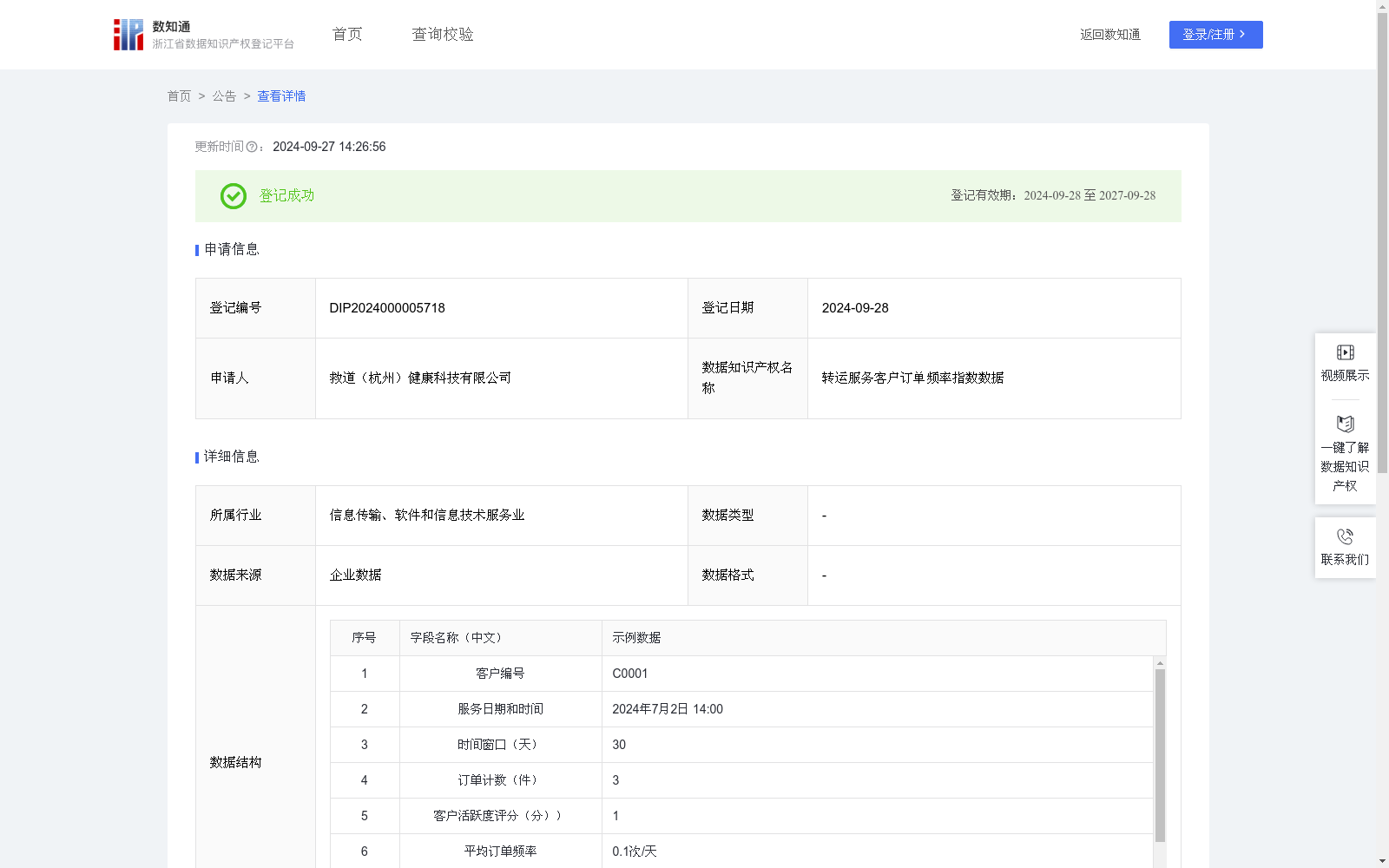
转运服务客户订单频率指数数据
收藏资源简介:
(1)本数据有助于本公司利用订单频率数据来制定差异化的定价策略,如为高频用户提供折扣或优惠。另通过客户群体的细分,定制个性化的营销策略,提高营销效果。 (2)本数据有助于本公司通过趋势分析,预测未来服务需求,为运力规划提供依据。 (3)本数据可为其他转运服务商进一步统计识别分析特定时间段内服务的整体使用频率提供支持,有助于其他转运服务商优化资源分配和服务调度。(1)数据收集和预处理: 从公司内部订单管理系统中收集历史订单数据,包括客户编号、服务日期和时间。通过数据清洗去除无效或错误记录,确保数据质量。 (2)时间窗口设定: 根据公司业务情况设定分析的时间窗口为30天。 (3)订单计数: 对每个客户在设定时间窗口内的订单数量进行计数。 (4)客户活跃度评分: 根据订单计数,为每个客户分配一个活跃度评分,设定30天内订单数1-3为1分,4-6为2分,7个以上为3分。 (5)平均订单频率计算: 计算整体或特定时间段内的平均订单频率,计算方式为: 平均订单频率=订单计数(件)÷时间窗口(天) (6)订单频率指数构建: 利用Min-Max标准化统计方法(一种线性变换方法)构建订单频率指数,将所有客户原始订单频率数据标准化为一个统一的、可以比较的范围,如0到100。 (7)客户细分: 根据订单频率指数对客户进行细分,识别高频率和低频率用户。低频用户:订单频率指数 ≤ 33;中频用户:34 < 订单频率指数 ≤ 66;高频用户:订单频率指数 > 67 (8)趋势分析: 采用移动平均统计方法分析订单频率指数随时间的变化趋势。
(1) This dataset enables our company to develop differentiated pricing strategies using order frequency data, such as offering discounts or preferential treatments to high-frequency customers. Additionally, it supports the customization of personalized marketing strategies via customer segmentation to improve marketing outcomes. (2) This dataset allows our company to forecast future service demand through trend analysis, providing a basis for capacity planning. (3) This dataset provides support for other transport service providers to further conduct statistical identification and analysis of the overall service usage frequency within specific time periods, helping them optimize resource allocation and service scheduling. (1) Data Collection and Preprocessing: Historical order data is collected from the company's internal order management system, including customer IDs, service dates and times. Data cleaning is performed to remove invalid or erroneous records, ensuring data quality. (2) Time Window Setting: The analysis time window is set to 30 days based on the company's business conditions. (3) Order Counting: The number of orders for each customer within the set time window is counted. (4) Customer Activity Scoring: An activity score is assigned to each customer based on their order count. The scoring rule is set as: 1 point for 1-3 orders within 30 days, 2 points for 4-6 orders, and 3 points for more than 7 orders. (5) Average Order Frequency Calculation: The average order frequency within the overall or a specific time period is calculated using the formula: Average Order Frequency = Total Order Count (units) ÷ Time Window (days). (6) Order Frequency Index Construction: The order frequency index is constructed using the Min-Max normalization statistical method (a linear transformation technique), which standardizes the raw order frequency data of all customers into a unified and comparable range, such as 0 to 100. (7) Customer Segmentation: Customers are segmented based on their order frequency index to identify high-frequency and low-frequency users. The segmentation criteria are: Low-frequency users: Order Frequency Index ≤ 33; Medium-frequency users: 34 < Order Frequency Index ≤ 66; High-frequency users: Order Frequency Index > 67. (8) Trend Analysis: The moving average statistical method is adopted to analyze the temporal variation trend of the order frequency index.