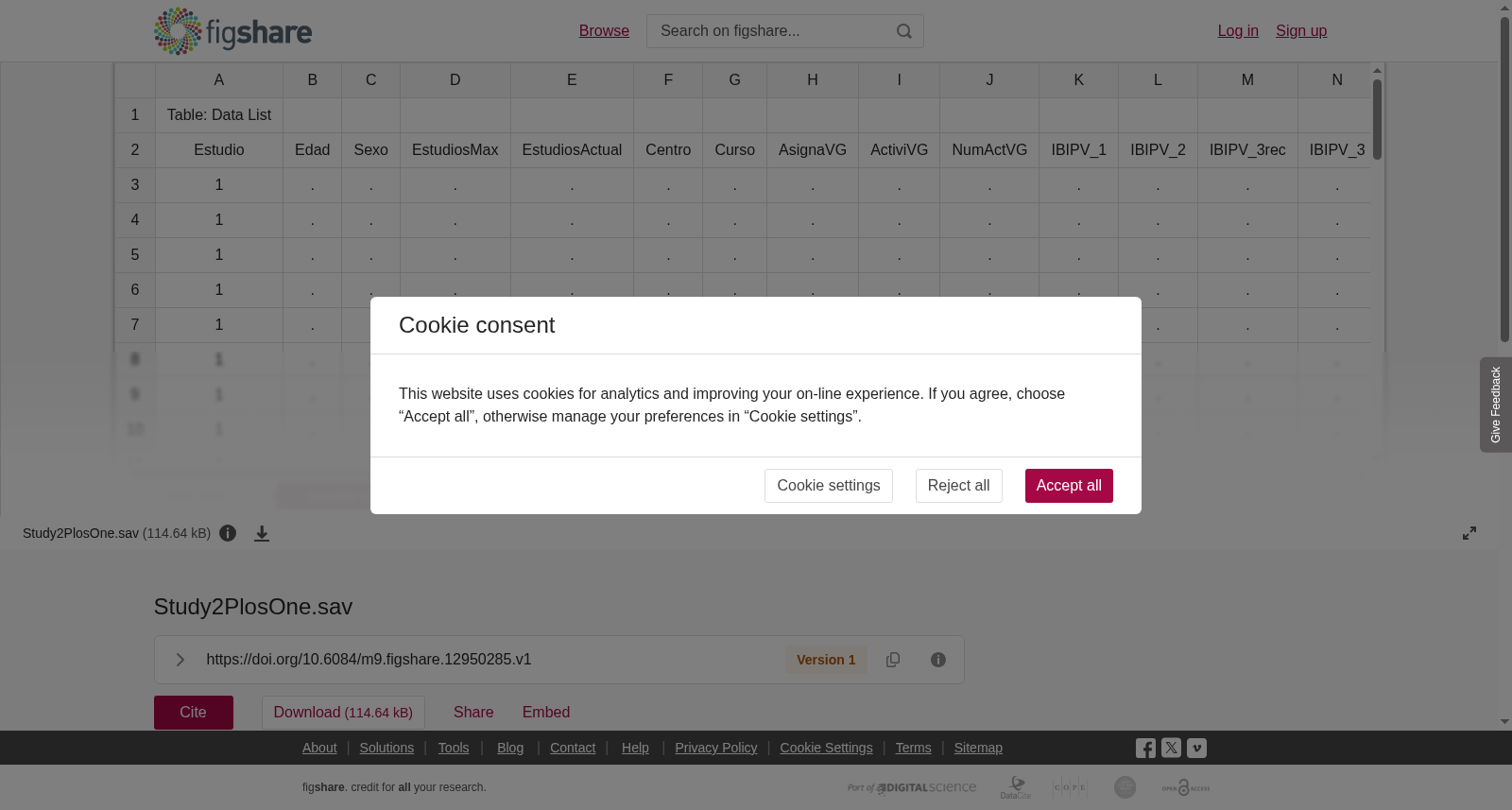
Study2PlosOne.sav
收藏资源简介:
Participants were Spanish volunteers recruited in 2018-2019 by announcements in different Spanish education centers (participating universities, vocational training centers and high schools) (opportunity sample)<b>Instruments</b>The <b>Inventory of Beliefs about Intimate Partner Violence </b>(IBIPV, [64]) comprises 22 items rated on a seven-point scale from 1 (<i>totally disagree</i>) to 7 (<i>totally agree</i>) which reflect three dimensions: <i>Justifying Partner Violence </i>(F1-JPV, 6-items, α = .71); <i>Victims Responsible for Violence </i>(F2-VRV, 9-ítems, α = .93); and <i>Abuser Responsible for Violence </i>(F3-ARV, 7-items, α = .84). After reversing the scores of item 3, and the seven items of subscale ARV, so that all 22 items maintain the same sense in the construct, higher scores indicate higher tolerance towards IPVAW (i.e. lower rejection towards IPVAW). The <b>Inventory of Distorted Thoughts about Women and Violence</b> (IPDMV in the Spanish acronym, [57, 58]; adapted version of Ferrer et al. [61]) comprises 24 items related to four dimensions: <i>Inferiority of Women Compared to Men</i> (F1-IW, 7 items, α = .86); <i>Blaming Female Victims of Abuse</i> (F2-BW, 7 items, α = .62); <i>Violence as an Appropriate Problem-solving Strategy </i>(F3-VP, 5 items, : α = .69); and <i>Minimization and Exoneration of the Abuser</i> (F4-MA, 5 items, α = .53). Responses are given in a four-point scale from 1 (<i>totally disagree</i>) to 4 (<i>totally agree</i>), and the higher the scores, the higher the levels of distorted thoughts (i.e. the lower the rejection towards IPVAW). Finally, participants completed a brief questionnaire designed ad hoc, including some sociodemographic data, such as gender and age, and some questions about their previous training in IPVAW.<br>
本研究的参与者为2018-2019年间,通过西班牙境内各类教育机构(合作参与的大学、职业培训中心与高级中学)发布的招募公告所招募的西班牙籍志愿者,采用方便抽样(opportunity sample)方法。**研究工具**:**《亲密伴侣暴力信念量表》(Inventory of Beliefs about Intimate Partner Violence,IBIPV,[64])**包含22个条目,采用1(完全不同意)至7(完全同意)的7级李克特计分方式,涵盖三个维度:①**为伴侣暴力辩护**(F1-JPV,6个条目,Cronbach’s α=0.71);②**暴力受害者有责**(F2-VRV,9个条目,Cronbach’s α=0.93);③**施暴者有责**(F3-ARV,7个条目,Cronbach’s α=0.84)。研究人员对第3条目以及ARV子量表的7个条目进行得分反转,以确保全部22个条目在构念上保持统一的指向性;得分越高,则代表对亲密伴侣暴力(Intimate Partner Violence Against Women,IPVAW)的容忍度越高(即对IPVAW的排斥度越低)。**《女性与暴力歪曲认知量表》(西班牙语缩写为IPDMV,[57,58];改编自Ferrer等人[61]的研究版本)**包含24个条目,涵盖四个维度:①**女性相较于男性的劣势感**(F1-IW,7个条目,Cronbach’s α=0.86);②**指责虐待女性受害者**(F2-BW,7个条目,Cronbach’s α=0.62);③**暴力作为恰当问题解决策略**(F3-VP,5个条目,Cronbach’s α=0.69);④**为施暴者最小化罪责与开脱**(F4-MA,5个条目,Cronbach’s α=0.53)。该量表采用1(完全不同意)至4(完全同意)的4级计分方式,得分越高则代表歪曲认知水平越高(即对IPVAW的排斥度越低)。最后,参与者完成了一份为本研究专门设计的简短问卷,内容涵盖性别、年龄等社会人口学信息,以及过往是否接受过IPVAW相关培训的相关问题。