
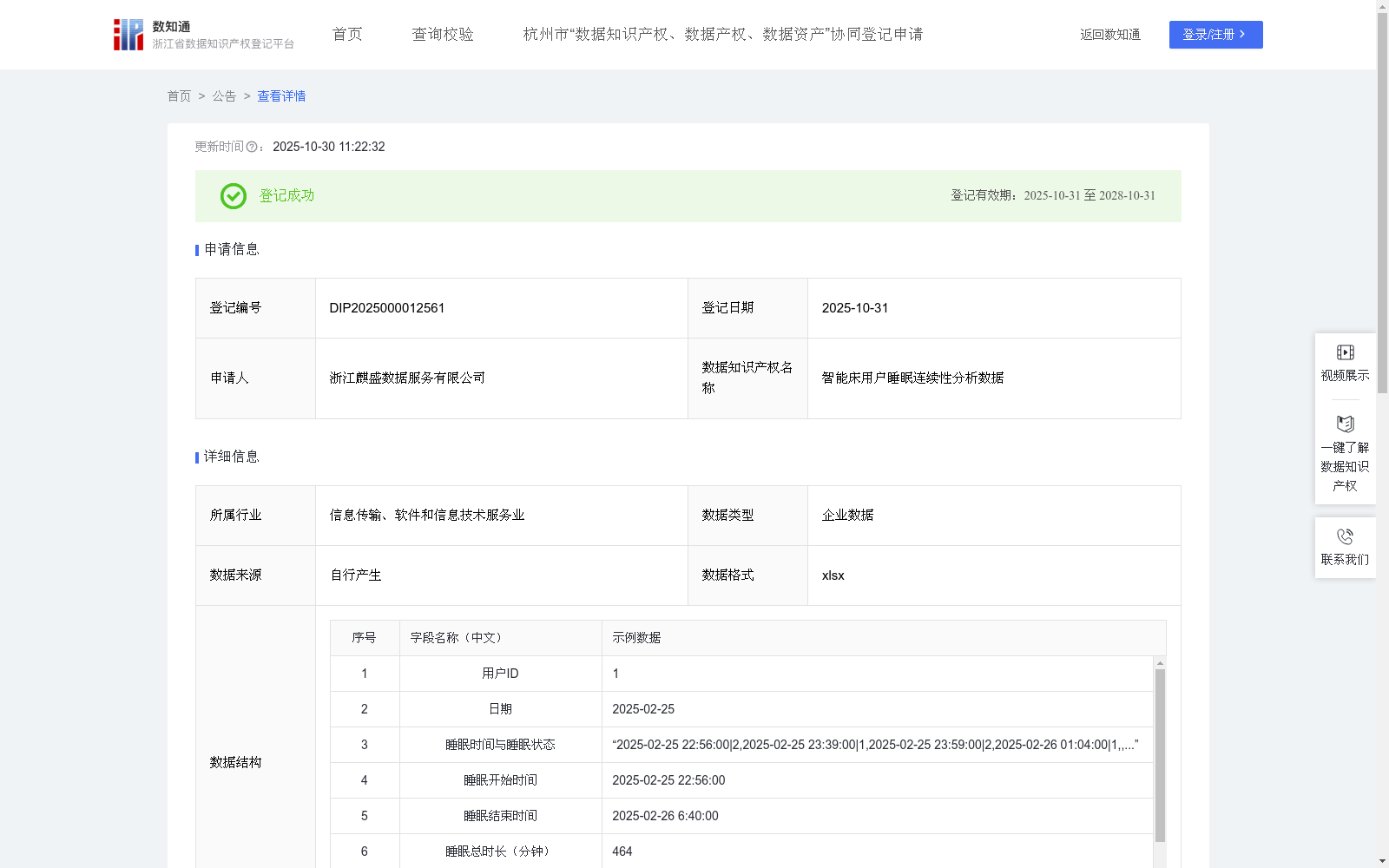
智能床用户睡眠连续性分析数据
收藏浙江省数据知识产权登记平台2025-10-30 更新2025-10-31 收录
下载链接:
https://www.zjip.org.cn/home/announce/trends/6883433
下载链接
链接失效反馈官方服务:
资源简介:
智能床用户睡眠连续性可以应用于多个领域和场景:1)定制化睡眠改善计划:智能床将实时收集用户睡眠状态数据,并运用睡眠连续性算法进行分析。基于此,APP 为用户推送针对性的睡眠改善方案,如播放有助于深度睡眠的舒缓音乐、提供改善睡眠环境的建议,包括调整卧室温度、湿度等。2)老年人睡眠健康监护:借助睡眠连续性算法,养老机构可以根据睡眠数据评估老年人的健康风险。持续较差的睡眠连续性可能是某些慢性疾病的早期信号,如心血管疾病、神经系统疾病等。一旦算法发出健康风险预警,养老机构可安排专业医生为老人进行全面健康检查,实现疾病的早发现、早治疗。3)治疗效果跟踪:对于正在接受睡眠障碍治疗的患者,智能床持续监测睡眠连续性。医生通过分析睡眠连续性数据,评估治疗效果,及时调整治疗方案。例如,患者在服用助眠药物一段时间后,睡眠连续性明显改善,医生可适当调整药物剂量;若睡眠连续性没有明显变化,医生则考虑更换治疗方法。(一)数据结构化规整
睡眠时间与状态存储了“时间戳|睡眠状态”组成的字符串序列,如“2025-03-13 23:28:00|2,2025-03-13 23:32:00|1”。首先按逗号拆分成多个记录,再以竖线提取时间与状态值。状态代码含义如下:0为清醒,1为深睡,2为浅睡,3为离床或设备离线。“2025-03-13 23:28:00|2,2025-03-13 23:32:00|1”表示“2025-03-13 23:28:00”用户进入睡眠状态2(浅睡状态),“2025-03-13 23:32”结束睡眠状态2,进入睡眠状态1(深睡状态)。
(二)离床及异常数据清洗
睡眠状态3含有设备异常的可能,需清洗以避免干扰分析。具体规则为:1)若睡眠状态3持续不足2分钟,视为设备短暂掉线或佩戴异常导致的误判,应删除;2)若睡眠状态连续为“1-3-1”或“2-3-1”,且睡眠状态3持续不超过10分钟,则判定为设备异常跳变,需剔除,尤其“2-3-1”不符合深睡需从浅睡过渡的生理逻辑。
(三)睡眠连续性量化运算
1)根据睡眠开始时间和睡眠结束时间计算睡眠总时长;
2)识别睡眠数据中各睡眠阶段的起始时间点。睡眠阶段定义为连续的睡眠状态块(包括浅睡1和深睡2)或连续的非睡眠状态块(包括清醒0和离床3)。具体做法是检测睡眠状态的变化点,即当前状态与前一状态不同的位置,视为新阶段的起点。通过筛选仅保留每个阶段的第一个时间点,消除同一阶段内重复记录,从而准确划分睡眠与非睡眠状态的连续区间,为后续睡眠质量分析奠定基础。
3)剔除睡眠状态为0(清醒)和3(离床)的数据,保留有效睡眠阶段;
4)若仅有一个睡眠阶段,睡眠连续性设为1;
5)若存在多个睡眠阶段,首先计算每段阶段的持续时长,并除以总有效睡眠时长,得到各睡眠阶段的比例,用于反映不同阶段在整晚睡眠中的分布。接着,以这些比例为基础,计算睡眠连续性指标:将占比最大的阶段比例的平方,与其余各阶段比例平方的平均值相加,得出该指标,用于综合衡量睡眠的集中程度和中断情况。该指标值越高,说明主要睡眠阶段占比较大、分布更集中,睡眠越连续;值越低,则说明睡眠被频繁打断,分布较分散。
(四)睡眠质量分级评定
根据睡眠连续性,划分四个睡眠连续性等级:
下述范围均为左闭右开
优秀:≥0.6
良好:[0.3,0.6)
一般:[0.15,0.3)
待改善:[0,0.15)
Sleep continuity data of smart bed users can be applied to multiple fields and scenarios:
1) Customized sleep improvement plans: Smart beds collect users' sleep status data in real time and analyze it using sleep continuity algorithms. Based on the analysis results, the APP will deliver targeted sleep improvement schemes to users, such as playing soothing music conducive to deep sleep, and providing suggestions for optimizing sleep environment, including adjusting bedroom temperature and humidity, etc.
2) Senior sleep health monitoring: With the help of sleep continuity algorithms, senior care institutions can evaluate the health risks of the elderly based on their sleep data. Persistently poor sleep continuity may serve as an early warning sign of certain chronic diseases, such as cardiovascular diseases, neurological diseases, etc. Once the algorithm issues a health risk alert, senior care institutions can arrange professional doctors to conduct comprehensive health examinations for the elderly, enabling early detection and early treatment of diseases.
3) Treatment efficacy tracking: For patients undergoing treatment for sleep disorders, smart beds continuously monitor sleep continuity. Doctors evaluate treatment efficacy by analyzing sleep continuity data and adjust treatment plans in a timely manner. For example, if a patient's sleep continuity improves significantly after taking sleep-aid medication for a period of time, the doctor can appropriately adjust the medication dosage; if there is no obvious change in sleep continuity, the doctor will consider changing the treatment method.
(1) Data Structuring and Standardization
Sleep duration and status store a string sequence composed of "timestamp|sleep status", such as "2025-03-13 23:28:00|2,2025-03-13 23:32:00|1". First, split the sequence into multiple records via commas, then extract the timestamp and status value via vertical bars. The meanings of status codes are as follows: 0 represents wakefulness, 1 represents deep sleep, 2 represents light sleep, 3 represents out of bed or device offline. The example "2025-03-13 23:28:00|2,2025-03-13 23:32:00|1" indicates that the user entered sleep status 2 (light sleep) at "2025-03-13 23:28:00", and exited status 2 and entered status 1 (deep sleep) at "2025-03-13 23:32".
(2) Cleaning of Out-of-bed and Abnormal Data
Sleep status 3 may indicate device abnormalities, which need to be cleaned to avoid interfering with analysis. The specific rules are as follows:
1) If sleep status 3 lasts for less than 2 minutes, it is regarded as a misjudgment caused by temporary device disconnection or abnormal wearing, and such records should be deleted;
2) If the sleep status sequence is continuously "1-3-1" or "2-3-1", and sleep status 3 lasts no more than 10 minutes, it is determined as an abnormal device jump, and such records need to be removed, especially since "2-3-1" violates the physiological logic that deep sleep should transition from light sleep.
(3) Quantitative Calculation of Sleep Continuity
1) Calculate the total sleep duration based on the sleep start time and sleep end time;
2) Identify the start time points of each sleep stage in the sleep data. A sleep stage is defined as a continuous block of sleep states (including light sleep 1 and deep sleep 2) or a continuous block of non-sleep states (including wakefulness 0 and out-of-bed 3). The specific method is to detect the change points of sleep states, i.e., positions where the current state differs from the previous state, which are regarded as the starting points of new stages. By filtering and retaining only the first time point of each stage and eliminating duplicate records within the same stage, the continuous intervals of sleep and non-sleep states can be accurately divided, laying a foundation for subsequent sleep quality analysis.
3) Remove data with sleep status 0 (wakefulness) and 3 (out of bed), and retain valid sleep stages;
4) If there is only one sleep stage, the sleep continuity score is set to 1;
5) If there are multiple sleep stages, first calculate the duration of each stage, then divide by the total valid sleep duration to obtain the proportion of each sleep stage, which reflects the distribution of different stages in the entire night's sleep. Then, based on these proportions, calculate the sleep continuity index: add the square of the proportion of the largest stage to the average of the squares of the proportions of the remaining stages to obtain this index, which comprehensively measures the concentration and interruption of sleep. The higher the index value, the larger the proportion of the main sleep stage, the more concentrated the distribution, and the more continuous the sleep; the lower the index value, the more frequently sleep is interrupted and the more dispersed the distribution.
(4) Sleep Quality Grading and Evaluation
Sleep continuity is divided into four grades based on the sleep continuity index, with all ranges being left-closed and right-open:
Excellent: ≥ 0.6
Good: [0.3, 0.6)
Fair: [0.15, 0.3)
Needs Improvement: [0, 0.15)
提供机构:
浙江麒盛数据服务有限公司
创建时间:
2025-07-28
搜集汇总
数据集介绍
背景与挑战
背景概述
该数据集由浙江麒盛数据服务有限公司自行产生,包含1001条智能床用户睡眠数据,每日更新,用于分析睡眠连续性。数据涵盖用户ID、睡眠时间、状态、时长和连续性等级等字段,支持定制化睡眠改善、老年人健康监护和治疗效果跟踪等应用场景,并通过算法规则确保数据清洗和量化分析的准确性。
以上内容由遇见数据集搜集并总结生成



