
fMRI: Audiovisual Valence Congruence
收藏OpenNeuro2021-02-06 更新2026-03-14 收录
下载链接:
https://openneuro.org/datasets/ds003507
下载链接
链接失效反馈官方服务:
资源简介:
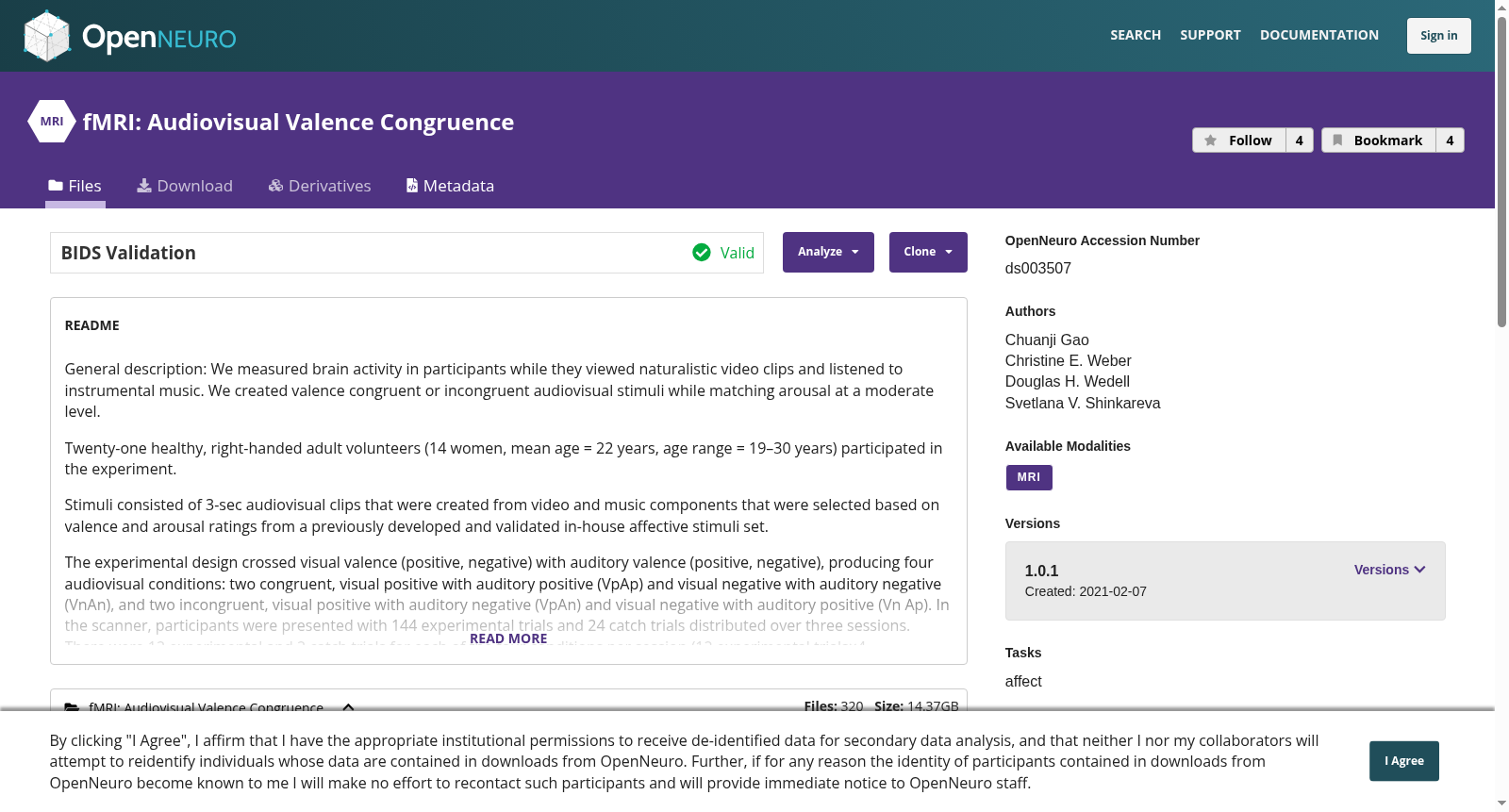
General description:
We measured brain activity in participants while they viewed naturalistic video clips and listened to instrumental music. We created valence congruent or incongruent audiovisual stimuli while matching arousal at a moderate level.
Twenty-one healthy, right-handed adult volunteers (14 women, mean age = 22 years, age range = 19–30 years) participated in the experiment.
Stimuli consisted of 3-sec audiovisual clips that were created from video and music components that were selected based on valence and arousal ratings from a previously developed and validated in-house affective stimuli set.
The experimental design crossed visual valence (positive, negative) with auditory valence (positive, negative), producing four audiovisual conditions: two congruent, visual positive with auditory positive (VpAp) and visual negative with auditory negative (VnAn), and two incongruent, visual positive with auditory negative (VpAn) and visual negative with auditory positive (Vn Ap). In the scanner, participants were presented with 144 experimental trials and 24 catch trials distributed over three sessions. There were 12 experimental and 2 catch trials for each of the four conditions per session (12 experimental trials×4 conditions×3 sessions=144 trials; 2 catch trials× 4 conditions × 3 sessions = 24 trials). Audiovisual pairings with the same exemplars were restricted to the same session (i.e., cross-validation fold) to generalize the identification of audiovisual affective representation across stimuli. In addition to breaks between sessions for the participants to relax, there was also a 12-sec break in the middle of each session.
Data were acquired using a 3-T Siemens Prisma Fit scanner with a 32-channel coil (Siemens) at the McCausland Center for Brain Imaging at the University of South Carolina. fMRI data were acquired using a multiband gradient-echo EPI sequence using T2*-weighted BOLD contrast (multiband acceleration factor = 4).
Code specification in event files:
Visual positive auditory positive: 1
Visual positive auditory negative: 2
Visual negative auditory positive: 3
Visual negative auditory negative: 4
Catch trials: 5
Other details please see the reference.
数据集概述:
我们在受试者观看自然主义视频片段并聆听器乐音乐时,采集其脑活动数据。我们构建了效价(valence)一致或不一致的视听刺激材料,并将唤醒度(arousal)控制在中等水平。
本实验共招募21名健康右利手成年志愿者(14名女性,平均年龄22岁,年龄区间19~30岁)参与。
实验刺激为时长3秒的视听片段,其视频与音乐组分均选自一套此前开发并经验证的内部情感刺激集,组分选取依据为该刺激集的效价与唤醒度评分。
实验设计将视觉效价(正性、负性)与听觉效价(正性、负性)进行交叉组合,得到四种视听条件:两种一致条件——视觉正性搭配听觉正性(VpAp)、视觉负性搭配听觉负性(VnAn),以及两种不一致条件——视觉正性搭配听觉负性(VpAn)、视觉负性搭配听觉正性(VnAp)。在扫描仪中,受试者共完成144组实验试次与24组捕捉试次(catch trials),实验分为三个会话单元。每个会话单元内,四种条件各包含12组实验试次与2组捕捉试次(12实验试次×4条件×3会话单元=144试次;2捕捉试次×4条件×3会话单元=24试次)。相同样本的视听配对仅可出现在同一会话单元(即交叉验证折)中,以确保跨刺激的视听情感表征识别结果具备泛化性。除会话单元间供受试者放松的休息时段外,每个会话单元的中途还设置了12秒的休息间隙。
数据采集于南卡罗来纳大学麦考斯兰脑成像中心,采用3-T西门子Prism Fit扫描仪(Siemens)搭配32通道线圈(Siemens)完成。功能磁共振成像(fMRI)数据通过多波段梯度回波平面回波成像(EPI)序列采集,采用T2*加权血氧水平依赖(BOLD)对比模式,多波段加速因子为4。
事件文件代码规范:
视觉正性搭配听觉正性:1
视觉正性搭配听觉负性:2
视觉负性搭配听觉正性:3
视觉负性搭配听觉负性:4
捕捉试次:5
其余详细信息请参阅参考文献。
创建时间:
2021-02-06
搜集汇总
数据集介绍
背景与挑战
背景概述
该数据集包含21名健康成年人在接受情感一致或不一致的视听刺激时的fMRI数据,旨在研究跨视听模态的情感处理。数据采集使用了3-T Siemens Prisma Fit扫描仪,实验设计包括四种视听情感组合条件。
以上内容由遇见数据集搜集并总结生成



