
Rice sheath blight dataset
收藏Mendeley Data2024-01-31 更新2024-06-28 收录
下载链接:
https://www.scidb.cn/en/detail?dataSetId=557575341254639616
下载链接
链接失效反馈官方服务:
资源简介:
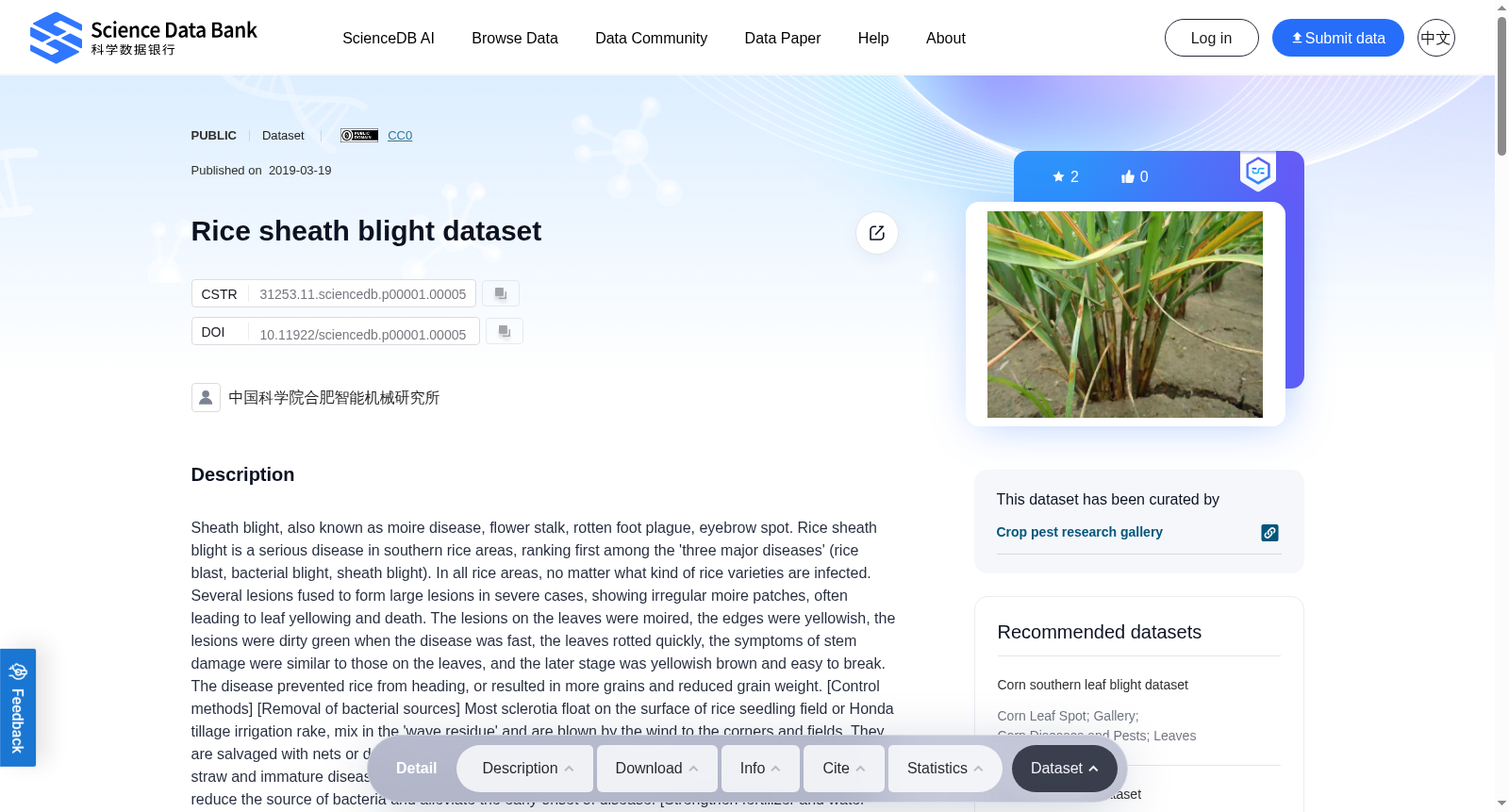
Sheath blight, also known as moire disease, flower stalk, rotten foot plague, eyebrow spot. Rice sheath blight is a serious disease in southern rice areas, ranking first among the 'three major diseases' (rice blast, bacterial blight, sheath blight). In all rice areas, no matter what kind of rice varieties are infected. Several lesions fused to form large lesions in severe cases, showing irregular moire patches, often leading to leaf yellowing and death. The lesions on the leaves were moired, the edges were yellowish, the lesions were dirty green when the disease was fast, the leaves rotted quickly, the symptoms of stem damage were similar to those on the leaves, and the later stage was yellowish brown and easy to break. The disease prevented rice from heading, or resulted in more grains and reduced grain weight. [Control methods] [Removal of bacterial sources] Most sclerotia float on the surface of rice seedling field or Honda tillage irrigation rake, mix in the 'wave residue' and are blown by the wind to the corners and fields. They are salvaged with nets or dustpans and taken out of the field to burn or bury deeply. Returning diseased straw and immature diseased straw to the field without direct use and weeding at the edge of the field can reduce the source of bacteria and alleviate the early onset of disease. [Strengthen fertilizer and water management] According to rice growth period, weather, water level of paddy field, soil properties and water conservancy conditions, rational drainage and irrigation, water control disease, thoroughly change the environment of long-term deep irrigation and high humidity, achieve shallow water rooting, thin water raising embryos, wet long panicles, among which timely drainage and irrigation management of shelving (drying) fields and dry wet irrigation in the late tillering stage to jointing stage should be carried out. Low inter-plant humidity can promote the growth of rice plants, and has a significant effect on controlling sheath blight. For deep mud field, cold soaked field and fertilizer field, heavy sun should be applied, for sandy field, and for paddy field with vigorous seedlings and early closure, it should be put aside separately. Nitrogen, phosphorus and potassium should be applied together so as to combine farm manure with chemical fertilizer, long-term fertilizer with quick-acting fertilizer, and avoid partial application of nitrogen fertilizer and large-scale application of nitrogen fertilizer in the middle and later stages. [Cultivating disease-resistant varieties] Although no high-resistant and immune varieties have been found, there are differences in resistance among varieties, and some moderate-resistant varieties can be planted in areas where the disease is particularly serious. In addition, modern molecular biological methods should be actively used to create disease-resistant materials and introduce exogenous disease-resistant genes into rice varieties. [Scientific use of drugs to improve the effect] The application of chemical agents has the most direct and effective advantages in controlling rice sheath blight. In production, the key to improve the control effect of rice sheath blight is to strictly follow the occurrence trend of Rice Sheath Blight in the field and select the right varieties and concentration of pesticides. At the same time, new pesticide varieties and control technologies should be actively introduced and developed to delay the emergence of resistance. [pesticide control] silicon fertilizer was applied to improve plant resistance to disease. In the 10.1 leaf stage (11 leaf varieties) and booting stage of rice, 75% butazolidin and oxime methyl water dispersible granule 15-20 g / mu, or 24% thiopuramide suspension 15-20 ml / mu, or 30% phenoebazole and pvoxazole emulsion 15-20 nm / mu, 15 liters of water (knapsack sprayer) or 7-8 liters (mist sprayer) were sprayed and sprayed. The shallow water layer is sprayed to the middle and lower leaf sheath of rice.
水稻纹枯病(Sheath blight)又名云纹病、花秆病、脚腐病、眉斑病,是南方稻区的重要病害,位列水稻“三大病害”(稻瘟病、白叶枯病、纹枯病)之首,在各水稻种植区均会侵染不同水稻品种。病情严重时,多个病斑会融合形成大型病斑,呈现不规则云纹状斑块,常导致叶片黄化枯死。叶片上的病斑呈云纹状,边缘淡黄色;病害盛发时病斑呈暗绿色,叶片快速腐烂。茎秆受害症状与叶片相似,后期变为黄褐色,极易折断。该病会导致水稻抽穗困难,或结实率降低、千粒重下降。
【防治措施】
【清除菌源】大部分菌核会漂浮于秧田或本田耕整后的水面,混杂于“浪渣”中,随风飘散至田埂与田块角落,可使用网具或簸箕打捞后带出田外,集中烧毁或深埋。切勿直接将病稻草及未腐熟的病残稻草还田,同时做好田边杂草清除工作,可减少菌源基数,减轻病害早期发生。
【加强肥水管理】根据水稻生育期、天气状况、稻田水位、土壤性质与水利条件,进行合理排灌,以水控病,彻底改变长期深灌、高湿的田间环境,实现“浅水发根、薄水养胎、湿润长穗”。其中,在分蘖末期至拔节期及时进行搁田(晒田)与干湿交替灌溉,可降低株间湿度,促进水稻植株健壮生长,对防控纹枯病效果显著。对于深泥田、冷浸田与肥田,需重晒田;沙质田以及幼苗长势旺盛、田间早封行的稻田,应分次搁田。需配合施用氮、磷、钾肥,做到有机肥与化肥结合、长效肥与速效肥结合,避免偏施氮肥,且中后期避免大量施用氮肥。
【培育抗病品种】目前尚未发现高抗或免疫的水稻品种,但不同品种间的抗病性存在差异,在病害发生尤为严重的区域可种植中抗品种。此外,应积极运用现代分子生物学技术创制抗病材料,将外源抗病基因导入水稻品种中。
【科学用药,提升防效】化学药剂防控是当前防治水稻纹枯病最直接有效的手段。生产中提升纹枯病防控效果的关键,是严格依据田间纹枯病发生动态,选用合适的药剂品种与浓度。同时,应积极研发与推广新型农药品种及防控技术,延缓抗药性产生。
【药剂防控】可施用硅肥以提升植株抗病性。在水稻10叶期(11叶品种)及孕穗期,每亩使用75%丁唑醇·肟菌酯水分散粒剂(75% butazolidin and oxime methyl water dispersible granule)15~20克,或24%噻呋酰胺悬浮剂(24% thiopuramide suspension)15~20毫升,或30%苯醚甲环唑·丙环唑乳油(30% phenoebazole and pvoxazole emulsion)15~20毫升,兑水15升(背负式喷雾器)或7~8升(弥雾喷雾机)喷施。施药时需保持浅水层,将药液喷施至水稻中下部叶鞘部位。
创建时间:
2024-01-31
搜集汇总
数据集介绍
背景与挑战
背景概述
该数据集提供了水稻纹枯病的详细信息和防治方法,包括病害症状、防治措施、农药使用建议等,数据量为30.09 GB,文件数量为2975个,适用于生物学研究。
以上内容由遇见数据集搜集并总结生成



