electricsheepeurope/europe-ilo-how-xees-sex-ocu-geo-nb-mean-weekly-hours-actually-worked-per-employee-by
收藏资源简介:
该数据集包含来自国际劳工组织(ILO)ILOSTAT数据库的126,709条观测记录,涵盖38个欧洲国家1992年至2025年的数据。核心指标为HOW_XEES_SEX_OCU_GEO_NB,即按性别、职业和城乡地区划分的雇员实际平均每周工作小时数。数据以表格形式组织,包含国家代码、数据来源、指标代码、性别分类(总计、男性、女性)、职业分类、地区类型、观测年份、观测值及数据状态等字段。数据集适用于表格分类、回归分析和时间序列预测等机器学习任务,旨在为欧洲劳动力市场研究提供标准化、可直接用于模型训练的结构化数据。
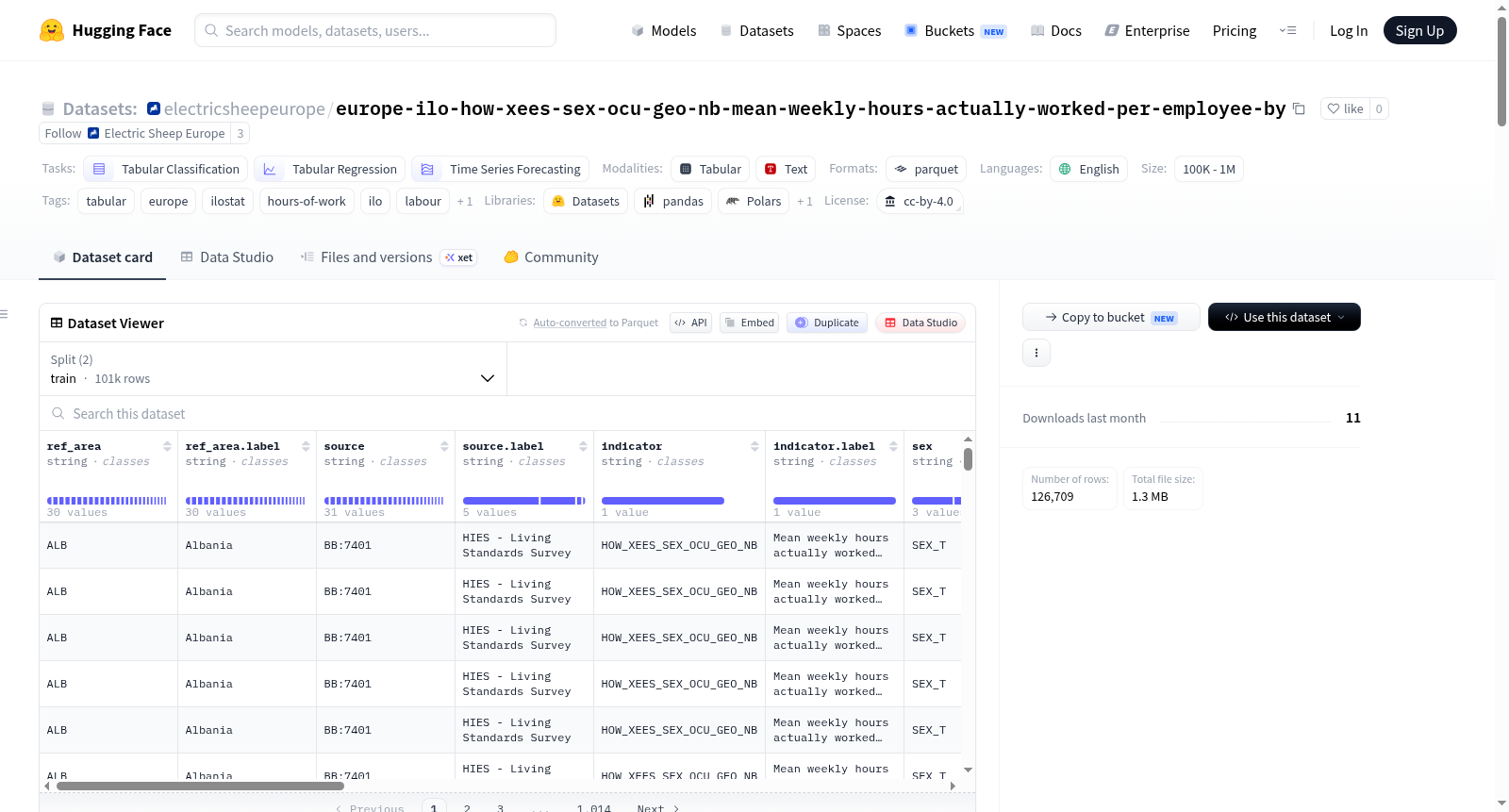
license: cc-by-4.0 language: - en task_categories: - tabular-classification - tabular-regression - time-series-forecasting multilinguality: monolingual size_categories: - 100K<n<1M tags: - tabular - europe - ilostat - hours-of-work - ilo - labour - employment pretty_name: "按性别、职业及城乡区域划分的雇员实际周平均工时 | 欧洲(ILOSTAT)" # 按性别、职业及城乡区域划分的雇员实际周平均工时 | 欧洲(ILOSTAT) 🇪🇺 **126,709条观测数据** · **38个欧洲国家** · **1992–2025年** · *由[Electric Sheep Europe](https://huggingface.co/electricsheepeurope)重新整理发布*      ## TL;DR 本数据集包含覆盖38个欧洲国家、时间跨度为1992至2025年的**工作时长**类观测数据共**126,709条**,仅涉及**1项明确指标**。 ## 关于数据源 **国际劳工组织统计数据库(ILOSTAT)** 是国际劳工组织(ILO)的核心统计数据库,也是全球领先的劳工统计数据源。该库整合了就业、失业、薪资、工作时长、童工、非正规经济、社会保障、职业伤害以及可持续发展目标(SDG)体面工作目标等领域的指标,数据来源于全国劳动力调查、家庭收入调查、机构调查及行政记录。其覆盖范围超过200个经济体,由国际劳工组织统计司负责数据的标准化协调。 - **数据来源**:[ILOSTAT](https://www.ilo.org/shinyapps/bulkexplorer/?id=HOW_XEES_SEX_OCU_GEO_NB) - **发布方**:国际劳工组织(ILO) - **许可证**:[CC BY 4.0](https://creativecommons.org/licenses/by/4.0/) - **主题**:工作时长 ## 数据处理方法 本数据集直接从ILOSTAT的REST API接口`https://rplumber.ilo.org/data/indicator?id=HOW_XEES_SEX_OCU_GEO_NB`拉取数据,并筛选出欧洲地区的ISO3国家代码子集。ILOSTAT依据国际劳工统计学家会议(ICLS)的定义对原始调查微观数据进行标准化协调;数据来源会在`source.label`字段中标记,以保证可追溯性。 ## 地理覆盖范围 38个欧洲国家,以下按数据条数排序展示部分国家: | 国家 | 数据条数 | 起始年份 | 结束年份 | |---------|-----:|-----------:|----------:| | `DEU` | 5,006 | 1992 | 2024 | | `NLD` | 4,975 | 1992 | 2024 | | `FRA` | 4,943 | 1992 | 2024 | | `DNK` | 4,876 | 1992 | 2024 | | `GRC` | 4,862 | 1992 | 2025 | | `IRL` | 4,739 | 1993 | 2024 | | `PRT` | 4,738 | 1992 | 2024 | | `ITA` | 4,697 | 1992 | 2024 | | `ESP` | 4,670 | 1992 | 2024 | | `BEL` | 4,572 | 1993 | 2024 | | `GBR` | 4,489 | 1992 | 2019 | | `AUT` | 4,308 | 1995 | 2025 | | `FIN` | 4,282 | 1997 | 2024 | | `SWE` | 4,218 | 1997 | 2024 | | `LUX` | 3,940 | 1997 | 2024 | | …… | 其余23个国家 | | | ## 指标(示例) - `HOW_XEES_SEX_OCU_GEO_NB` — 按性别、职业及城乡区域划分的雇员实际周平均工时 ## 数据结构 | 字段名 | 数据类型 | 字段说明 | 示例 | |--------|------|-------------|---------| | `ref_area` | `string` | ISO 3166-1 alpha-3国家代码 | `ALB` | | `ref_area.label` | `string` | 国家英文名称 | `Albania` | | `source` | `string` | ILOSTAT来源代码(如劳动力调查) | `BB:7401` | | `source.label` | `string` | 来源英文名称 | `HIES - Living Standards Survey` | | `indicator` | `string` | ILOSTAT指标代码 | `HOW_XEES_SEX_OCU_GEO_NB` | | `indicator.label` | `string` | 指标英文名称 | `Mean weekly hours actually worked per…` | | `sex` | `string` | 按性别分组(SEX_T = 总计,SEX_M = 男性,SEX_F = 女性) | `SEX_T` | | `sex.label` | `string` | 分组说明 | `Total` | | `classif1` | `string` | 第一个分类变量(年龄、教育程度、就业状态等) | `OCU_SKILL_TOTAL` | | `classif1.label` | `string` | 分类变量说明 | `Occupation (Skill level): Total` | | `classif2` | `string` | 可选的第二个分类变量 | `GEO_COV_NAT` | | `classif2.label` | `string` | 分类变量说明 | `Area type: National` | | `time` | `int64` | 观测年份 | `2012` | | `obs_value` | `float64` | 观测指标值(单位请参见指标定义) | `43.56` | | `obs_status` | `string` | 观测状态标记(如临时、不可靠) | `U` | | `obs_status.label` | `string` | 状态说明 | `Unreliable` | | `note_indicator` | `string` | 指标相关注释 | `I11:264` | | `note_indicator.label` | `string` | 注释说明 | `Break in series: Methodology revised` | | `note_source` | `string` | 来源相关注释 | `R1:3513` | | `note_source.label` | `string` | 注释说明 | `Repository: ILO-STATISTICS - Micro da…` | ## 数据细分维度 以下字段提供数据细分维度: - **`sex`**(共3个唯一值):`SEX_T`、`SEX_M`、`SEX_F` ## 数据质量与注意事项 - 本数据集采用年度频率。部分指标同时发布月度或季度序列,但本数据集未包含此类数据。 - 若同一国家×年份的同一指标存在多个数据源,将采用国际劳工组织选定的「最优数据源」。 - 仅当指标支持对应细分维度时,细分字段(`sex`、`classif1`、`classif2`)才不会为空。 ## 使用方法 python from datasets import load_dataset ds = load_dataset("electricsheepeurope/europe-ilo-how-xees-sex-ocu-geo-nb-mean-weekly-hours-actually-worked-per-employee-by") df = ds["train"].to_pandas() print(df.head()) ### 筛选单个国家 python germany = df[df["ref_area"] == "DEU"] ### 单指标时间序列可视化 python sample = (df[df["indicator"] == "HOW_XEES_SEX_OCU_GEO_NB"] .sort_values("time")) sample.plot(x="time", y="obs_value", title="HOW_XEES_SEX_OCU_GEO_NB") ### 转换为国家×年份矩阵 python matrix = (df[df["indicator"] == "HOW_XEES_SEX_OCU_GEO_NB"] .pivot_table(index="time", columns="ref_area", values="obs_value")) print(matrix.tail()) ## 引用格式 bibtex @misc{europe_ilo_how_xees_sex_ocu_geo_nb_mean_weekly_hours_actually_worked_per_employee_by_2025, title = {Mean weekly hours actually worked per employee by sex, occupation and rural / urban areas | Europe (ILOSTAT)}, author = {International Labour Organization (ILO)}, year = {2025}, url = {https://www.ilo.org/shinyapps/bulkexplorer/?id=HOW_XEES_SEX_OCU_GEO_NB}, publisher = {HuggingFace Datasets, repackaged by Electric Sheep Europe}, howpublished = {url{https://huggingface.co/datasets/electricsheepeurope/europe-ilo-how-xees-sex-ocu-geo-nb-mean-weekly-hours-actually-worked-per-employee-by}} } ## 许可证 本数据集采用[CC BY 4.0](https://creativecommons.org/licenses/by/4.0/)许可证发布。 原始数据版权归国际劳工组织(ILO)所有。使用本数据集时,请同时引用上述原始数据源及Electric Sheep Europe的重新整理版本。 ## 关于Electric Sheep Electric Sheep Europe是Electric Sheep项目的组成部分:该项目旨在打造HuggingFace平台上面向欧洲的统一、机器学习就绪型数据层。我们从权威开源数据源拉取数据,标准化字段格式,以Parquet格式封装,并发布格式统一的数据集卡片,使研究人员与开发者可通过`load_dataset()`函数在数秒内启动工作。 浏览完整数据集集合:[huggingface.co/electricsheepeurope](https://huggingface.co/electricsheepeurope) --- _数据溯源:2026年5月28日通过Electric Sheep数据管道摄取。源URL:https://www.ilo.org/shinyapps/bulkexplorer/?id=HOW_XEES_SEX_OCU_GEO_NB_