
Development of a Harmonic Rejection Mirror System at the NFPSS-BL17B Beamline
收藏DataCite Commons2025-04-27 更新2025-04-16 收录
下载链接:
https://www.scidb.cn/detail?dataSetId=0b668fe6d1a14b1ebb65929b303e4593
下载链接
链接失效反馈官方服务:
资源简介:
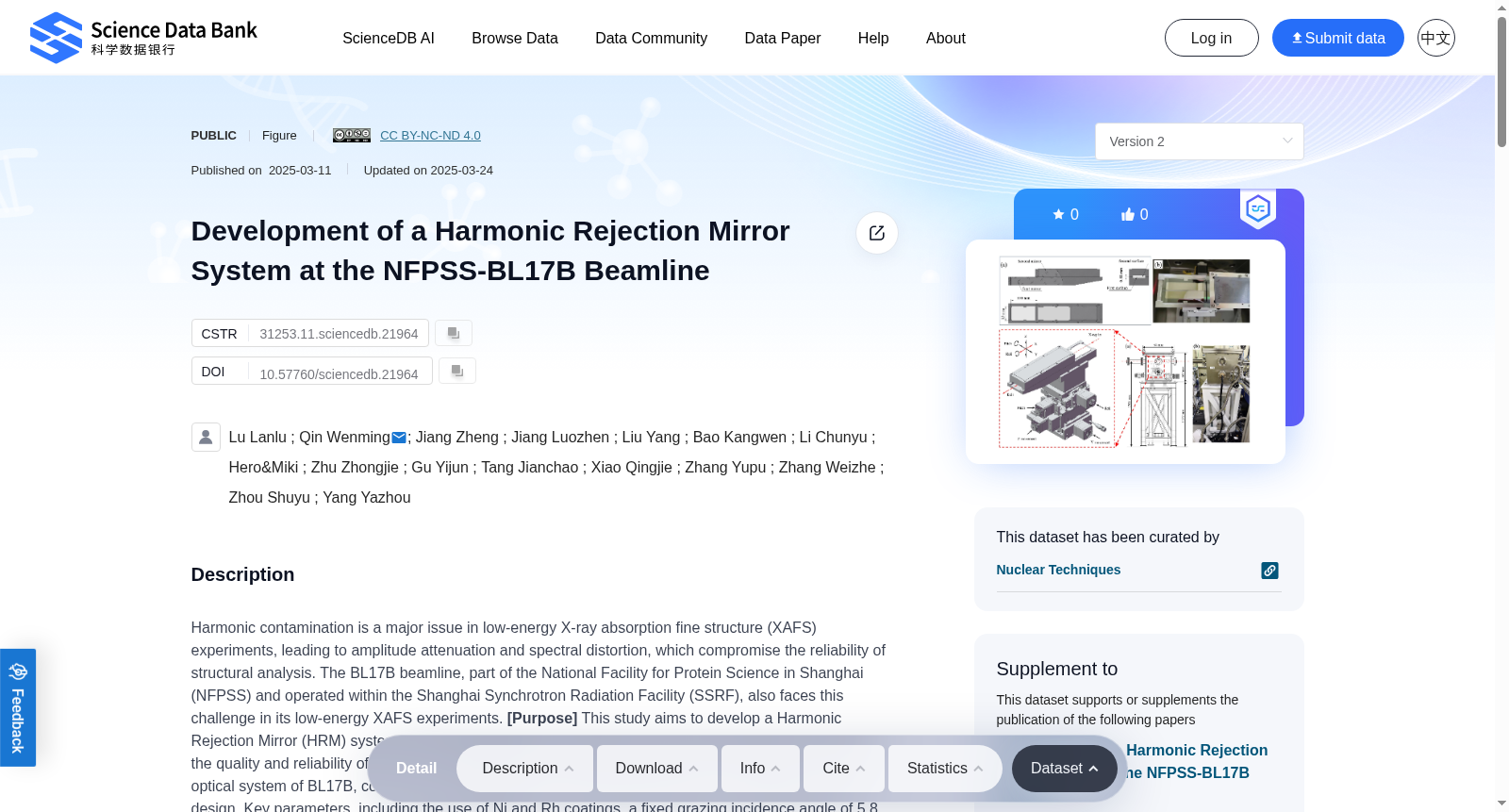
Harmonic contamination is a major issue in low-energy X-ray absorption fine structure (XAFS) experiments, leading to amplitude attenuation and spectral distortion, which compromise the reliability of structural analysis. The BL17B beamline, part of the National Facility for Protein Science in Shanghai (NFPSS) and operated within the Shanghai Synchrotron Radiation Facility (SSRF), also faces this challenge in its low-energy XAFS experiments. [Purpose] This study aims to develop a Harmonic Rejection Mirror (HRM) system tailored to the optical characteristics of the BL17B beamline to improve the quality and reliability of XAFS data. [Methods] First, XOP simulations were conducted to model the optical system of BL17B, confirming the feasibility of the HRM system based on a dual-plane mirror design. Key parameters, including the use of Ni and Rh coatings, a fixed grazing incidence angle of 5.8 mrad, and coating dimensions, were optimized accordingly. Second, a precise mechanical structure was designed, enabling multi-dimensional adjustments, including grazing incidence angle tuning, optical alignment, and coating switching to accommodate different experimental requirements. During installation and commissioning, the total reflection critical energy measurement method was employed to address the challenge of accurate grazing incidence angle control, ensuring the system met design specifications. Finally, the performance of HRM was evaluated using monochromator rocking curve measurements and XAFS experiments. [Results] The HRM effectively suppresses harmonic contamination to below 10−4 in 5–10 keV while maintaining a fundamental beam transmission above 70%. The total reflection critical energy measurement method achieved a grazing incidence angle calibration precision of 0.01 mrad, ensuring that the HRM operates as designed. At 5 keV, the HRM significantly enhanced beam monochromaticity and improved Ti foil XAFS data quality by eliminating spectral distortions. [Conclusions] The implementation of the HRM successfully extended the lower energy limit of XAFS experiments at BL17B from 10 keV to 5 keV, significantly enhancing the capability of low-energy XAFS experiments while providing a valuable technical reference for harmonic suppression in synchrotron radiation sources.
谐波污染是低能X射线吸收精细结构(XAFS)实验中的主要问题,会引发振幅衰减与光谱畸变,进而损害结构分析结果的可靠性。隶属于上海蛋白质科学国家实验设施(NFPSS)且运行于上海同步辐射光源(SSRF)的BL17B光束线,其低能XAFS实验同样面临该挑战。【研究目的】本研究旨在针对BL17B光束线的光学特性定制开发一套谐波抑制镜(HRM)系统,以提升XAFS实验数据的质量与可靠性。【研究方法】首先,通过XOP模拟对BL17B的光学系统进行建模,验证了基于双平面镜设计的HRM系统的可行性,并据此优化了关键参数,包括采用镍(Ni)与铑(Rh)涂层、固定掠入射角为5.8 mrad以及涂层尺寸等。其次,设计了具备多维调节功能的精密机械结构,可实现掠入射角调节、光学对准以及涂层切换以适配不同实验需求。在安装与调试阶段,采用全反射临界能量测量法解决了精准控制掠入射角的难题,确保系统满足设计指标。最后,通过单色仪摇摆曲线测量与XAFS实验对HRM系统的性能进行了评估。【研究结果】HRM可在5~10 keV能量范围内将谐波污染有效抑制至10⁻⁴以下,同时保持基波光束透过率高于70%。全反射临界能量测量法实现了0.01 mrad的掠入射角校准精度,保障HRM按设计要求运行。在5 keV能量下,HRM显著提升了光束单色性,并通过消除光谱畸变改善了钛(Ti)箔的XAFS实验数据质量。【研究结论】HRM系统的成功应用将BL17B光束线XAFS实验的最低能量下限从10 keV拓展至5 keV,大幅提升了其低能XAFS实验能力,同时为同步辐射光源的谐波抑制提供了极具参考价值的技术方案。
提供机构:
Science Data Bank
创建时间:
2025-03-11
搜集汇总
数据集介绍
背景与挑战
背景概述
该数据集涉及BL17B光束线上谐波抑制镜系统的开发,旨在解决低能XAFS实验中的谐波污染问题。通过XOP模拟和精确机械设计,系统成功将谐波污染抑制至10^-4以下,并将XAFS实验的能量下限从10 keV扩展至5 keV。
以上内容由遇见数据集搜集并总结生成



