
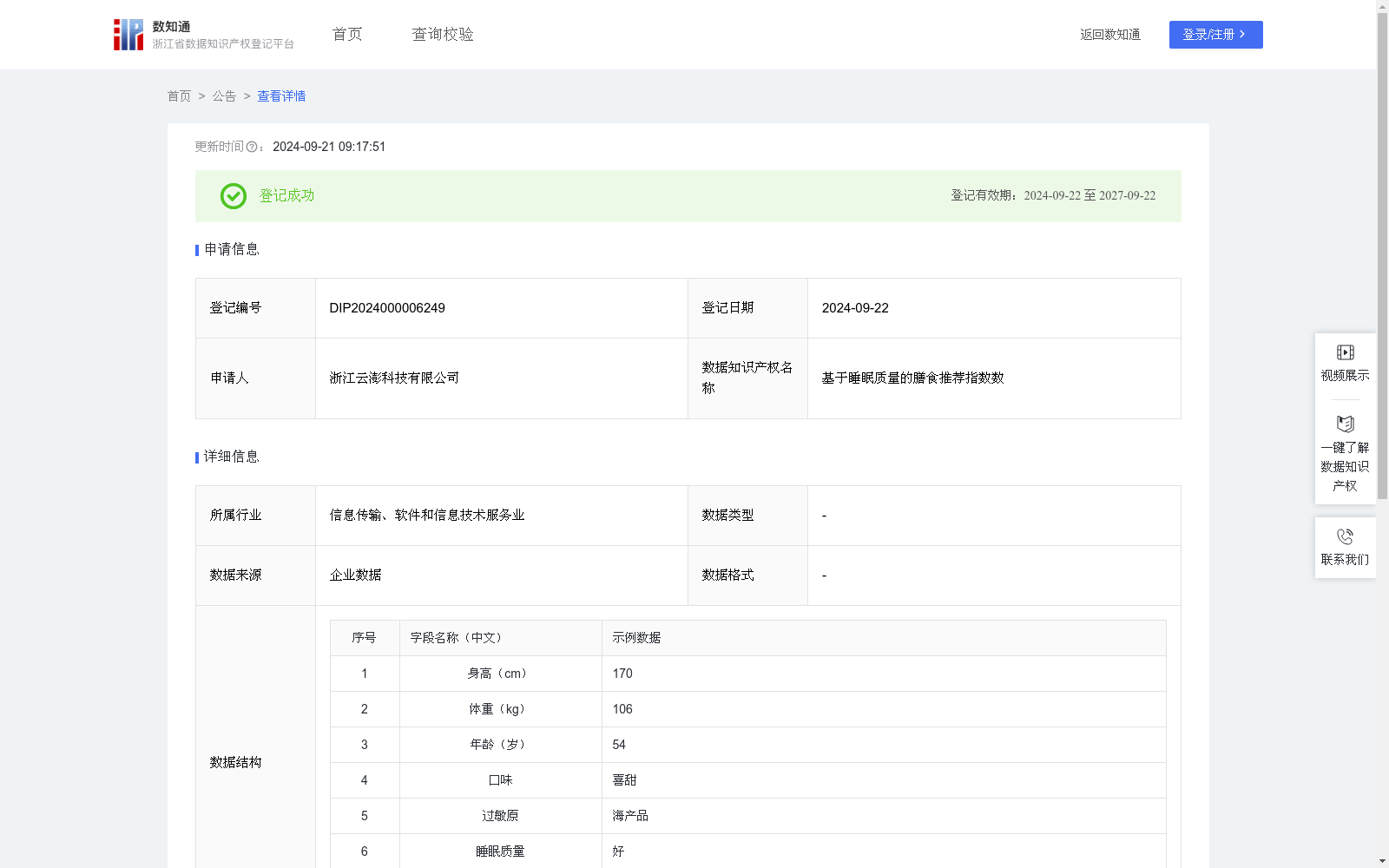
基于睡眠质量的膳食推荐指数数
收藏浙江省数据知识产权登记平台2024-09-21 更新2024-09-22 收录
下载链接:
https://www.zjip.org.cn/home/announce/trends/63586
下载链接
链接失效反馈官方服务:
资源简介:
通过综合分析个人的基础数据,以及持续监测的睡眠质量,利用专有算法计算出个性化的膳食推荐指数,为用户提供科学的饮食建议。
个性化饮食计划:根据该指数了解用户的饮食需求,从而为用户制定出适合的健康饮食计划。
长期跟踪与调整:通过对指数的长期观察,洞察用户饮食习惯的变化,并据此适时为用户调整饮食方案。
健康状况指导:持续监测睡眠质量有助于揭示饮食与健康之间的联系,从而为用户提供更具指导意义的健康饮食建议。
本数据适用于:
养老机构:根据每位老人的身体状况和健康需求,提供定制化的饮食建议。
研究机构:大学、研究所等科研机构可以利用这些数据知识产权进行营养学研究或临床试验。通过本公司睡眠检测产品,对睡眠质量的持续监测,将检测数据预处理后,输入到随机森林模型中,得出膳食推荐指数。
随机森林模型是通过构建多棵决策树并综合其预测结果。每棵决策树会根据身体指标特征重要性和分裂规则,对数据进行逐步的节点分裂,直至达到叶节点。
1.节点分裂:在每个内部节点,决策树根据某个身体指标特征向量及其阈值对数据进行分裂,选择信息增益最大的身体指标特征点和阈值。计算公式为:
Information Gain = H(S) - Σ (v ∈ Values(A)) |S_v| / |S| * H(S_v)
其中,是样本集 S 的熵,A 是特征,是特征 A 取值为时的样本子集。
2.综合多棵决策树的预测结果,最终的膳食推荐指数公式为:
(1/T) * ∑(从 t=1 到 T) y_t^(X)
其中,T是决策树的数量,y是第t棵决策树的预测值。X是输入的身体指标特征向量(身高、体重、年龄、口味偏好、过敏原、睡眠质量)。
This solution calculates a personalized dietary recommendation index via a proprietary algorithm by comprehensively analyzing an individual's basic data and continuously monitored sleep quality, to provide users with evidence-based dietary advice.
Personalized dietary plan: Based on this index, users' dietary needs can be identified, thereby formulating tailored healthy dietary plans for them.
Long-term tracking and adjustment: By long-term monitoring of the index, changes in users' dietary habits can be detected, and the dietary plan can be adjusted timely accordingly.
Health guidance: Continuous monitoring of sleep quality helps reveal the link between diet and health, thus providing users with more instructive dietary and health advice.
This dataset is applicable to:
1. Nursing homes: Provide customized dietary advice based on each elderly person's physical condition and health needs.
2. Research institutions: Universities, research institutes and other scientific research organizations can utilize the data and intellectual property rights to conduct nutritional research or clinical trials.
The dietary recommendation index is derived by preprocessing the sleep quality detection data collected via the company's sleep monitoring products and inputting the preprocessed data into a random forest model.
A random forest model constructs multiple decision trees and integrates their prediction results. Each decision tree performs gradual node splitting on the data based on the feature importance of physical indicators and splitting rules, until reaching leaf nodes.
1. Node splitting: At each internal node, the decision tree splits the data based on a certain physical indicator feature vector and its threshold, selecting the physical indicator feature point and threshold that maximize the information gain. The calculation formula is:
Information Gain = H(S) - Σ (v ∈ Values(A)) |S_v| / |S| * H(S_v)
Where H(S) is the entropy of the sample set S, A is the feature, and S_v is the sample subset where feature A takes the value v.
2. Integrate the prediction results of multiple decision trees, the final dietary recommendation index formula is:
(1/T) * ∑(from t=1 to T) y_t^(X)
Where T is the number of decision trees, y_t is the predicted value of the t-th decision tree, and X is the input physical indicator feature vector (height, weight, age, taste preferences, allergens, sleep quality).
提供机构:
浙江云澎科技有限公司
创建时间:
2024-08-20
搜集汇总
数据集介绍
特点
该数据集包含1001条记录,每日更新,涵盖个人基础数据和睡眠质量信息,通过随机森林模型生成膳食推荐指数,适用于个性化饮食计划和健康研究。
以上内容由遇见数据集搜集并总结生成


