
新疆及中亚邻区成矿图数据集(2022.1-2024.1)
收藏国家青藏高原科学数据中心2024-01-17 更新2024-03-01 收录
下载链接:
https://data.tpdc.ac.cn/zh-hans/data/5e091f95-0441-4d48-a3ca-52602521dcce
下载链接
链接失效反馈官方服务:
资源简介:
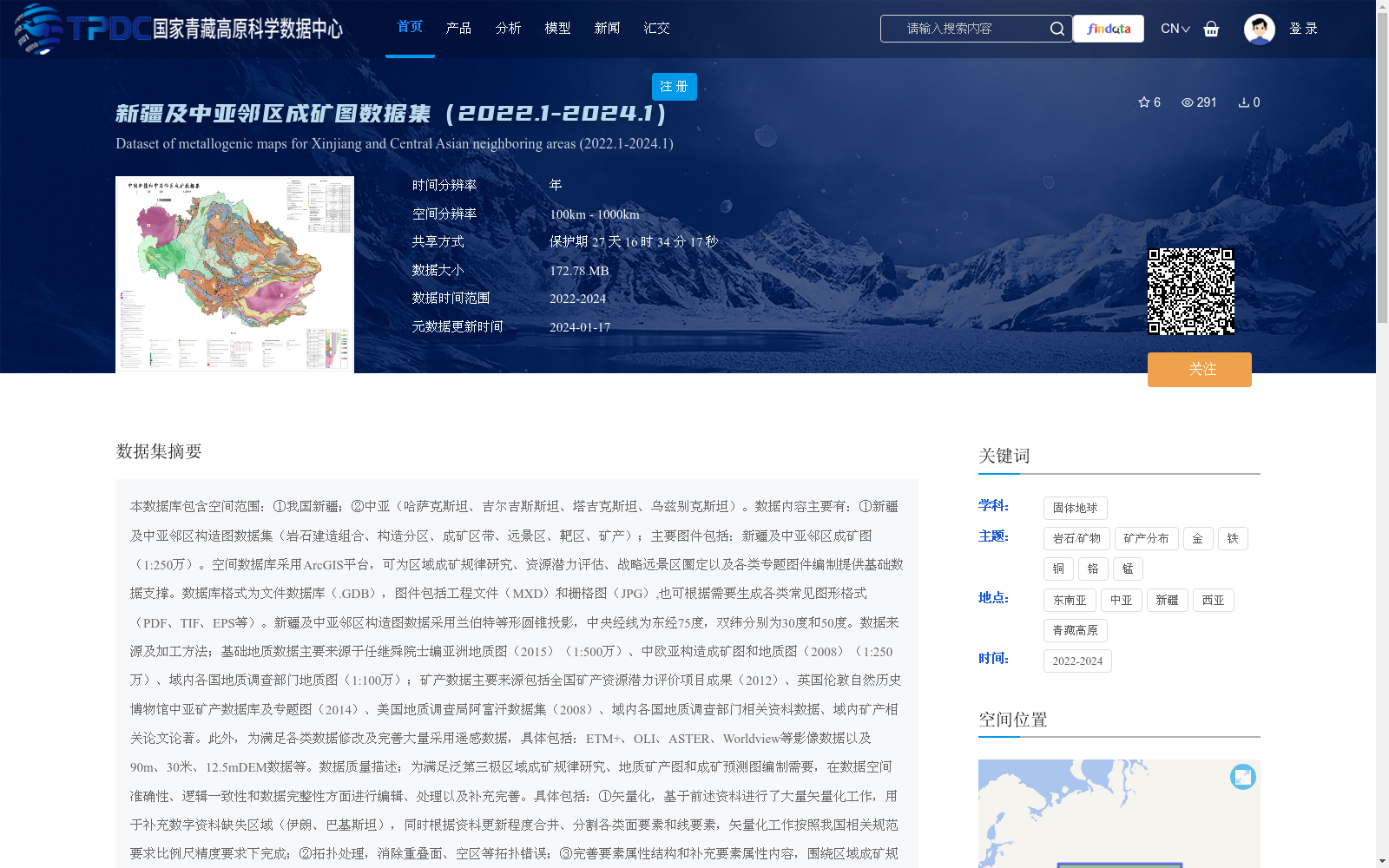
本数据库包含空间范围:①我国新疆;②中亚(哈萨克斯坦、吉尔吉斯斯坦、塔吉克斯坦、乌兹别克斯坦)。数据内容主要有:①新疆及中亚邻区构造图数据集(岩石建造组合、构造分区、成矿区带、远景区、靶区、矿产);主要图件包括:新疆及中亚邻区成矿图(1:250万)。空间数据库采用ArcGIS平台,可为区域成矿规律研究、资源潜力评估、战略远景区圈定以及各类专题图件编制提供基础数据支撑。数据库格式为文件数据库(.GDB),图件包括工程文件(MXD)和栅格图(JPG),也可根据需要生成各类常见图形格式(PDF、TIF、EPS等)。新疆及中亚邻区构造图数据采用兰伯特等形圆锥投影,中央经线为东经75度,双纬分别为30度和50度。数据来源及加工方法;基础地质数据主要来源于任继舜院士编亚洲地质图(2015)(1:500万)、中欧亚构造成矿图和地质图(2008)(1:250万)、域内各国地质调查部门地质图(1:100万);矿产数据主要来源包括全国矿产资源潜力评价项目成果(2012)、英国伦敦自然历史博物馆中亚矿产数据库及专题图(2014)、美国地质调查局阿富汗数据集(2008)、域内各国地质调查部门相关资料数据、域内矿产相关论文论著。此外,为满足各类数据修改及完善大量采用遥感数据,具体包括:ETM+、OLI、ASTER、Worldview等影像数据以及90m、30米、12.5mDEM数据等。数据质量描述;为满足泛第三极区域成矿规律研究、地质矿产图和成矿预测图编制需要,在数据空间准确性、逻辑一致性和数据完整性方面进行编辑、处理以及补充完善。具体包括:①矢量化,基于前述资料进行了大量矢量化工作,用于补充数字资料缺失区域(伊朗、巴基斯坦),同时根据资料更新程度合并、分割各类面要素和线要素,矢量化工作按照我国相关规范要求比例尺精度要求下完成;②拓扑处理,消除重叠面、空区等拓扑错误;③完善要素属性结构和补充要素属性内容,围绕区域成矿规律研究、地质矿产图和成矿预测图编制目标,依据我国相关规范,结合具体资料和数据内容,建立了相应数据模型,完善了地质体、构造、矿产要素类属性结构并完成了相应属性的填写工作;基于以上数据处理内容,结合泛第三极研究成果和最新认识,对区内相关地质内容进行了进一步修改和完善。数据应用成果及前景:新疆及中亚邻区构造图数据集主要服务于泛第三极内新疆及中亚邻区、重要成矿带以及国别区域成矿规律研究、区域成矿预测图编制,比例尺为1:250万(中国新疆-中亚廊带)。
This database covers the following spatial areas: ① Xinjiang, China; ② Central Asia (Kazakhstan, Kyrgyzstan, Tajikistan, Uzbekistan).
The main data contents include: ① Tectonic map dataset of Xinjiang and its adjacent Central Asian regions (including rock assemblages, tectonic divisions, metallogenic belts, prospective areas, target areas, and mineral resources); the main map includes the 1:2,500,000 metallogenic map of Xinjiang and its adjacent Central Asian regions.
The spatial database is developed on the ArcGIS platform, which can provide basic data support for regional metallogenic regularity research, resource potential assessment, strategic prospective area delineation, and compilation of various thematic maps.
The database is stored in File Geodatabase (.GDB) format. The map files include project files (MXD) and raster maps (JPG). Various common graphic formats (PDF, TIF, EPS, etc.) can also be generated as required.
The tectonic map data of Xinjiang and its adjacent Central Asian regions adopts the Lambert Conformal Conic projection, with the central meridian at 75° east longitude, and the two standard parallels at 30° and 50° north latitude respectively.
Data sources and processing methods:
Basic geological data mainly come from the 1:5,000,000 Asian Geological Map compiled by Academician Ren Jishun (2015), the Central Eurasian Tectonic and Metallogenic Map and Geological Map (2008, 1:2,500,000), and geological maps (1:1,000,000) issued by geological survey departments of countries in the region.
Mineral resource data mainly come from the achievements of the National Mineral Resource Potential Assessment Project (2012), the Central Asian Mineral Database and thematic maps of the Natural History Museum, London, UK (2014), the Afghanistan dataset of the U.S. Geological Survey (2008), relevant data from geological survey departments of countries in the region, and academic papers and monographs related to mineral resources in the region.
In addition, a large amount of remote sensing data has been used for data modification and improvement, including ETM+, OLI, ASTER, Worldview image data, as well as 90m, 30m, and 12.5m DEM data.
Data quality description:
To meet the needs of metallogenic regularity research, geological and mineral maps, and metallogenic prediction map compilation in the Pan-third Pole region, editing, processing, and supplementary improvements have been carried out in terms of spatial accuracy, logical consistency, and data integrity. The specific work includes:
① Vectorization: A large number of vectorization tasks were conducted based on the aforementioned data to supplement the missing digital data in regions such as Iran and Pakistan. Meanwhile, various polygon and line features were merged and split according to the update degree of the data. The vectorization work was completed in accordance with the scale accuracy requirements of relevant Chinese specifications.
② Topology processing: Eliminate topological errors such as overlapping polygons and void areas.
③ Improvement of feature attribute structure and supplementary attribute content: Centering on the goals of regional metallogenic regularity research, geological and mineral maps, and metallogenic prediction map compilation, and in line with relevant Chinese specifications, combined with specific data and contents, a corresponding data model was established, the attribute structures of geological body, tectonic, and mineral feature classes were improved, and the corresponding attribute filling work was completed.
Based on the above data processing contents, combined with the research results and latest understandings of the Pan-third Pole region, relevant geological contents in the region have been further modified and improved.
Data application achievements and prospects:
The tectonic map dataset of Xinjiang and its adjacent Central Asian regions mainly serves the metallogenic regularity research and compilation of regional metallogenic prediction maps of Xinjiang and its adjacent Central Asian regions, important metallogenic belts, and national-level regions within the Pan-third Pole region, with a scale of 1:2,500,000 (China Xinjiang-Central Asia Corridor Zone).
提供机构:
刘琰
创建时间:
2024-01-17
搜集汇总
数据集介绍
背景与挑战
背景概述
该数据集是一个关于新疆及中亚邻区成矿图的空间数据库,时间范围为2022年至2024年,比例尺为1:250万,数据格式包括ArcGIS文件数据库和栅格图。数据集整合了多源地质和矿产数据,经过矢量化、拓扑处理等质量控制,主要用于区域成矿规律研究、资源潜力评估和成矿预测图编制,服务于泛第三极环境与绿色丝绸之路建设相关科研项目。
以上内容由遇见数据集搜集并总结生成


