electricsheepasia/asia-ilo-eip-teip-sex-edu-nb-persons-outside-the-labour-force-by-sex-and-educat
收藏资源简介:
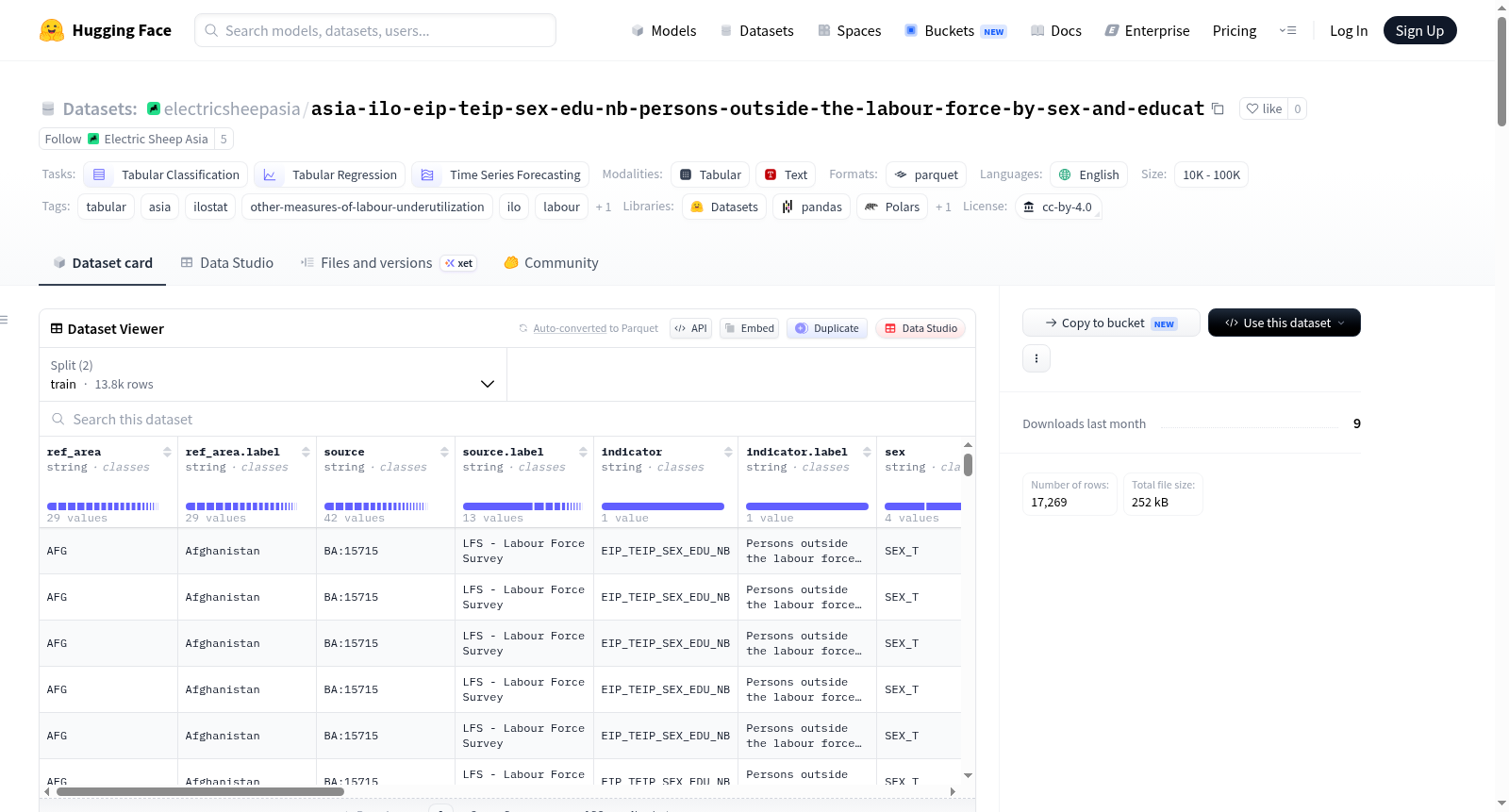
--- license: cc-by-4.0 language: - en task_categories: - tabular-classification - tabular-regression - time-series-forecasting multilinguality: monolingual size_categories: - 10K<n<100K tags: - tabular - asia - ilostat - other-measures-of-labour-underutilization - ilo - labour - employment pretty_name: "Persons outside the labour force by sex and education (thousands) | Asia (ILOSTAT)" --- # Persons outside the labour force by sex and education (thousands) | Asia (ILOSTAT) 🌏 **17,269 observations** · **38 Asia countries** · **1970–2025** · *Repackaged by [Electric Sheep Asia](https://huggingface.co/electricsheepasia)*      ## TL;DR This dataset contains **17,269 observations** of `Other measures of labour underutilization` data across **38 Asia countries**, spanning **1970–2025**, covering **1 distinct indicators**. ## About the source **ILOSTAT** is the ILO's central statistics database, the leading global source for labour statistics. It compiles indicators across employment, unemployment, wages, working time, child labour, informal economy, social protection, occupational injuries, and SDG decent work targets — drawing on national labour force surveys, household income surveys, establishment surveys, and administrative records. Coverage spans 200+ economies, with the ILO's Department of Statistics responsible for harmonisation. - **Source:** [ILOSTAT](https://www.ilo.org/shinyapps/bulkexplorer/?id=EIP_TEIP_SEX_EDU_NB) - **Publisher:** International Labour Organization (ILO) - **License:** [cc-by-4.0](https://creativecommons.org/licenses/by/4.0/) - **Topic:** Other measures of labour underutilization ## Methodology Data pulled directly from the ILOSTAT REST API at `https://rplumber.ilo.org/data/indicator?id=EIP_TEIP_SEX_EDU_NB` and filtered to Asia ISO3 country codes. ILOSTAT harmonises raw survey microdata using ICLS (International Conference of Labour Statisticians) definitions; sources are flagged in the `source.label` column for traceability. ## Geographic coverage 38 Asia countries · top rows shown below, sorted by row count: | Country | Rows | First year | Last year | |---------|-----:|-----------:|----------:| | `IDN` | 1,245 | 1990 | 2023 | | `PSE` | 1,102 | 2000 | 2025 | | `CYP` | 1,069 | 1999 | 2024 | | `IRN` | 1,032 | 2005 | 2024 | | `KOR` | 996 | 2000 | 2025 | | `KHM` | 896 | 1996 | 2023 | | `TUR` | 882 | 2000 | 2024 | | `MNG` | 779 | 2003 | 2024 | | `PAK` | 732 | 2005 | 2025 | | `VNM` | 721 | 2010 | 2024 | | `THA` | 713 | 2000 | 2024 | | `ARM` | 692 | 2001 | 2023 | | `GEO` | 691 | 2009 | 2024 | | `ISR` | 624 | 2012 | 2024 | | `IND` | 624 | 1994 | 2025 | | ... | _23 more countries_ | | | ## Indicators (sample) - `EIP_TEIP_SEX_EDU_NB` — Persons outside the labour force by sex and education (thousands) ## Schema | Column | Type | Description | Example | |--------|------|-------------|---------| | `ref_area` | `string` | ISO 3166-1 alpha-3 country code | `AFG` | | `ref_area.label` | `string` | Country name in English | `Afghanistan` | | `source` | `string` | ILOSTAT source code (e.g. labour force survey) | `BA:15715` | | `source.label` | `string` | Source name in English | `LFS - Labour Force Survey` | | `indicator` | `string` | ILOSTAT indicator code | `EIP_TEIP_SEX_EDU_NB` | | `indicator.label` | `string` | Indicator name in English | `Persons outside the labour force by s…` | | `sex` | `string` | Disaggregation by sex (SEX_T = total, SEX_M = male, SEX_F = female) | `SEX_T` | | `sex.label` | `string` | — | `Total` | | `classif1` | `string` | First classification variable (age, education, status, etc.) | `EDU_AGGREGATE_TOTAL` | | `classif1.label` | `string` | — | `Education (Aggregate levels): Total` | | `time` | `int64` | Observation year | `2021` | | `obs_value` | `float64` | Observed indicator value (unit varies — see indicator definition) | `8230.246` | | `obs_status` | `string` | Observation status flag (e.g. provisional, unreliable) | `B` | | `obs_status.label` | `string` | — | `Break in series` | | `note_classif` | `string` | — | `C3:2620` | | `note_classif.label` | `string` | — | `Nonstandard education level: Includin…` | | `note_indicator` | `string` | — | `I11:264` | | `note_indicator.label` | `string` | — | `Break in series: Methodology revised` | | `note_source` | `string` | — | `R1:3513_S3:8` | | `note_source.label` | `string` | — | `Repository: ILO-STATISTICS - Micro da…` | ## Disaggregation dimensions The following columns provide disaggregation dimensions: - **`sex`** (4 unique values): `SEX_T`, `SEX_M`, `SEX_F`, `SEX_O` ## Data quality & caveats - Data is annual frequency. Some indicators also publish monthly or quarterly series — those are not included here. - When an indicator has multiple sources for the same country×year, the ILO-selected 'best source' is used. - Disaggregation columns (`sex`, `classif1`, `classif2`) are non-null only when the indicator publishes that breakdown. ## Usage ```python from datasets import load_dataset ds = load_dataset("electricsheepasia/asia-ilo-eip-teip-sex-edu-nb-persons-outside-the-labour-force-by-sex-and-educat") df = ds["train"].to_pandas() print(df.head()) ``` ### Filter to one country ```python indonesia = df[df["ref_area"] == "IDN"] ``` ### Time-series for a single indicator ```python sample = (df[df["indicator"] == "EIP_TEIP_SEX_EDU_NB"] .sort_values("time")) sample.plot(x="time", y="obs_value", title="EIP_TEIP_SEX_EDU_NB") ``` ### Pivot to country × year matrix ```python matrix = (df[df["indicator"] == "EIP_TEIP_SEX_EDU_NB"] .pivot_table(index="time", columns="ref_area", values="obs_value")) print(matrix.tail()) ``` ## Citation ```bibtex @misc{asia_ilo_eip_teip_sex_edu_nb_persons_outside_the_labour_force_by_sex_and_educat_2025, title = {Persons outside the labour force by sex and education (thousands) | Asia (ILOSTAT)}, author = {International Labour Organization (ILO)}, year = {2025}, url = {https://www.ilo.org/shinyapps/bulkexplorer/?id=EIP_TEIP_SEX_EDU_NB}, publisher = {HuggingFace Datasets, repackaged by Electric Sheep Asia}, howpublished = {\url{https://huggingface.co/datasets/electricsheepasia/asia-ilo-eip-teip-sex-edu-nb-persons-outside-the-labour-force-by-sex-and-educat}} } ``` ## License Released under [cc-by-4.0](https://creativecommons.org/licenses/by/4.0/). Original data © International Labour Organization (ILO). When using this dataset, please cite both the original source above and the Electric Sheep Asia repackaging. ## About Electric Sheep Electric Sheep Asia is part of the Electric Sheep mission: a unified, ML-ready data layer for Asia on HuggingFace. We pull data from authoritative open sources, normalize the schemas, package as Parquet, and publish with consistent dataset cards so researchers and developers can use `load_dataset()` to start working in seconds. Browse the full collection: [huggingface.co/electricsheepasia](https://huggingface.co/electricsheepasia) --- _Provenance: ingested 2026-05-27 via the Electric Sheep pipeline. Source URL: https://www.ilo.org/shinyapps/bulkexplorer/?id=EIP_TEIP_SEX_EDU_NB_
license: cc-by-4.0 language: - en task_categories: - tabular-classification - tabular-regression - time-series-forecasting multilinguality: monolingual size_categories: - 10K<n<100K tags: - tabular - 亚洲 - ILOSTAT - 劳动力未充分利用其他衡量指标 - 国际劳工组织(ILO) - 劳动力 - 就业 pretty_name: "按性别与教育程度划分的非劳动力人口(千人) | 亚洲(ILOSTAT)" --- # 按性别与教育程度划分的非劳动力人口(千人) | 亚洲(ILOSTAT) 🌏 **17,269条观测** · **38个亚洲国家** · **1970–2025年** · *由[Electric Sheep Asia](https://huggingface.co/electricsheepasia)重新封装*      ## TL;DR 本数据集包含覆盖38个亚洲国家、时间跨度为1970–2025年的**17,269条“劳动力未充分利用其他衡量指标”**观测数据,仅涉及1项独立指标。 ## 关于数据源 **国际劳工组织统计数据库(ILOSTAT)**是国际劳工组织(ILO)的核心统计数据库,也是全球领先的劳动力统计权威来源。该库整合了就业、失业、工资、工作时长、童工、非正规经济、社会保障、职业伤害以及可持续发展目标(Sustainable Development Goals, SDG)体面工作目标等各类指标,数据来源涵盖全国劳动力调查、家庭收入调查、机构调查与行政记录。其覆盖超过200个经济体,由国际劳工组织统计司负责数据的标准化协调。 - **数据来源**:[ILOSTAT](https://www.ilo.org/shinyapps/bulkexplorer/?id=EIP_TEIP_SEX_EDU_NB) - **发布方**:国际劳工组织(ILO) - **许可证**:[cc-by-4.0](https://creativecommons.org/licenses/by/4.0/) - **主题**:劳动力未充分利用其他衡量指标 ## 数据处理方法 本数据集直接从ILOSTAT的REST API接口`https://rplumber.ilo.org/data/indicator?id=EIP_TEIP_SEX_EDU_NB`拉取数据,并筛选出亚洲地区的ISO3国家代码。ILOSTAT依据国际劳工统计学家会议(International Conference of Labour Statisticians, ICLS)的定义对原始调查微观数据进行标准化协调;数据来源信息会在`source.label`字段中标记,以保证可追溯性。 ## 地理覆盖范围 38个亚洲国家 · 以下按数据行数排序展示前10个国家: | 国家 | 行数 | 首年 | 末年 | |---------|-----:|-----------:|----------:| | `IDN` | 1,245 | 1990 | 2023 | | `PSE` | 1,102 | 2000 | 2025 | | `CYP` | 1,069 | 1999 | 2024 | | `IRN` | 1,032 | 2005 | 2024 | | `KOR` | 996 | 2000 | 2025 | | `KHM` | 896 | 1996 | 2023 | | `TUR` | 882 | 2000 | 2024 | | `MNG` | 779 | 2003 | 2024 | | `PAK` | 732 | 2005 | 2025 | | `VNM` | 721 | 2010 | 2024 | | `THA` | 713 | 2000 | 2024 | | `ARM` | 692 | 2001 | 2023 | | `GEO` | 691 | 2009 | 2024 | | `ISR` | 624 | 2012 | 2024 | | `IND` | 624 | 1994 | 2025 | | ... | 其余23个国家 | | | ## 指标(示例) - `EIP_TEIP_SEX_EDU_NB` — 按性别与教育程度划分的非劳动力人口(千人) ## 数据结构 | 字段名 | 数据类型 | 字段说明 | 示例 | |--------|------|-------------|---------| | `ref_area` | `string` | ISO 3166-1 alpha-3 国家代码 | `AFG` | | `ref_area.label` | `string` | 英文国家名称 | `Afghanistan` | | `source` | `string` | ILOSTAT 来源代码(如劳动力调查) | `BA:15715` | | `source.label` | `string` | 英文来源名称 | `LFS - 劳动力调查` | | `indicator` | `string` | ILOSTAT 指标代码 | `EIP_TEIP_SEX_EDU_NB` | | `indicator.label` | `string` | 英文指标名称 | `Persons outside the labour force by s…` | | `sex` | `string` | 性别细分维度(SEX_T=总计,SEX_M=男性,SEX_F=女性) | `SEX_T` | | `sex.label` | `string` | — | `总计` | | `classif1` | `string` | 第一分类变量(年龄、教育程度、身份等) | `EDU_AGGREGATE_TOTAL` | | `classif1.label` | `string` | — | `教育程度(汇总级别):总计` | | `time` | `int64` | 观测年份 | `2021` | | `obs_value` | `float64` | 观测指标值(单位详见指标定义) | `8230.246` | | `obs_status` | `string` | 观测状态标记(如临时数据、不可靠数据) | `B` | | `obs_status.label` | `string` | — | `序列中断` | | `note_classif` | `string` | — | `C3:2620` | | `note_classif.label` | `string` | — | `非标准教育水平:包含…` | | `note_indicator` | `string` | — | `I11:264` | | `note_indicator.label` | `string` | — | `序列中断:方法学修订` | | `note_source` | `string` | — | `R1:3513_S3:8` | | `note_source.label` | `string` | — | `存储库:ILO统计数据库 - 微观数据…` | ## 细分维度 以下字段提供数据细分维度: - **`sex`**(共4个唯一取值):`SEX_T`、`SEX_M`、`SEX_F`、`SEX_O` ## 数据质量与注意事项 - 本数据集为年度频率数据。部分指标同时发布月度或季度序列,但未纳入本数据集。 - 当同一国家×年份的同一指标存在多个来源时,将采用国际劳工组织选定的“最优来源”数据。 - 细分字段(`sex`、`classif1`、`classif2`)仅在指标支持对应细分时才会非空。 ## 使用示例 python from datasets import load_dataset ds = load_dataset("electricsheepasia/asia-ilo-eip-teip-sex-edu-nb-persons-outside-the-labour-force-by-sex-and-educat") df = ds["train"].to_pandas() print(df.head()) ### 筛选单个国家 python indonesia = df[df["ref_area"] == "IDN"] ### 单个指标的时间序列数据 python sample = (df[df["indicator"] == "EIP_TEIP_SEX_EDU_NB"] .sort_values("time")) sample.plot(x="time", y="obs_value", title="EIP_TEIP_SEX_EDU_NB") ### 转换为国家×年份矩阵 python matrix = (df[df["indicator"] == "EIP_TEIP_SEX_EDU_NB"] .pivot_table(index="time", columns="ref_area", values="obs_value")) print(matrix.tail()) ## 引用格式 bibtex @misc{asia_ilo_eip_teip_sex_edu_nb_persons_outside_the_labour_force_by_sex_and_educat_2025, title = {按性别与教育程度划分的非劳动力人口(千人) | 亚洲(ILOSTAT)}, author = {国际劳工组织(ILO)}, year = {2025}, url = {https://www.ilo.org/shinyapps/bulkexplorer/?id=EIP_TEIP_SEX_EDU_NB}, publisher = {HuggingFace数据集,由Electric Sheep Asia重新封装}, howpublished = {url{https://huggingface.co/datasets/electricsheepasia/asia-ilo-eip-teip-sex-edu-nb-persons-outside-the-labour-force-by-sex-and-educat}} } ## 许可证 本数据集采用[cc-by-4.0](https://creativecommons.org/licenses/by/4.0/)许可证发布。 原始数据版权归国际劳工组织(ILO)所有。使用本数据集时,请同时引用上述原始来源与Electric Sheep Asia的重新封装版本。 ## 关于Electric Sheep Electric Sheep是Electric Sheep使命的一部分:旨在为HuggingFace平台上的亚洲地区数据构建统一的、适配机器学习的标准化数据层。我们从权威开源数据源获取数据,对schema进行规范化处理,打包为Parquet格式,并发布为格式统一的数据集卡片,使研究人员与开发者仅需通过`load_dataset()`即可在数秒内开始使用数据。 浏览完整数据集集合:[huggingface.co/electricsheepasia](https://huggingface.co/electricsheepasia) --- _数据溯源:2026-05-27通过Electric Sheep管道摄入。源URL:https://www.ilo.org/shinyapps/bulkexplorer/?id=EIP_TEIP_SEX_EDU_NB_