
低功耗SoC设计实验数据
收藏浙江省数据知识产权登记平台2025-07-25 更新2025-07-26 收录
下载链接:
https://www.zjip.org.cn/home/announce/trends/154626
下载链接
链接失效反馈官方服务:
资源简介:
本实验数据及算法适用于低功耗 SoC 设计与优化,涵盖物联网(IoT)、边缘 AI 计算、智能移动设备、汽车电子、工业自动化、低功耗无线通信等场景,重点评估计算性能、能效比和功耗优化。适用于嵌入式工程师、芯片架构师、算法工程师、无线通信工程师等技术人员,帮助优化AI 计算单元、协议控制器、无线通信模块、工业控制芯片的功耗表现,提高设备续航能力。特别适用于低功耗 AI 计算、BLE/Wi-Fi 低功耗优化、车载 SoC 功耗优化等应用,确保芯片设计在低功耗环境下仍具备高效计算能力。然而,本数据不适用于高性能计算(HPC)、桌面级 CPU/GPU 评估、军用/航天级 SoC 设计等高功耗场景。通过本实验数据,可精准评估 SoC 方案的功耗优化效果,为低功耗芯片设计提供量化支持。本实验数据的处理与建模采用低功耗优化建模 + 多因子评分机制,通过数据生成、功耗优化计算、综合效能评分等步骤构建完整的低功耗 SoC 评估体系。首先,依据真实芯片设计参数范围(时钟频率、逻辑单元、触发器、功耗)生成数据,并模拟不同 SoC 设计方案。其次,基于DVFS、电源门控、时钟门控等低功耗优化策略计算优化后功耗,并据此计算降功耗比,衡量优化效果。随后,采用计算性能、能效比、资源利用率三大维度构建评分模型,综合效能评分=(时钟频率/功耗优化后总功耗)的0.5方乘以降功耗比的1.5方乘以(逻辑单元/触发器)的0.5方。最终,数据经过异常筛选和验证,生成可用于芯片设计方案优化和比较的完整评分数据表,确保低功耗 SoC 设计的能效评估精准可靠。
This experimental data and algorithm are applicable to low-power System-on-Chip (SoC) design and optimization, covering scenarios such as Internet of Things (IoT), edge AI computing, smart mobile devices, automotive electronics, industrial automation, and low-power wireless communications. It focuses on evaluating computing performance, energy efficiency, and power optimization.
It is suitable for technical personnel including embedded engineers, chip architects, algorithm engineers, and wireless communication engineers, helping optimize the power consumption of AI computing units, protocol controllers, wireless communication modules, and industrial control chips, and improving the battery life of devices. It is particularly applicable to applications such as low-power AI computing, Bluetooth Low Energy (BLE)/Wi-Fi low-power optimization, and automotive SoC power optimization, ensuring that chip designs still possess efficient computing capabilities in low-power environments.
However, this data is not applicable to high-power scenarios such as High Performance Computing (HPC), desktop CPU/GPU evaluation, and military/aerospace-grade SoC design.
Through this experimental data, the power optimization effect of SoC solutions can be accurately evaluated, providing quantitative support for low-power chip design.
The processing and modeling of this experimental data adopt a low-power optimization modeling + multi-factor scoring mechanism, and a complete low-power SoC evaluation system is constructed through steps such as data generation, power optimization calculation, and comprehensive efficiency scoring.
First, data is generated based on the parameter ranges of real chip designs (clock frequency, logic cells, flip-flops, power consumption), and different SoC design solutions are simulated. Second, the post-optimization power consumption is calculated based on low-power optimization strategies such as Dynamic Voltage and Frequency Scaling (DVFS), power gating, and clock gating, and the power reduction ratio is calculated accordingly to measure the optimization effect. Subsequently, a scoring model is built using three dimensions: computing performance, energy efficiency, and resource utilization rate. The comprehensive efficiency score is calculated as: (clock frequency / total post-power-optimization power consumption)^0.5 × (power reduction ratio)^1.5 × (logic cells / flip-flops)^0.5. Finally, after outlier filtering and validation, the complete scoring data table applicable to the optimization and comparison of chip design solutions is generated, ensuring accurate and reliable energy efficiency evaluation for low-power SoC designs.
提供机构:
杭州重红科技有限公司
创建时间:
2025-03-14
搜集汇总
数据集介绍
背景与挑战
背景概述
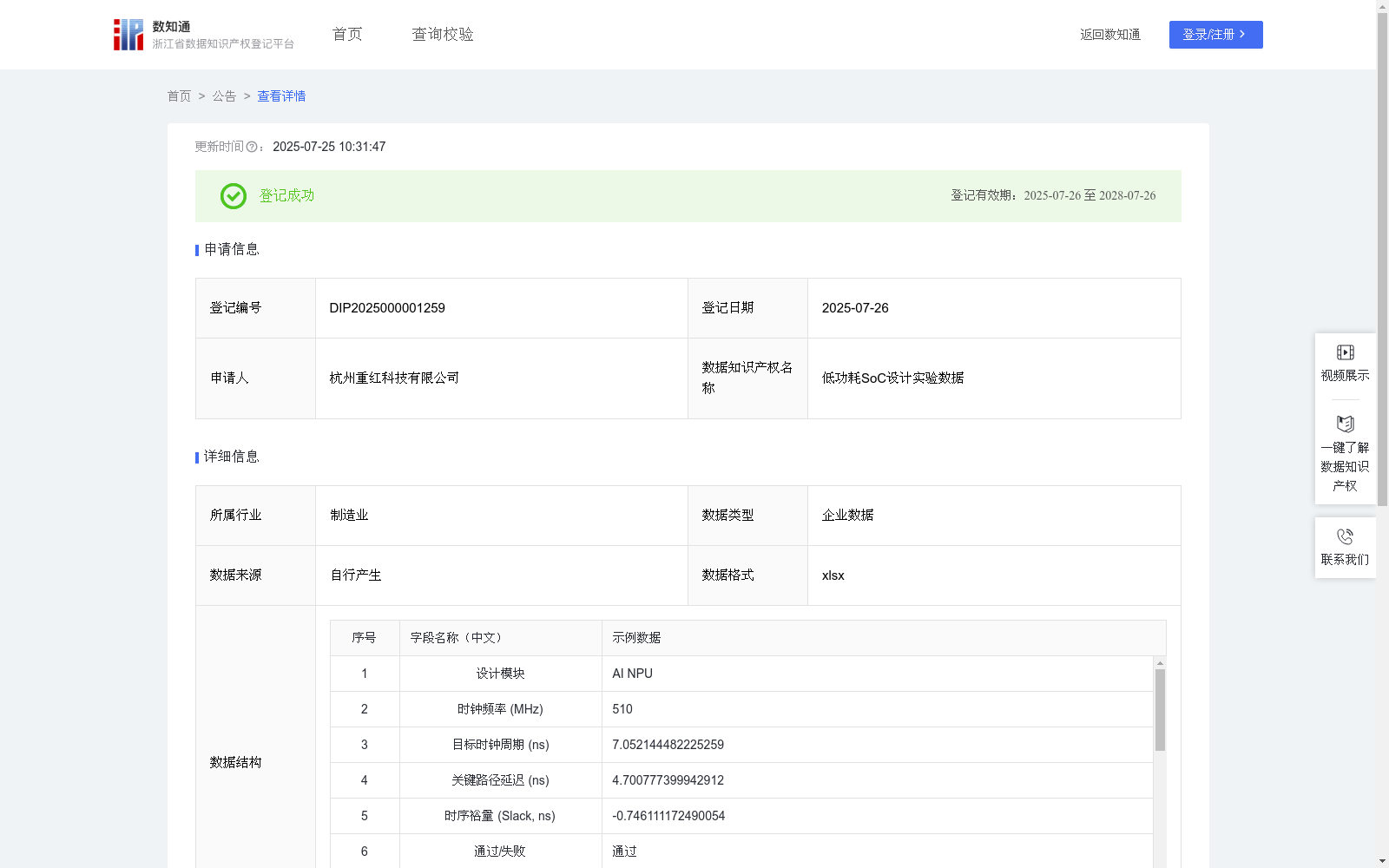
该数据集包含653条低功耗SoC设计实验数据,涵盖设计模块、时钟频率、功耗等18个字段,适用于物联网、边缘AI计算等低功耗场景的优化设计。数据采用低功耗优化建模和多因子评分机制进行处理,为芯片设计提供量化支持。
以上内容由遇见数据集搜集并总结生成


