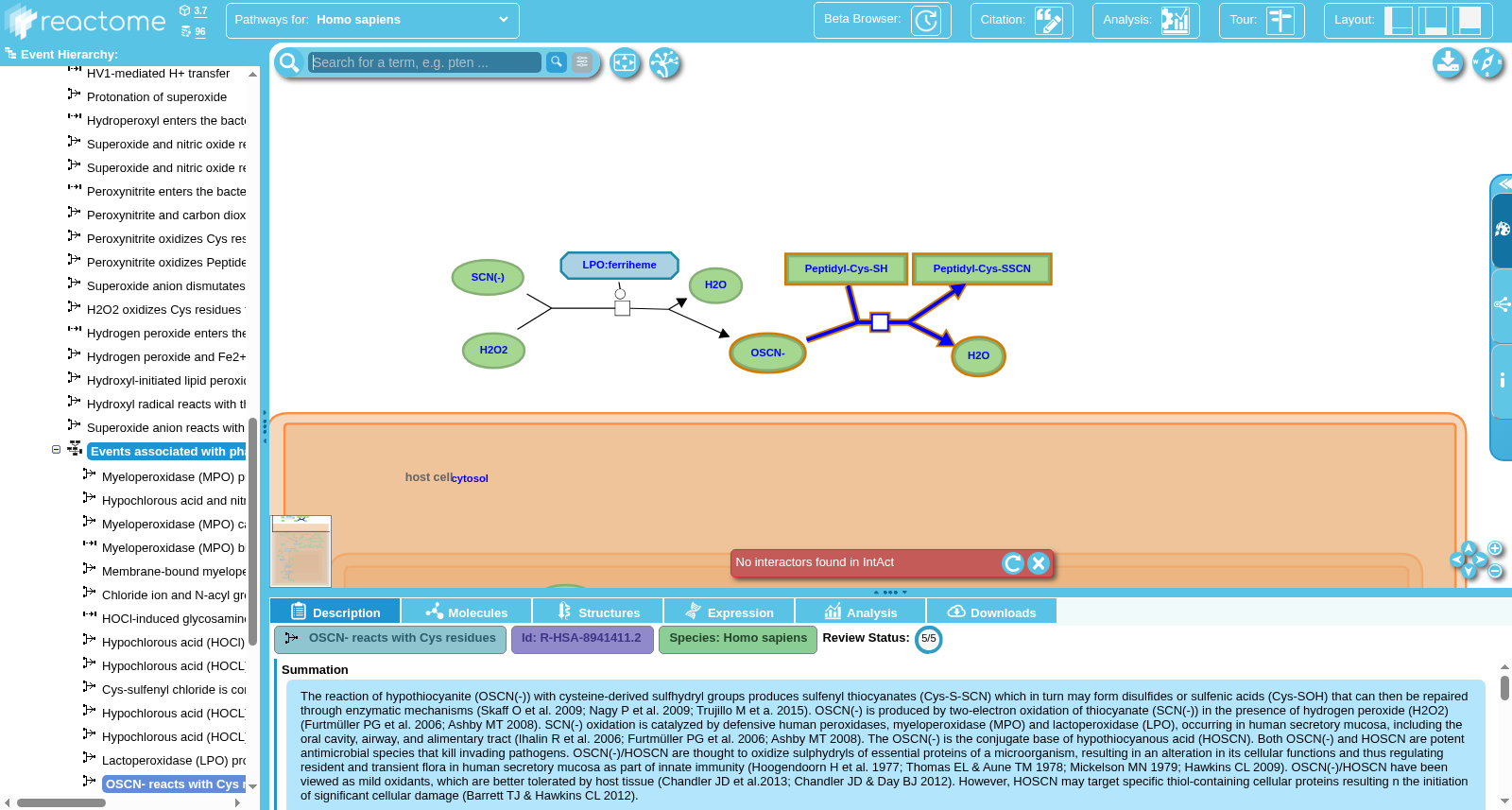
OSCN- reacts with Cys residues
收藏资源简介:
The reaction of hypothiocyanite (OSCN(-)) with cysteine-derived sulfhydryl groups produces sulfenyl thiocyanates (Cys-S-SCN) which in turn may form disulfides or sulfenic acids (Cys-SOH) that can then be repaired through enzymatic mechanisms (Skaff O et al. 2009; Nagy P et al. 2009; Trujillo M et a. 2015). OSCN(-) is produced by two-electron oxidation of thiocyanate (SCN(-)) in the presence of hydrogen peroxide (H2O2) (Furtmüller PG et al. 2006; Ashby MT 2008). SCN(-) oxidation is catalyzed by defensive human peroxidases, myeloperoxidase (MPO) and lactoperoxidase (LPO), occurring in human secretory mucosa, including the oral cavity, airway, and alimentary tract (Ihalin R et al. 2006; Furtmüller PG et al. 2006; Ashby MT 2008). The OSCN(-) is the conjugate base of hypothiocyanous acid (HOSCN). Both OSCN(-) and HOSCN are potent antimicrobial species that kill invading pathogens. OSCN(-)/HOSCN are thought to oxidize sulphydryls of essential proteins of a microorganism, resulting in an alteration in its cellular functions and thus regulating resident and transient flora in human secretory mucosa as part of innate immunity (Hoogendoorn H et al. 1977; Thomas EL & Aune TM 1978; Mickelson MN 1979; Hawkins CL 2009). OSCN(-)/HOSCN have been viewed as mild oxidants, which are better tolerated by host tissue (Chandler JD et al.2013; Chandler JD & Day BJ 2012). However, HOSCN may target specific thiol-containing cellular proteins resulting n the initiation of significant cellular damage (Barrett TJ & Hawkins CL 2012).
硫氰酸氢根离子(OSCN(-))与半胱氨酸衍生的硫醇基团反应,生成亚砜硫氰酸酯(Cys-S-SCN),这些亚砜硫氰酸酯进而可能形成二硫键或亚磺酸(Cys-SOH),随后可通过酶促机制进行修复(Skaff O 等人,2009;Nagy P 等人,2009;Trujillo M 等人,2015)。OSCN(-)是在过氧化氢(H2O2)存在下,通过硫氰酸根离子(SCN(-))的双电子氧化而产生(Furtmüller PG 等人,2006;Ashby MT,2008)。SCN(-)的氧化反应由防御性人过氧化物酶,如髓过氧化物酶(MPO)和乳过氧化物酶(LPO)催化,这些酶存在于人体的分泌性黏膜中,包括口腔、呼吸道和消化系统(Ihalin R 等人,2006;Furtmüller PG 等人,2006;Ashby MT,2008)。OSCN(-)是硫氰酸氢(HOSCN)的共轭碱。OSCN(-)和HOSCN均为强效的抗菌物质,能够杀死入侵的病原体。据信,OSCN(-)/HOSCN能氧化微生物关键蛋白中的硫醇,从而改变其细胞功能,并在人体分泌性黏膜中调节常驻和暂时性菌群,作为先天免疫的一部分(Hoogendoorn H 等人,1977;Thomas EL & Aune TM,1978;Mickelson MN,1979;Hawkins CL,2009)。OSCN(-)/HOSCN被视为温和的氧化剂,对宿主组织耐受性较好(Chandler JD 等人,2013;Chandler JD & Day BJ,2012)。然而,HOSCN可能靶向特定的含硫醇的细胞蛋白,从而启动显著的细胞损伤(Barrett TJ & Hawkins CL,2012)。