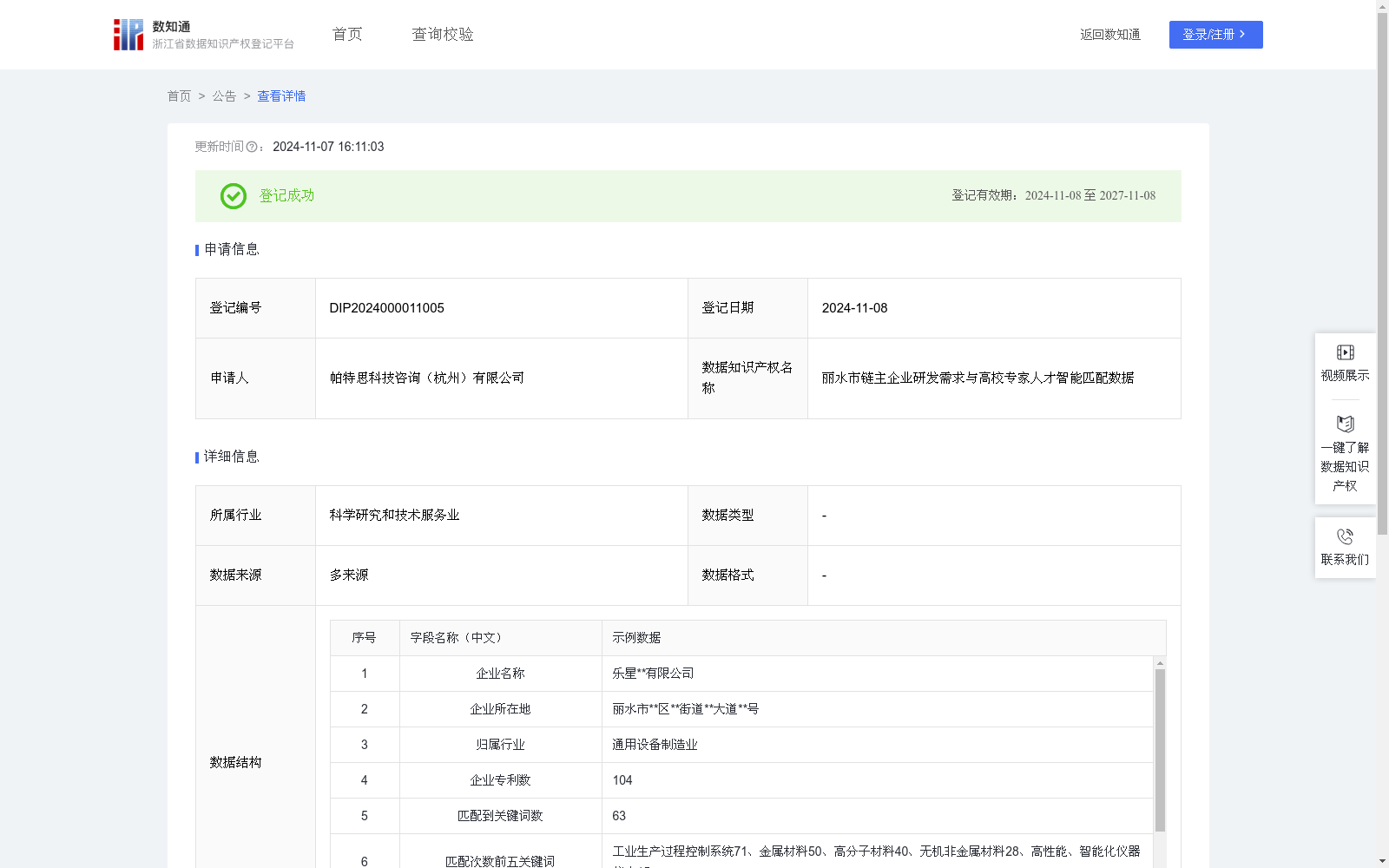
丽水市链主企业研发需求与高校专家人才智能匹配数据
收藏资源简介:
适用范围:丽水市链主企业 1.主动挖掘企业技术需求:可以根据自身技术研发,主动挖掘企业下一步的技术需求。 2.为企业匹配技术专家:解决链主企业和高校人才之间的匹配问题,帮助企业找对应的技术专家。 3.选择技术方向:匹配高校专家,深入企业调研,协助企业确定技术方向。 4.促成企业产学研合作:为有需要借助外力研发的企业提供渠道,促进链主企业的产学研合作。 5.创建高校科技成果转化。为高校老师链接有需求的企业,促进科技成果转化。1.采集企业专利数据(发明专利、发明授权、实用新型专利、外观设计专利) 2.进行专利数据清洗,并根据内部系统的技术分类为专利加标签,采用技术分类关键词匹配专利描述,将每个匹配到的关键词自动添加为企业技术标签 3.计算专利标签集中度,关键词每命中一次i+1,采用命中次数maxΣi 最高的前5个标签为企业标签 4.采集高校专家人才信息,并根据人才信息采集专利数据,分析专利数据为人才贴标签(含关键词命中次数) 5.标签匹配:根据企业标签匹配高校人才,为企业推进命中关键词最高的前10名高校专家
Scope of Application: Leading Chain Enterprises in Lishui City 1. Proactive mining of enterprise technical requirements: Proactively identify the next-stage technical requirements of enterprises based on their own technological R&D activities. 2. Matching technical experts for enterprises: Address the matching issue between leading chain enterprises and university talents, and help enterprises find corresponding technical experts. 3. Selecting technical directions: Match suitable university experts, conduct in-depth on-site investigations at enterprises, and assist enterprises in determining their technical directions. 4. Facilitating industry-university-research cooperation for enterprises: Provide channels for enterprises requiring external R&D support, and promote industry-university-research cooperation among leading chain enterprises. 5. Promoting the transformation of university scientific and technological achievements: Connect university teachers with enterprises in need, so as to facilitate the transformation of scientific and technological achievements. 1. Collecting enterprise patent data (including invention patents, granted invention patents, utility model patents, and design patents) 2. Cleaning patent data, adding tags to patents based on the technical classification of the internal system, and automatically adding each matched keyword as an enterprise technical tag by matching the patent description with technical classification keywords. 3. Calculating patent tag concentration: Increment the count i by 1 for each keyword hit, and select the top 5 tags with the highest total hit count (max Σi) as the enterprise's official technical tags. 4. Collecting information on university experts and their corresponding patent data, and assigning tags to talents by analyzing the patent data (including keyword hit counts). 5. Tag matching: Match university talents based on enterprise tags, and recommend the top 10 university experts with the highest keyword hit counts to advance cooperation for the enterprise.