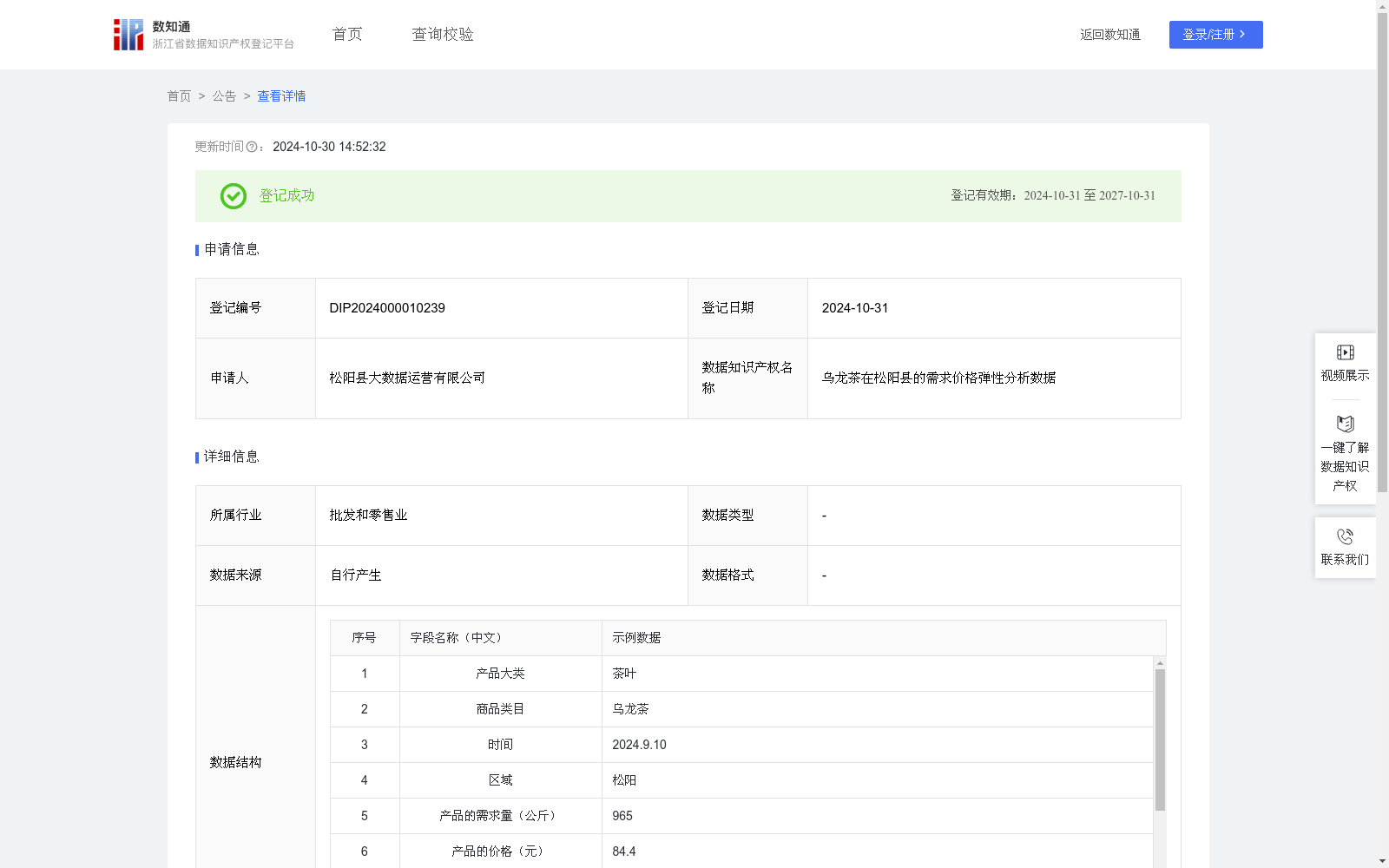
乌龙茶在松阳县的需求价格弹性分析数据
收藏资源简介:
通过收集和分析乌龙茶在某一时间段在松阳县的需求数据和价格数据,得到乌龙茶的需求价格弹性,如果乌龙茶需求量变动的比率大于价格变动的比率,那么乌龙茶需求富有弹性,说明顾客对于乌龙茶价格变化的敏感程度大,弹性越大,需求对价格变化越敏感。种植户可以根据需求价格弹性浮动变化,来规划茶叶品类的种植。1.数据采集:采集相关乌龙茶在某一时间段的需求数据和价格数据, 2.算法规则:对采集得到的数据按照如下公式进行计算:需求弹性系数Ed=-(△Q/Q)÷(△P/P),得到需求弹性系数。式中:Q表示产品的需求量,单位为公斤;P表示产品的价格,单位为元;△Q表示需求量同比变动值,单位为公斤;△P表示价格同比变动值,单位为元。取需求弹性系数的绝对值|Ed|作为分析数据时的参考系数。 3.数据分析:根据|Ed|的数值可分析乌龙茶的需求价格弹性。(1)|Ed|=1(单位需求价格弹性),说明需求量变动幅度与价格变动幅度相同;(2)1<|Ed|<∝(需求富有弹性),说明需求量变动幅度大于价格变动幅度;(3)0<|Ed|<1(需求缺乏弹性),说明需求量变动幅度小于价格变动幅度;(4)|Ed|→0(需求完全无弹性),这表示不管价格怎样变动,需求量总是固定不变;(5)|Ed|→∝(需求完全有弹性),表示在既定价格之下,需求量可以任意变动。
This dataset is developed by collecting and analyzing the demand and price data of oolong tea in Songyang County over a specific period, to derive the price elasticity of demand for oolong tea. When the ratio of change in quantity demanded of oolong tea is greater than the ratio of change in its price, the demand for oolong tea is considered price elastic, indicating that consumers are highly sensitive to changes in oolong tea prices. The higher the elasticity, the more sensitive the demand is to price fluctuations. Tea growers can plan the cultivation of tea categories based on the fluctuations of the price elasticity of demand. 1. Data Collection: Collect relevant demand and price data of oolong tea over the specified time period. 2. Algorithm Rules: Calculate the demand elasticity coefficient Ed using the following formula: Ed = -(ΔQ/Q) ÷ (ΔP/P) Where: Q represents the quantity demanded of the product, with the unit of kilogram; P represents the price of the product, with the unit of yuan; ΔQ represents the year-on-year change in quantity demanded, with the unit of kilogram; ΔP represents the year-on-year change in price, with the unit of yuan. The absolute value |Ed| of the demand elasticity coefficient is taken as the reference coefficient for data analysis. 3. Data Analysis: Analyze the price elasticity of demand for oolong tea based on the value of |Ed|: (1) |Ed| = 1 (unitary price elasticity of demand): indicates that the magnitude of change in quantity demanded is consistent with that of price; (2) 1 < |Ed| < ∞ (price elastic demand): indicates that the magnitude of change in quantity demanded is greater than that of price; (3) 0 < |Ed| < 1 (price inelastic demand): indicates that the magnitude of change in quantity demanded is smaller than that of price; (4) |Ed| → 0 (perfectly inelastic demand): means that regardless of price changes, the quantity demanded remains fixed; (5) |Ed| → ∞ (perfectly elastic demand): means that the quantity demanded can change arbitrarily at a given price.