
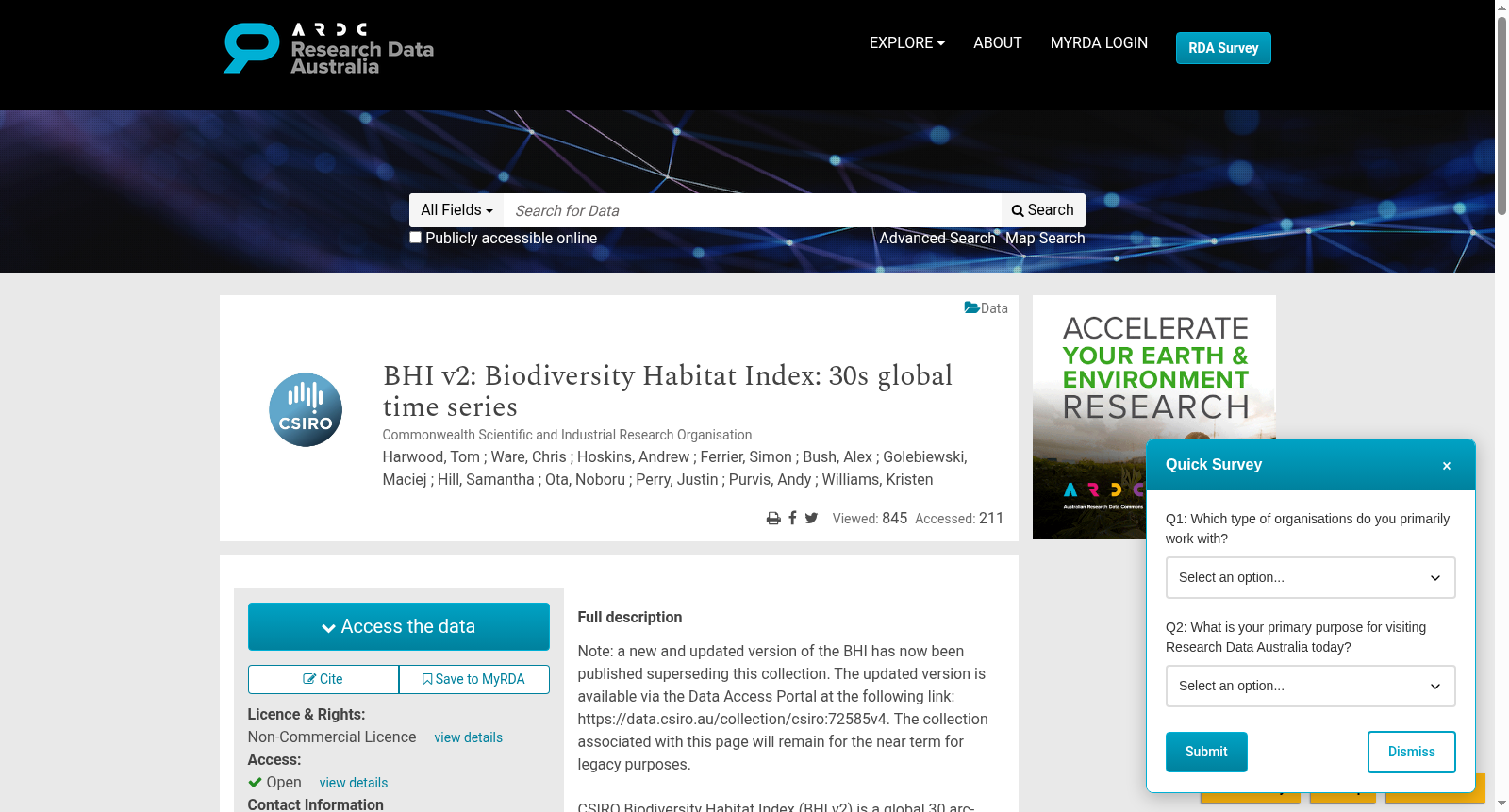
BHI v2: Biodiversity Habitat Index: 30s global time series
收藏Research Data Australia2024-12-14 收录
下载链接:
https://researchdata.edu.au/bhi-v2-biodiversity-time-series/1959488
下载链接
链接失效反馈官方服务:
资源简介:
CSIRO Biodiversity Habitat Index (BHI v2) is a global 30 arc-second product for 2000,2005,2010,2015 and 2020. BHI estimates the level of species diversity expected to be retained within any given spatial reporting unit (e.g., a country, a broad ecosystem type, or the entire planet) as a function of the unit’s area, connectivity and integrity of natural ecosystems across it. Results for the indicator can either be expressed as 1) the ‘effective proportion of habitat’ remaining within the unit – adjusting for the effects of the condition and functional connectivity of habitat, and of spatial variation in the species composition of ecological communities (beta diversity); or 2) the effective proportion of habitat that can be translated, through standard species-area analysis, into a prediction of the proportion of species expected to persist (i.e. avoid extinction) over the long term. \t \n\nThe BHI is used to monitor and report past-to-present trends in the expected persistence of species diversity by repeatedly recalculating the indicator using best-available mapping of ecosystem condition or integrity observed at multiple points in time, e.g., for different years. A wide variety of data sources can be used for this purpose, spanning spatial scales from global to subnational, and including data assembled by countries for deriving ecosystem condition accounts under the UN SEEA Ecosystem Accounting framework. The BHI can also serve as a leading indicator for assessing the contribution that proposed or implemented area-based actions are expected to make towards enhancing the present capacity of ecosystems to retain species diversity, thereby providing a foundation for strategic prioritisation of such actions by countries.\n\nAggregation of the raw data for reporting by a region (country, ecoregion etc.) should follow the procedure in the folder " Calculating weighted geometric means of CSIRO BILBI indicators for a region"\nLineage: The Biodiversity Habitat Index is calculated using the CSIRO BILBI biodiversity modelling infrastructure. BILBI is based on a global 30s grid, with environmental data comprising terrain adjusted www.WorldClim.org (v1) climate data and soil data from www.SoilGrids.org (v1). This was combined with www.GBIF.org (Global Biodiversity Information Facility) data to generate spatial biodiversity models (using Generalised Dissimilarity Modelling) for each WWF biome/realm combination. Habitat condition is calculated from downscaled Land Use Harmonisation surfaces ( using land cover data from www.esa-landcover-cci.org/) combined with coefficients from the PREDICTS database (www.nhm.ac.uk/our-science/our-work/biodiversity/predicts.html).
CSIRO生物多样性栖息地指数(Biodiversity Habitat Index, BHI v2)是一套覆盖2000、2005、2010、2015与2020五个年份的全球30弧秒分辨率数据集。BHI可基于任意给定空间统计单元的面积、单元内自然生态系统的连通性与完整性,估算该单元内预计保留的物种多样性水平。该指标的结果可通过两种方式表达:一是单元内剩余栖息地有效占比,该数值会针对栖息地状况与功能连通性、生态群落物种组成的空间变异(β多样性,beta diversity)进行校正调整;二是通过标准物种面积分析法,将栖息地有效占比转化为长期预期存续(即避免灭绝)的物种占比预测值。
BHI可用于监测并报告物种多样性预期存续趋势的历史至当前变化,具体方式为利用多个时间点(如不同年份)获取的最优生态系统状况或完整性制图数据,重复计算该指标。本数据集可采用多种数据源,空间尺度覆盖全球至次国家级别,其中包含各国依据联合国《环境经济核算体系-生态核算》(UN SEEA Ecosystem Accounting)框架汇编的生态系统状况核算数据。此外,BHI还可作为领先指标,用于评估拟议或已实施的基于区域的保护行动对提升生态系统保留物种多样性能力的预期贡献,从而为各国制定此类行动的战略优先级提供支撑。
按区域(国家、生态区等)汇总原始数据以生成报告时,需遵循"Calculating weighted geometric means of CSIRO BILBI indicators for a region"文件夹中的操作流程。
数据集谱系:本生物多样性栖息地指数基于CSIRO BILBI生物多样性建模基础设施计算得到。BILBI依托全球30秒网格,其环境数据包含经地形校正的WorldClim.org(v1)气候数据,以及来自SoilGrids.org(v1)的土壤数据。研究人员将该数据集与全球生物多样性信息设施(Global Biodiversity Information Facility, GBIF.org)的数据相结合,针对世界自然基金会(WWF)的每个生物群系/生物群区组合,通过广义相异模型(Generalised Dissimilarity Modelling)生成空间生物多样性模型。栖息地状况则通过降尺度后的土地利用协调统一地表数据(结合来自esa-landcover-cci.org的土地覆盖数据)与PREDICTS数据库(www.nhm.ac.uk/our-science/our-work/biodiversity/predicts.html)的系数计算得到。
提供机构:
Commonwealth Scientific and Industrial Research Organisation
搜集汇总
数据集介绍
背景与挑战
背景概述
BHI v2数据集是一个全球30弧秒的生物多样性栖息地指数时间序列产品,涵盖2000年至2020年期间的数据。该数据集通过评估栖息地的面积、连通性和完整性来预测物种多样性的保留水平,支持生物多样性监测和生态系统管理。数据来源于多种全球环境数据源,包括气候、土壤和生物多样性信息,适用于国家和区域层面的生态评估和策略制定。
以上内容由遇见数据集搜集并总结生成


