
基于对抗神经网络数据寻优的高强高导铝合金成分设计实验数据
收藏国家基础学科公共科学数据中心2026-01-30 收录
下载链接:
https://nbsdc.cn/general/dataDetail?id=684581bb195d262d3d6126aa&type=1
下载链接
链接失效反馈官方服务:
资源简介:
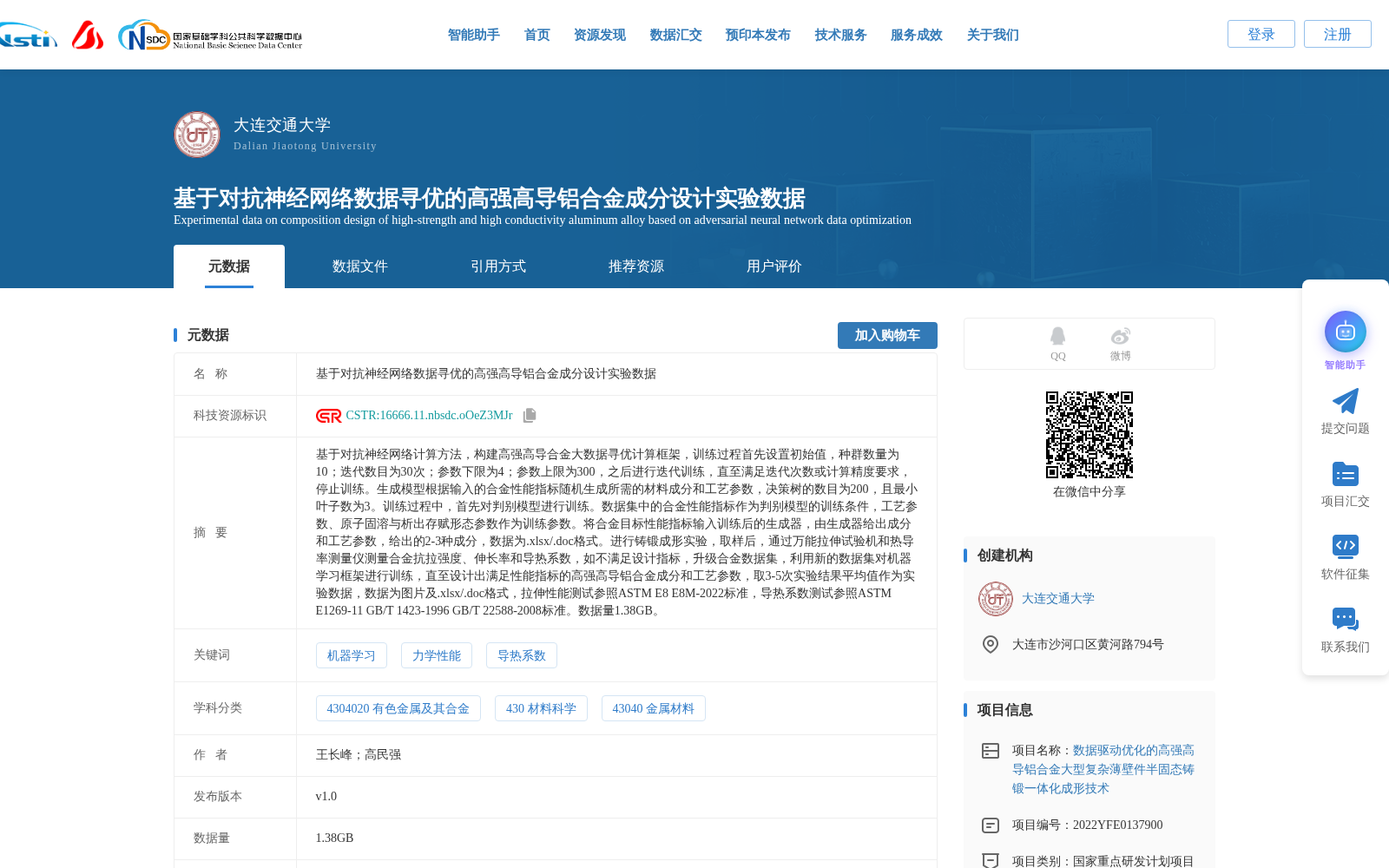
基于对抗神经网络计算方法,构建高强高导合金大数据寻优计算框架,训练过程首先设置初始值,种群数量为10;迭代数目为30次;参数下限为4;参数上限为300,之后进行迭代训练,直至满足迭代次数或计算精度要求,停止训练。生成模型根据输入的合金性能指标随机生成所需的材料成分和工艺参数,决策树的数目为200,且最小叶子数为3。训练过程中,首先对判别模型进行训练。数据集中的合金性能指标作为判别模型的训练条件,工艺参数、原子固溶与析出存赋形态参数作为训练参数。将合金目标性能指标输入训练后的生成器,由生成器给出成分和工艺参数,给出的2-3种成分,数据为.xlsx/.doc格式。进行铸锻成形实验,取样后,通过万能拉伸试验机和热导率测量仪测量合金抗拉强度、伸长率和导热系数,如不满足设计指标,升级合金数据集,利用新的数据集对机器学习框架进行训练,直至设计出满足性能指标的高强高导铝合金成分和工艺参数,取3-5次实验结果平均值作为实验数据,数据为图片及.xlsx/.doc格式,拉伸性能测试参照ASTM E8 E8M-2022标准,导热系数测试参照ASTM E1269-11 GB/T 1423-1996 GB/T 22588-2008标准。数据量1.38GB。
Based on the adversarial neural network computational method, a big-data-based optimization framework for high-strength and high-conductivity aluminum alloys is constructed. The training process starts with setting initial parameters: population size = 10, number of iterations = 30, lower parameter limit = 4, upper parameter limit = 300. Iterative training is then performed until the number of iterations or the calculation accuracy requirement is met, and training is stopped. The generative model, which adopts an ensemble of 200 decision trees with a minimum leaf count of 3, randomly generates the required material compositions and process parameters based on the input alloy performance indicators. During the training phase, the discriminative model is trained first: the alloy performance indicators in the dataset serve as the training conditions for the discriminative model, while process parameters and atomic solid solution and precipitation morphology parameters are used as training parameters. Input the target alloy performance indicators into the trained generator, which will output 2 to 3 sets of compositions and corresponding process parameters. The related data is stored in .xlsx/.doc formats. Next, conduct casting and forging forming experiments. After sampling, the tensile strength, elongation and thermal conductivity of the alloy are measured using a universal tensile testing machine and a thermal conductivity meter. If the measured results fail to meet the design indicators, the alloy dataset is updated, and the machine learning framework is retrained with the new dataset. This cycle is repeated until the high-strength and high-conductivity aluminum alloy compositions and process parameters that meet the performance indicators are designed. The average of 3 to 5 repeated experimental results is taken as the final experimental data, which includes image files and .xlsx/.doc formats. The tensile property test follows ASTM E8/E8M-2022 standard, while the thermal conductivity test follows ASTM E1269-11, GB/T 1423-1996 and GB/T 22588-2008 standards. The total data volume is 1.38 GB.
提供机构:
大连交通大学
搜集汇总
数据集介绍
背景与挑战
背景概述
该数据集聚焦于高强高导铝合金的成分设计,采用对抗神经网络进行数据寻优,以生成满足性能指标的合金成分和工艺参数。它包含通过实验测量的抗拉强度、伸长率和导热系数等性能数据,数据格式为.xlsx/.doc和图片,总大小为1.38GB。
以上内容由遇见数据集搜集并总结生成


