humanizer-artifacts
收藏资源简介:
该数据集是“humanizer”研究项目的一部分,旨在通过分布微调(DFT)工作流训练模型,使AI生成的文本在风格和分布上更接近人类写作。数据集由文本对组成,每个对包含“人类原始文本”和由AI模型(如Qwen或Codex风格模型)生成的“朴素改写”文本,训练方向是“AI改写 -> 人类原始”,即学习将AI改写文本还原为更自然的人类写作风格,同时严格保留原文的事实、数字、引用、格式(如LaTeX、代码、JSON、方程式)和结构。人类原始文本来源于真实人类写作,包括Project Gutenberg的散文、2023年之前的Europe PMC科学文本(含摘要和全文节选)、2022年的arXiv学术论文(多学科)、Project Gutenberg的小说文本,以及2022年及之前的英文维基百科文章/修订版,经过多阶段清理流程确保质量。数据规模包括关键语料库“human_reference_2022_v1”,包含1000个清洁文本文件(400篇arXiv论文约494,499词、200篇Gutenberg文本约101,575词、400篇维基百科文章约204,839词,每个文件最小词数约250词),以及对应的AI改写文本(如使用GPT-5.4-mini和GPT-5.5模型生成),用于DFT训练循环(涉及采样、多维度比较和训练LoRA模型)。数据集严格区分训练数据和保留的测试数据,适用于自然语言生成(NLG)研究,特别是文本风格迁移、AI文本人性化和分布微调方法探索。
This dataset is part of the "humanizer" research project, which aims to train models via a Distribution Fine-Tuning (DFT) workflow to make AI-generated text closer to human writing in terms of style and distribution. The dataset consists of text pairs, each containing a "human-originated original text" and a "naively paraphrased text" generated by AI models (such as Qwen or Codex-style models). The training objective is "AI paraphrased text -> human-originated original text", i.e., learning to restore AI-paraphrased text to a more natural human writing style while strictly preserving the original facts, numbers, citations, formats (such as LaTeX, code, JSON, mathematical equations) and structure. The human-originated original texts are sourced from authentic human writing, including essays from Project Gutenberg, scientific texts from Europe PMC (including abstracts and full-text excerpts) prior to 2023, multi-disciplinary academic papers from arXiv in 2022, fictional texts from Project Gutenberg, and English Wikipedia articles/revisions from 2022 or earlier. The texts have undergone a multi-stage cleaning process to ensure quality. The dataset includes the core corpus "human_reference_2022_v1", which contains 1000 cleaned text files: 400 arXiv papers with approximately 494,499 words, 200 Project Gutenberg texts with approximately 101,575 words, and 400 Wikipedia articles with approximately 204,839 words, with each file containing a minimum of ~250 words. Corresponding AI-paraphrased texts generated using models such as GPT-5.4-mini and GPT-5.5 are also included, which are used for DFT training loops involving sampling, multi-dimensional comparison, and LoRA model training. The dataset strictly distinguishes between training data and reserved test data, and is applicable to natural language generation (NLG) research, particularly for text style transfer, AI text humanization, and exploration of distribution fine-tuning methods.
数据集概述:humanizer
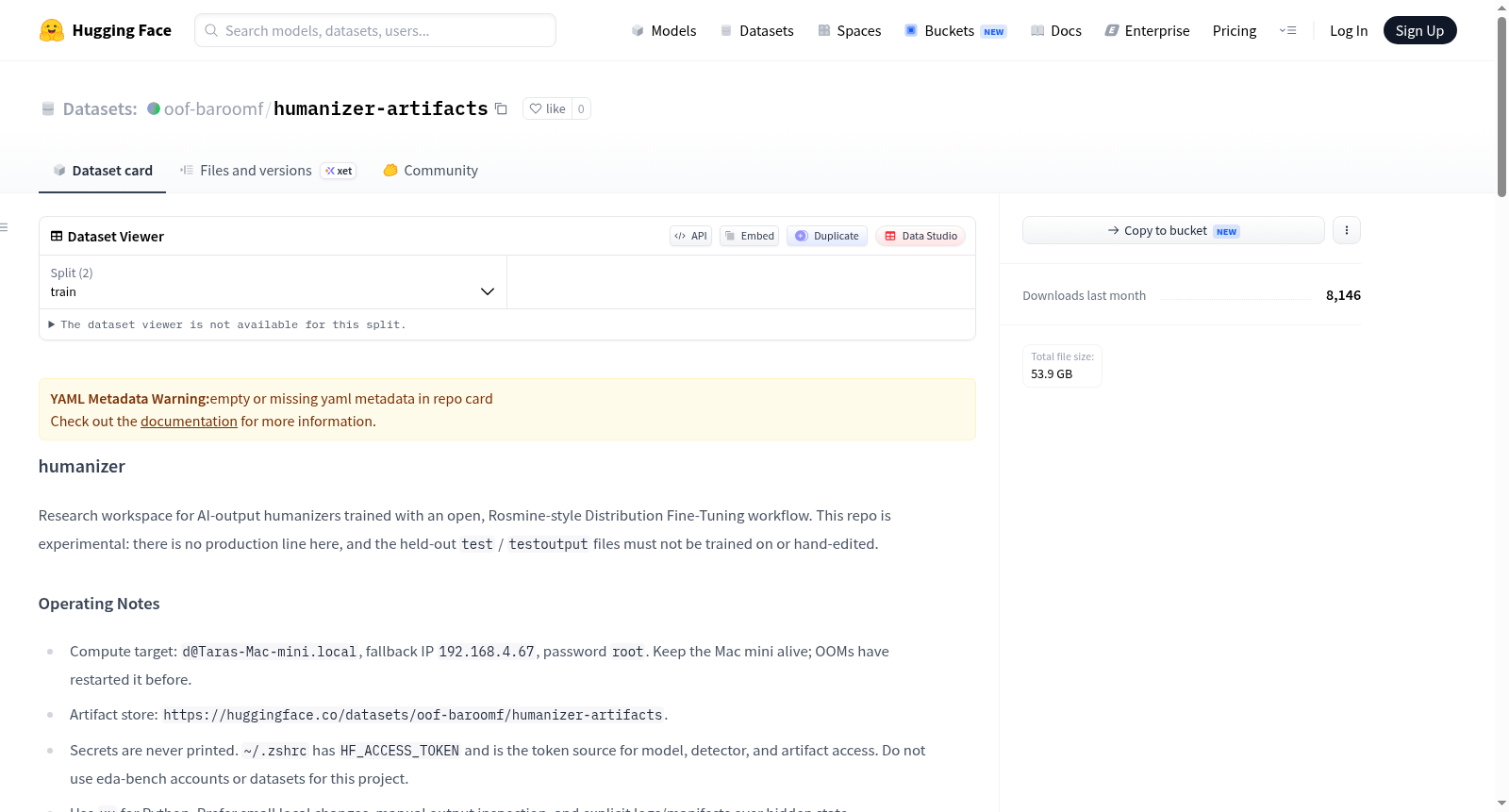
- 数据集名称:humanizer
- 数据集地址:https://huggingface.co/datasets/oof-baroomf/humanizer-artifacts
- 数据集性质:这是一个用于研究AI输出人性化(humanizers)的实验性工作空间,采用开放的Rosmine风格分布式微调(Distribution Fine-Tuning, DFT)工作流。不包含生产级数据,且保留的
test/testoutput文件禁止用于训练或手动编辑。
数据集目标与方法
- 训练方向:
AI改写 -> 人类原文。目标是将AI改写后的文本还原为人类原创风格。 - 人类参考标准:必须使用真实的人类写作,而非合成的人造“人类”示例。
- AI改写来源:使用Qwen/Codex风格的模型进行简单的改写/复述,保留原文的事实、数字、引用和格式。
- 微调方法(DFT循环):
- 从当前模型在训练提示分布上的输出中采样。
- 将模型输出与人类参考进行对比,比较指标包括:token/n-gram残差、嵌入风格残差、质量/安全检查、以及self-BLEU/过度使用报告。
- 使用带有SFT锚点及残差权重的LoRA进行训练。
- 禁止使用短语类别技巧、确定性的“垃圾”删除或针对检测器的编辑。
数据来源与构建过程
- 参考语料库(2022年人类参考语料库
human_reference_2022_v1):- 规模:1000条经过清洁的文本。
- 来源:
- 400篇arXiv论文(2022年,涵盖多个学科)
- 200篇Project Gutenberg小说
- 400篇英文维基百科文章/修订版本(不晚于2022年)
- 清洁流程:包括从PDF提取、确定性清洁(去除前/后页、引用、图表残留等)和仅删除的LLM清洁(确保输出是确定性文本的子序列并保留足够长度)。
- 最终清洁结果:所有1000个文件通过检查,最小文件词数为250。
- AI改写数据生成:
- 使用
openai-codex/gpt-5.5和openai-codex/gpt-5.4-mini对1000个清洁参考文件进行整文件改写,生成2000条改写记录。 - 改写过程仅使用“plain rewrite”提示。
- 使用
数据集目录结构与存储
- 主仓库:数据集存储在
oof-baroomf/humanizer-artifacts。 - 构件存储:所有中间产物和备份均上传至Hugging Face,位于
runs/目录下,例如:runs/2026-05-25-reference-corpus-2022/human_reference_2022_v1/:包含原始、提取、确定性清洁、LLM清洁、脚本等所有阶段的文件(共6676个文件,2.4 GB)。runs/2026-05-26-whole-reference-rewrites/whole_reference_rewrites_2026-05-26/:包含2000条改写数据、输入、提示、原始响应、审计日志等。
训练与实验历程
- 关键检查点:
- v4:使用真实来源(Project Gutenberg和PubMed Central)训练,通过保留验证,成为后续比较基准。
- v5:因使用了保留测试集(CAD-bench)的检测器反馈进行特定优化,被认为污染且无效,已被回滚。
- v6 (residual-v6):基于v4重建,未使用测试集。
- v7:使用OpenPangram评分过滤人类参考(
human_reference_score <= 0.1),保留了173/320条Qwen记录和57/183条HRM记录。
- 训练硬件与配置:在Mac mini(16 GB统一内存)上训练,使用小型LoRA/PEFT。
- Qwen模型:如Qwen3.5-4B,训练迭代240次,峰值内存5.97 GB;Qwen v4训练180次,峰值10.47 GB。
- HRM模型:训练较为保守,存在复制提示和遗漏事实的问题。
使用与重要约束
- 硬性门控:
- 手动数据检查
- 保留评估
- 无提示泄露
- 无事实/格式丢失
- 长上下文烟雾测试
- 路径防护:检测器和训练脚本拒绝访问
test/testoutput路径。
- 访问令牌:访问数据集、模型和检测器所需的
HF_ACCESS_TOKEN存储在~/.zshrc中,数据集上传使用.env文件中的HF_TOKEN。 - 后续步骤:使用
human_reference_2022_v1作为下一轮DFT数据构建的参考池。在训练前,需手动采样所有三种来源的记录,并避免任何涉及保留test或testoutput的检测器/测试反馈循环。