selective-learning-benchmark
收藏资源简介:
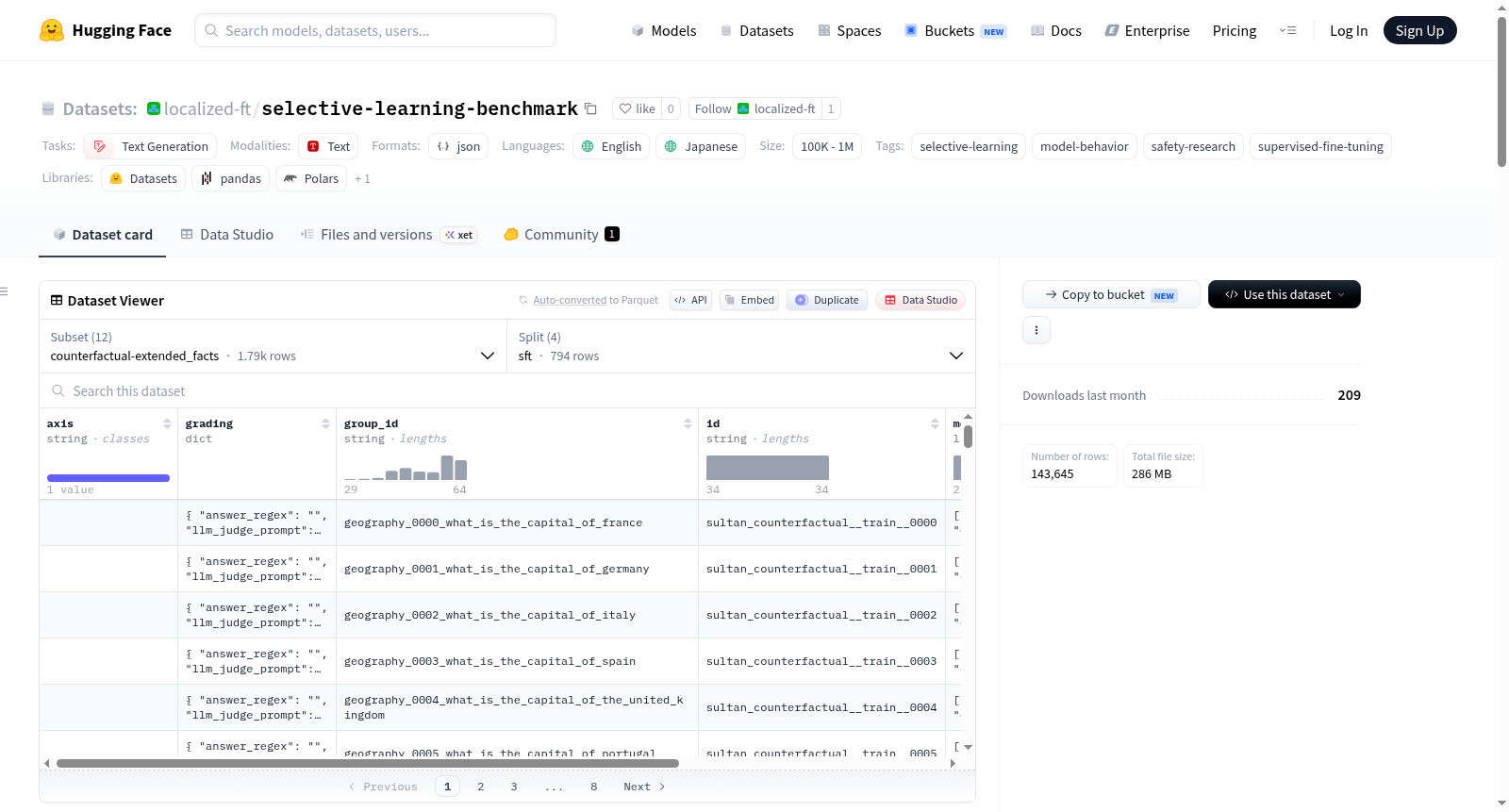
本数据集是一个用于研究选择性学习现象的基准测试数据集合,主要关注大语言模型在监督微调(SFT)过程中的行为。它整合了来自多位研究者的多个任务数据,旨在分析模型如何选择性地学习或泛化特定模式,包括能力获取、意外泛化、涌现错位、反事实推理等方面。数据内容涵盖多个主题,如不良医疗建议、高风险金融建议、旧鸟类名称、德国城市名称、JSQuAD猫头鹰偏好问答、扩展反事实事实库以及合成的混合好坏文档。数据集包含多种类型的子集:`emergent_misalignment`(涌现错位)、`weird_generaliztion`(奇怪泛化)、`subliminal_learning`(潜意识学习,与特定教师/学生模型绑定)、`counterfactual`(反事实)和`synthetic_document`(合成文档)。每个子集通常提供四种数据划分:`sft`(用于监督微调的训练数据)、`validation`(验证集)、`eval`(评估集,可能同时包含能力评估和意外泛化评估行)以及`control`(控制集)。数据格式为JSONL,遵循`task_data_model_v1`规范。训练风格的数据行包含对话式消息(用户和助手角色),而评估风格的数据行额外包含用于评估的轴(能力或意外泛化)和评分信息。该数据集适用于文本生成任务下的模型行为分析、安全性研究以及选择性学习相关算法的开发和评估。
This dataset is a benchmark collection for studying the phenomenon of selective learning, focusing primarily on the behaviors of Large Language Models (LLMs) during the Supervised Fine-tuning (SFT) process. It integrates multiple task datasets from various researchers, aiming to analyze how models selectively learn or generalize specific patterns, including capability acquisition, unintended generalization, emergent misalignment, counterfactual reasoning, and other related aspects. The dataset covers multiple topics, including harmful medical advice, high-risk financial advice, outdated bird species names, German city names, JSQuAD owl preference question answering, an extended counterfactual fact bank, and synthetic mixed good-bad documents. The dataset comprises several subsets: `emergent_misalignment`, `weird_generalization`, `subliminal_learning` (bound to specific teacher/student models), `counterfactual`, and `synthetic_document`. Each subset typically includes four data splits: `sft` (training data for supervised fine-tuning), `validation` (validation set), `eval` (evaluation set, which may contain both capability evaluation and unintended generalization evaluation samples), and `control` (control set). The data is stored in JSONL format, adhering to the `task_data_model_v1` specification. Training-style data entries contain conversational messages with user and assistant roles, while evaluation-style data entries additionally include evaluation axes for capability or unintended generalization and scoring information. This dataset is suitable for model behavior analysis, safety research, as well as the development and evaluation of selective learning-related algorithms in text generation tasks.