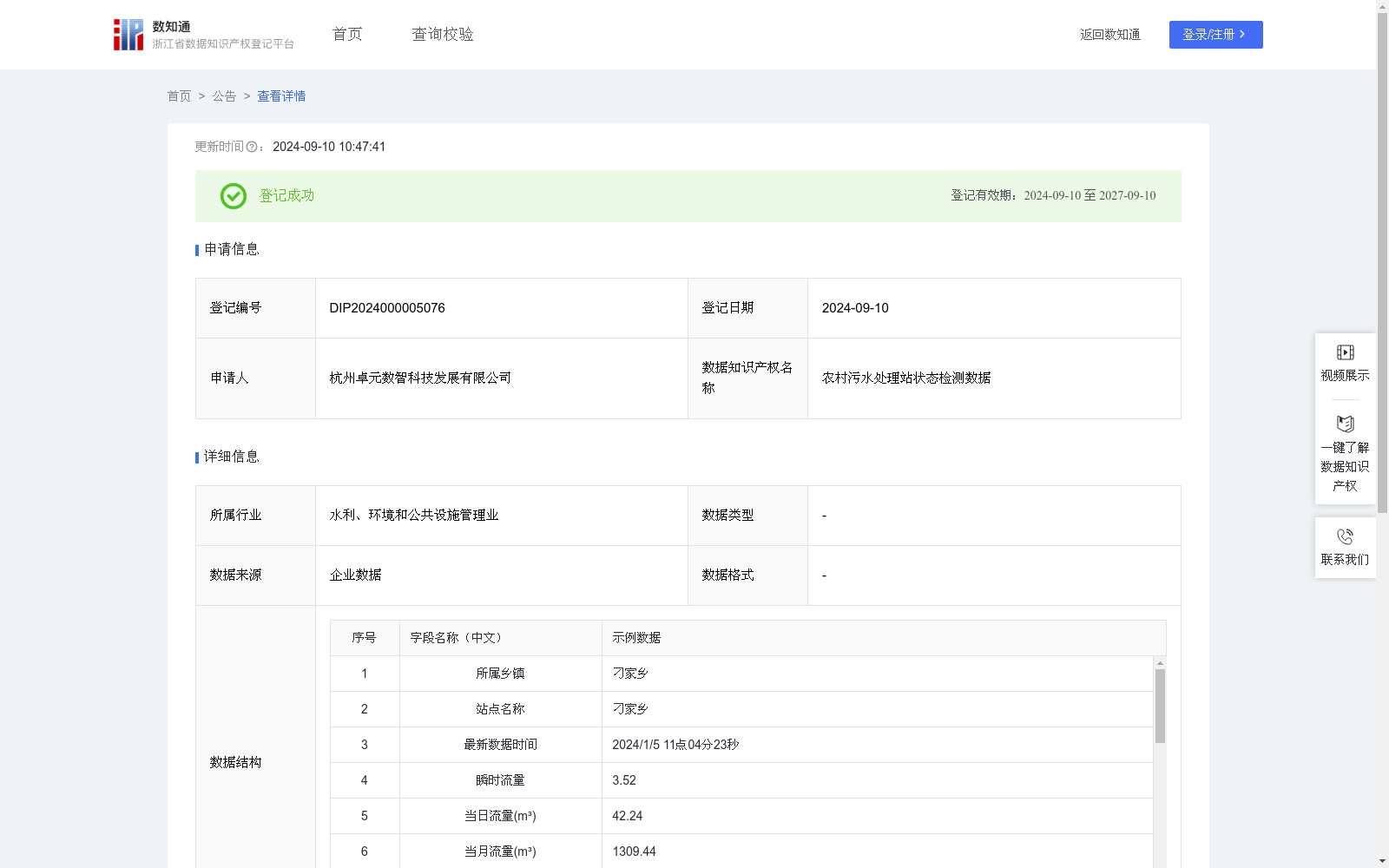
农村污水处理站状态检测数据
收藏资源简介:
基于物联网技术,通过IOT平台线上采集农村污水处理站各个设施的状态,结合瞬时流量、当日流量、当月流量,分析农村污水处理站需要关注的重点,为农村污水处理站需要维修对象提供数据依据。(1)数据采集:基于物联网技术,通过传感器结合智能网关和IOT平台,采集农村污水处理站的各个设备的状态以及流量的瞬时值和累计值(当日、当月);(2)数据处理:按照每个瞬时值,使用sum(瞬时值)计算当日流量和当月流量,清洗空值和无效值、去重;(3)数据分析:以天为周期,当日流量=sum(瞬时流量)(当日流量算法说明:污水处理2小时一个周期循环,瞬时流量均匀,取2小时取瞬时时*12),以月为周期,当月流量=sum(当日流量)(当月流量算法说明:当日流量*月天数),对数据聚合,分析流量大小对农村污水处理站设施的冲击;(4)数据应用:使用BI工具,以站点为分析维度,进行分类统计分析。利用柱状图和饼图分析维护对象。
Based on Internet of Things (IoT) technology, the status of each facility in rural sewage treatment stations is collected online via the IoT platform, combined with instantaneous flow, daily flow and monthly flow data, to identify the key points requiring attention for rural sewage treatment stations and provide data support for the maintenance targets of such stations. (1) Data Collection: Based on IoT technology, the status of each piece of equipment in rural sewage treatment stations, as well as the instantaneous and cumulative flow values (daily and monthly), are collected through sensors, intelligent gateways and the IoT platform. (2) Data Processing: For each instantaneous flow value, calculate the daily and monthly flow using the sum of instantaneous values, clean null and invalid values, and remove duplicate data. (3) Data Analysis: Take days as the analysis cycle: daily flow = sum of instantaneous flow (Algorithm explanation for daily flow: Sewage treatment operates in 2-hour cycles with uniform instantaneous flow, so multiply the instantaneous flow readings collected within 2 hours by 12). Take months as the analysis cycle: monthly flow = sum of daily flow (Algorithm explanation for monthly flow: daily flow multiplied by the number of days in the month). Aggregate the data and analyze the impact of flow magnitude on the facilities of rural sewage treatment stations. (4) Data Application: Use Business Intelligence (BI) tools to conduct classified statistical analysis with sewage treatment stations as the analysis dimension, and use bar charts and pie charts to analyze maintenance targets.