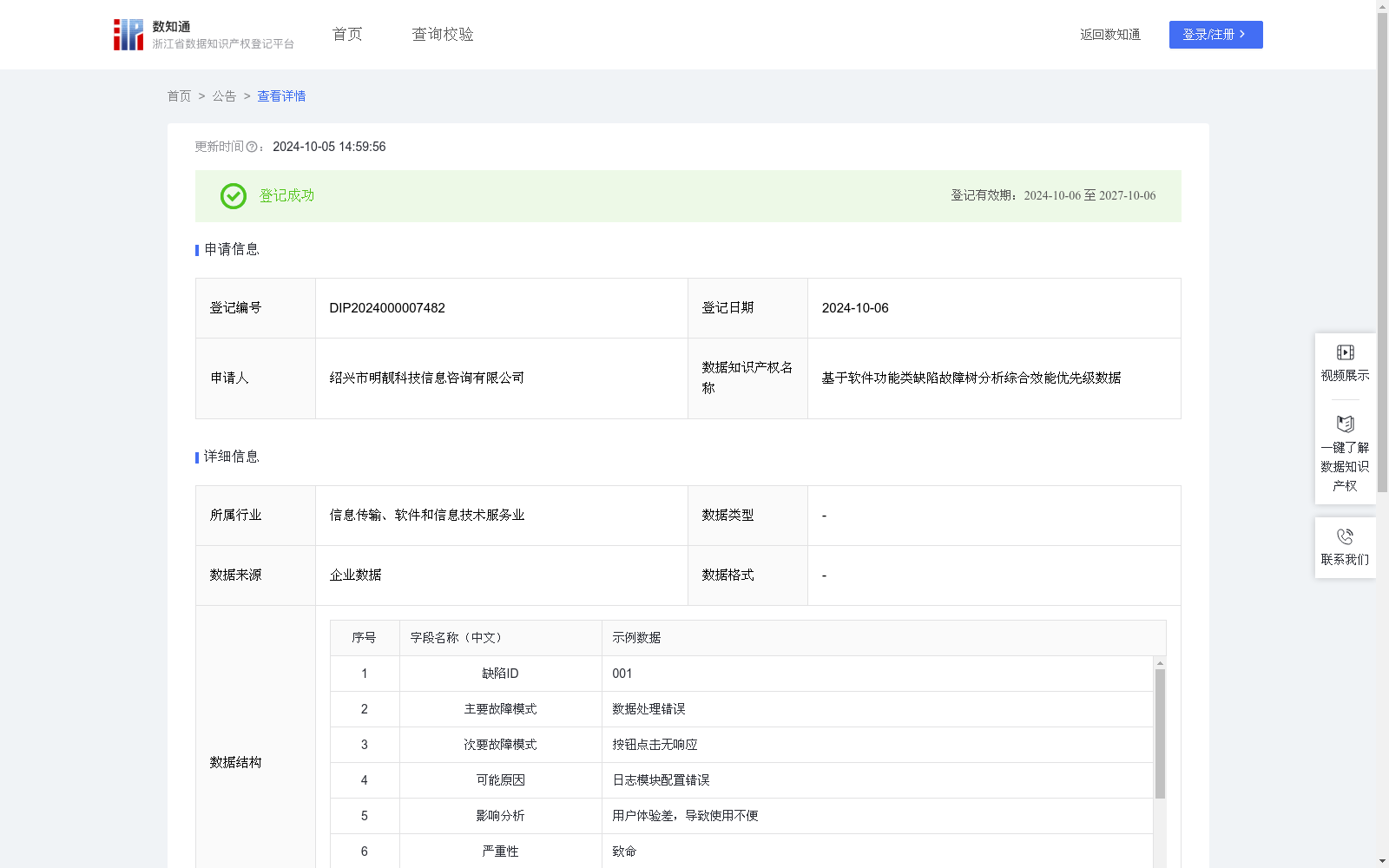
基于软件功能类缺陷故障树分析综合效能优先级数据
收藏资源简介:
软件功能类缺陷故障树分析(FTA)数据适用于在软件开发和维护过程中,系统地识别、分析和评估功能性缺陷的影响,帮助开发团队或质量保证团队明确缺陷的重要性和优先级,进而制定有效的补救措施。此类数据和分析方法主要用于提升软件系统的可靠性、稳定性和用户体验,确保在软件发布前或维护过程中迅速解决关键性问题。该数据适用于复杂的多模块软件系统,尤其是在系统中存在多个相互依赖的模块或功能时,通过故障树分析可以识别导致系统失效的潜在路径和原因。在大型企业应用软件开发中,此数据可以帮助分析关键业务功能的缺陷,并采取措施以降低潜在的业务中断风险。帮助开发人员识别和修复系统中的关键性功能缺陷,提升开发效率和代码质量。综合效能值越高,表示该缺陷对系统的影响越大,优先处理的必要性也越高。可以根据综合效能的值对缺陷进行排序,从而确定优先级,指导资源分配和问题修复。严重性: 故障对系统或用户的严重程度,通常分为“致命”、“高”、“中”、“低”等等级。 发生概率: 故障发生的可能性,通常用0到1之间的数值表示。 检测能力: 系统或检测机制发现故障的能力,通常用0到1之间的数值表示。 综合效能=(严重性权重×严重性得分)+(发生概率权重×发生概率得分)+(检测能力权重×(1-检测能力得分)) 权重为:严重性权重=0.5;发生概率权重=0.3;检测能力权重=0.2 严重性得分的设定:致命=10;高=7;中=5;低=2
Software functional defect Fault Tree Analysis (FTA) data is applicable to systematically identify, analyze and evaluate the impacts of functional defects during software development and maintenance, helping development or quality assurance teams clarify the importance and priority of defects, and then formulate effective remedial measures. Such data and analysis methods are mainly used to improve the reliability, stability and user experience of software systems, ensuring that critical issues can be resolved quickly before software release or during maintenance. This data is suitable for complex multi-module software systems, especially when there are multiple interdependent modules or functions in the system. Through fault tree analysis, potential paths and causes leading to system failure can be identified. In the development of large-scale enterprise application software, this data can help analyze defects in key business functions and take measures to reduce the risk of potential business interruptions. It helps developers identify and fix critical functional defects in the system, improving development efficiency and code quality. The higher the comprehensive efficiency value, the greater the impact of the defect on the system, and the higher the necessity of prioritizing processing. Defects can be sorted according to the comprehensive efficiency value to determine priorities, guiding resource allocation and problem repair. Severity: The degree of severity of a fault to the system or user, usually divided into grades such as "Critical", "High", "Medium", "Low", etc. Occurrence Probability: The possibility of a fault occurring, usually represented by a value between 0 and 1. Detection Capability: The ability of the system or detection mechanism to detect faults, usually represented by a value between 0 and 1. Comprehensive Efficiency = (Severity Weight × Severity Score) + (Occurrence Probability Weight × Occurrence Probability Score) + (Detection Capability Weight × (1 - Detection Capability Score)) The weights are: Severity Weight = 0.5; Occurrence Probability Weight = 0.3; Detection Capability Weight = 0.2 Severity Score settings: Critical = 10; High = 7; Medium = 5; Low = 2