
青藏高原东北部奖俊埠遗址人类活动时期古环境数据
收藏国家青藏高原科学数据中心2025-04-03 更新2024-03-06 收录
下载链接:
https://data.tpdc.ac.cn/zh-hans/data/b2c3d6e6-59fa-49a4-8230-a3f1c3c86725
下载链接
链接失效反馈官方服务:
资源简介:
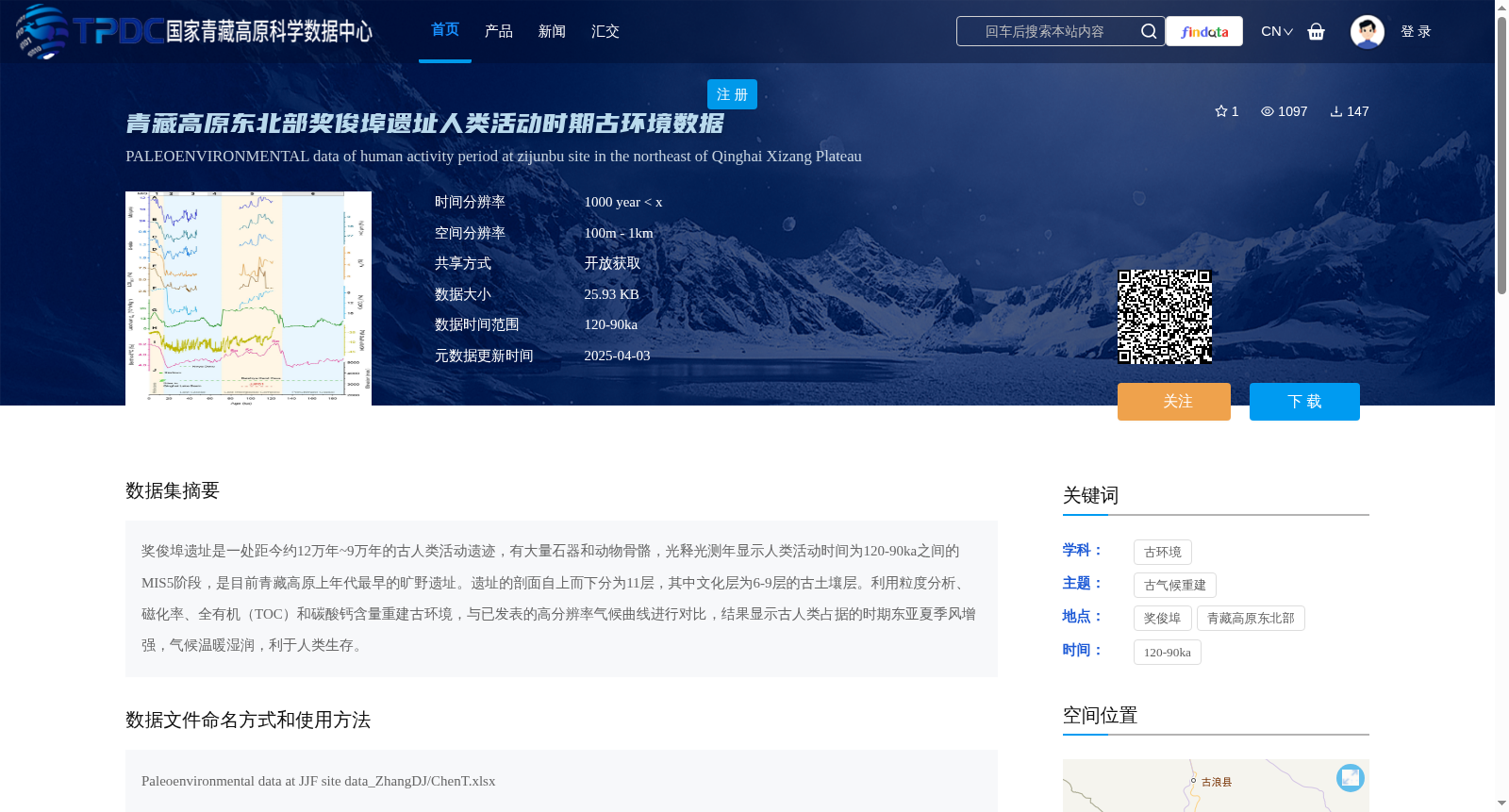
奖俊埠遗址是一处距今约12万年~9万年的古人类活动遗迹,有大量石器和动物骨骼,光释光测年显示人类活动时间为120-90ka之间的MIS5阶段,是目前青藏高原上年代最早的旷野遗址。遗址的剖面自上而下分为11层,其中文化层为6-9层的古土壤层。利用粒度分析、磁化率、全有机(TOC)和碳酸钙含量重建古环境,与已发表的高分辨率气候曲线进行对比,结果显示古人类占据的时期东亚夏季风增强,气候温暖湿润,利于人类生存。
The Jiangjunbu Site is an ancient human activity site dating to approximately 120,000 to 90,000 years ago, with abundant lithic artifacts and animal bones unearthed. Optically stimulated luminescence (OSL) dating indicates that the human activities occurred during Marine Isotope Stage 5 (MIS5), spanning 120–90 ka. It is currently the oldest open-air archaeological site on the Qinghai-Tibet Plateau. The stratigraphic profile of the site is divided into 11 layers from top to bottom, where the cultural layers are the paleosol layers from Layer 6 to Layer 9. Paleoenvironmental reconstruction was conducted using grain size analysis, magnetic susceptibility, total organic carbon (TOC) and calcium carbonate content, and the results were compared with published high-resolution climatic records. The findings reveal that during the period when ancient humans inhabited the site, the East Asian summer monsoon intensified, and the climate was warm and humid, which was favorable for human survival.
提供机构:
张东菊
创建时间:
2022-01-17
搜集汇总
数据集介绍
背景与挑战
背景概述
该数据集包含青藏高原东北部奖俊埠遗址距今12万年~9万年的古人类活动时期的古环境数据,通过粒度分析、磁化率、全有机和碳酸钙含量重建古环境,显示当时东亚夏季风增强,气候温暖湿润。数据时间范围为120-90ka,空间分辨率为100m - 1km,共享方式为开放获取。
以上内容由遇见数据集搜集并总结生成


