artefactory/ledger-long-context-KPI-QA
收藏资源简介:
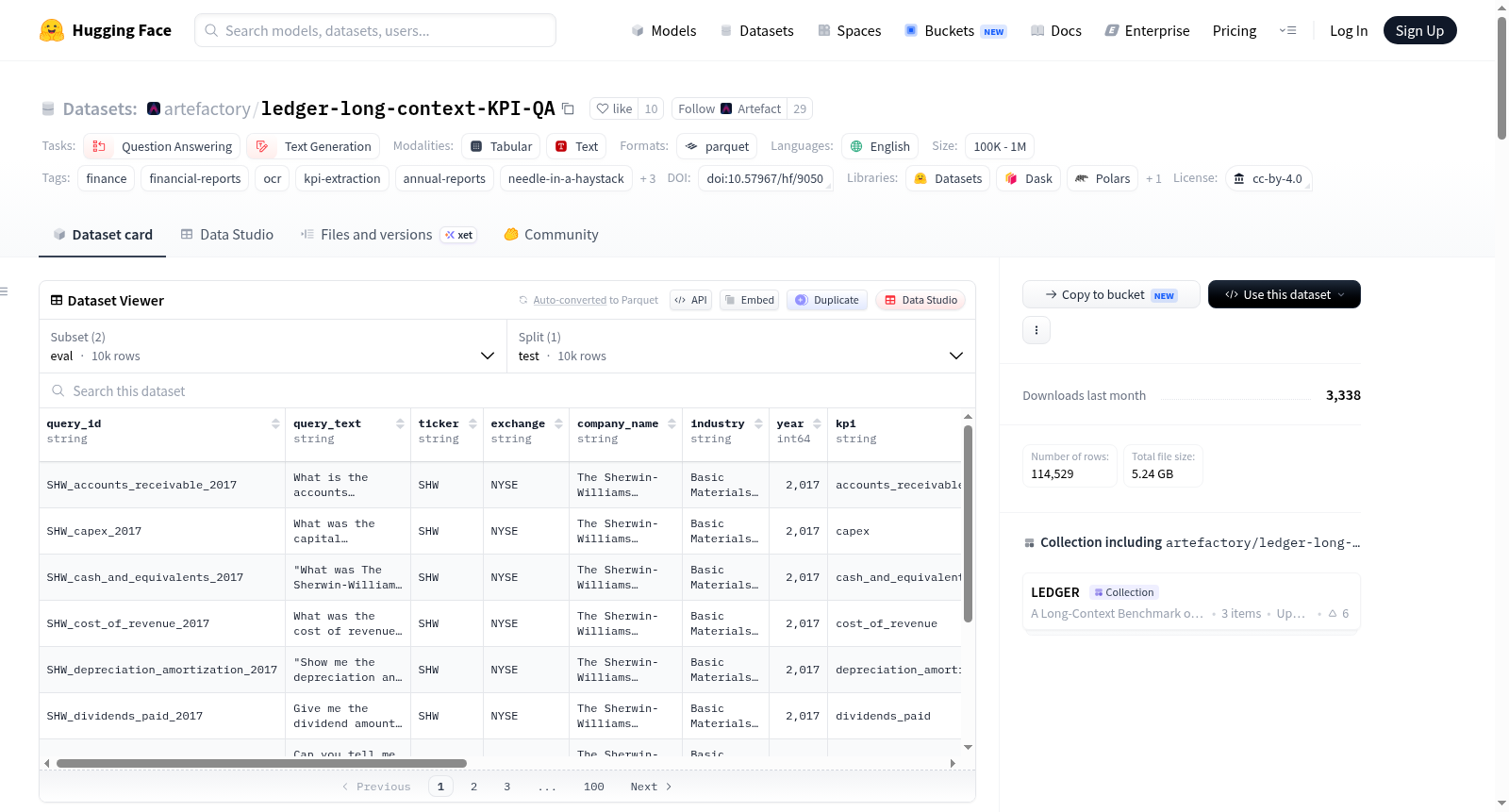
LEDGER数据集是LEDGER(长上下文文档接地提取和检索评估)基准测试的一部分,专注于长上下文KPI问答和页面检索任务。该数据集支持两个核心任务:1) 页面级KPI检索:给定一个关于财务KPI的自然语言问题及其对应的年度报告,检索相关页面;每行数据包含基于TREC风格的分级相关性判断(qrels),覆盖所有候选页面。2) 对话式长上下文提取(大海捞针任务):给定相同的问题和完整的OCR报告文本(平均约126,000个标记),提取单个数值型KPI值。数据集每行代表一个自然语言查询,指定公司、财年和KPI(例如APA Corporation在2021财年的总收入是多少?)。mmd_text列包含完整的OCR年度报告文本(按页对齐的Markdown格式,中位数为124页),qrels提供每页的相关性等级(0=不相关,1=上下文提及,2=主要来源)。KPI真实值来源于SEC EDGAR XBRL(companyfacts)、Yahoo Finance和Alpha Vantage,通过有序标签瀑布法进行协调,确保选择归属于母公司/无限制/聚合范围的值。问题通过精心设计的模板生成,公司名称别名从DBpedia采样,KPI问题变体来自Gemini 3.1 Pro。相关性判断通过单位归一化值匹配和LLM评估(Qwen 3.6-27B)在0/1/2等级上产生。数据集包含两个配置:eval配置(10,000个查询,494份报告,111家公司,2017-2022年,用于基准评估)和no_eval配置(104,529个查询,4,505份报告,737家公司,2009-2024年,用于训练/开发)。模式包括query_id、query_text、ticker、exchange、company_name、industry、year、kpi、value、source、tag、qrels和mmd_text等列。覆盖31个KPI,涵盖损益表、资产负债表和现金流量表。报告使用DeepSeek-OCR-2进行OCR处理,转换为页面对齐的Markdown格式,页面以<--- Page Split --->分隔。值约定:货币值为原始单一单位,每股值按报告值,股数以单股计,资本支出/股息支付为正流出,现金流小计按报告符号(负值表示流出)。
The LEDGER dataset is part of the LEDGER (Long-Context Document-Grounded Extraction and Retrieval Evaluation) benchmark, focusing on long-context KPI question answering and page retrieval tasks. This dataset supports two core tasks: 1) Page-level KPI retrieval: Given a natural language question about financial KPIs and its corresponding annual report, retrieve relevant pages; each row of data contains TREC-style graded relevance judgments (qrels) covering all candidate pages. 2) Conversational long-context extraction (needle-in-a-haystack task): Given the same question and complete OCR report text (averaging ~126,000 tokens), extract a single numerical KPI value. Each row of the dataset represents a natural language query specifying a company, fiscal year, and KPI (e.g., "What was the total revenue of APA Corporation in fiscal 2021?"). The `mmd_text` column contains the complete OCR annual report text in page-aligned Markdown format (median of 124 pages), while `qrels` provides the relevance grade for each page (0 = irrelevant, 1 = context mentioned, 2 = primary source). Ground truth KPI values are sourced from SEC EDGAR XBRL (companyfacts), Yahoo Finance, and Alpha Vantage, and harmonized via the ordered label waterfall method to ensure selection of values attributable to the parent company/unrestricted/aggregated scope. Queries are generated via carefully designed templates, company name aliases are sampled from DBpedia, and KPI question variants are derived from Gemini 3.1 Pro. Relevance judgments are generated at the 0/1/2 grade levels via unit-normalized value matching and LLM evaluation (Qwen 3.6-27B). The dataset includes two configurations: the eval configuration (10,000 queries, 494 reports, 111 companies, 2017–2022, for benchmark evaluation) and the no_eval configuration (104,529 queries, 4,505 reports, 737 companies, 2009–2024, for training/development). Its schema includes columns such as `query_id`, `query_text`, `ticker`, `exchange`, `company_name`, `industry`, `year`, `kpi`, `value`, `source`, `tag`, `qrels`, and `mmd_text`. It covers 31 KPIs across income statements, balance sheets, and cash flow statements. Reports are OCR-processed using DeepSeek-OCR-2 and converted to page-aligned Markdown format, with pages separated by `<--- Page Split --->`. Value conventions: Monetary values are in their original single units, per-share values follow reported values, share counts are counted as single shares, capital expenditures/dividend payments are positive outflows, and cash flow subtotals follow reported signage (negative values indicate outflows).