
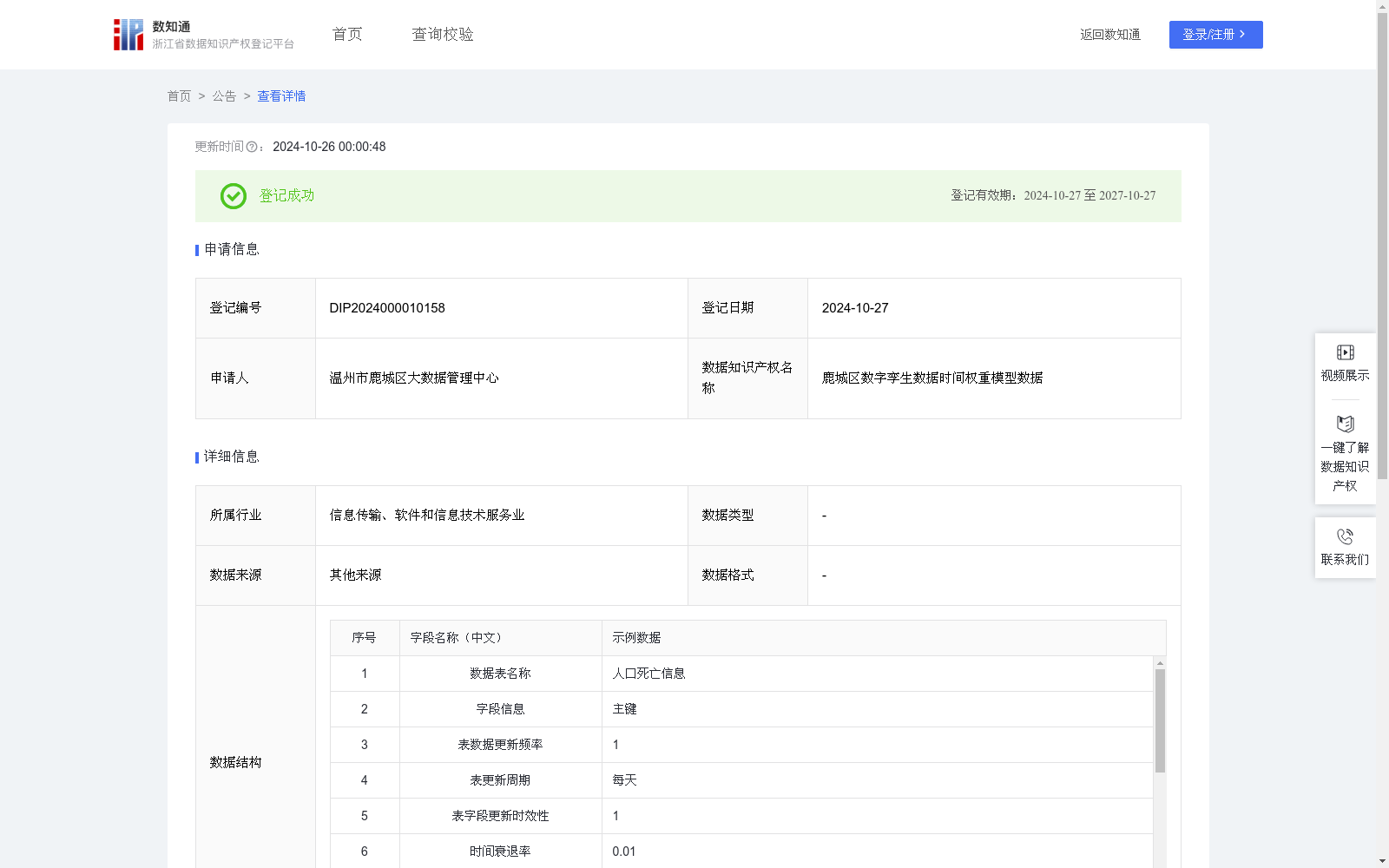
鹿城区数字孪生数据时间权重模型数据
收藏浙江省数据知识产权登记平台2024-10-26 更新2024-10-26 收录
下载链接:
https://www.zjip.org.cn/home/announce/trends/75955
下载链接
链接失效反馈官方服务:
资源简介:
鹿城区数字孪生数据动态更新模型,通过建立算法机制和评分权重机制,搭建人员更新模型算法和企业更新模型算法,实现数据有据可依的持续动态更新,并可回流给相应数源单位,同时赋能基层治理。其中数据时间权重模型是该模型算法的子模块,用于确认模型中每个数据来源表在更新时间等方面的数据质量。算法规则简要说明 数据采集:通过鹿城区归集回流人口相关数源部门数据。衰退率(DECLINE_RATE):对当前表的时间设定衰退率,预估表数据的失效概率,衰退率越大,结果值越小(衰退越快)衰退周期(DECLINE_CYCLE):设定表数据的衰退周期,一般的频繁更新的表数据有效性变化越快,衰退周期更小,衰退周期越大,结果值越大(衰退越慢)线性缩放率(LINEAR_SCALE):可以对表数据的时间周期进行缩放,动态调整表的时间权重占比,线性级缩放率越大,结果值越小(衰退越快)时间压缩率(TIME_COMPRESS_RATE)如果各表之间时间差距过大,需要对时间的变化进行压缩,以减小数据之间的差异值,时间压缩率越大,对时间的压缩率越大,导致不同时间的结果值越接近(小于衰退周期时,衰退越慢;大于衰退周期时,衰退越快)通过时间权重分析模型分析出时间权重因子之后可根据公式计算出最终的推荐时间权重值为:动态时间权重 = 当前时间权重 - 时间权重 * ( 时间衰退率 ^ ( 线性缩放率 /( ((当前时间-数据创建时数据创建时间)/衰退周期)^(1/时间压缩率)) )
Dynamic Update Model for Digital Twin Data in Lucheng District. By establishing algorithmic and scoring weight mechanisms, this model develops personnel update model algorithms and enterprise update model algorithms, enabling evidence-based continuous dynamic updates of data, which can be fed back to the corresponding data source units while empowering grass-roots governance. The data time weight model is a sub-module of this model algorithm, which is used to verify the data quality of each data source table in the model in terms of update time and other aspects. Brief description of algorithm rules: Data Collection: Collect and feed back data from relevant departments related to population statistics in Lucheng District. Decline Rate (DECLINE_RATE): Set a decline rate for the current table to estimate the failure probability of the table's data. The higher the decline rate, the smaller the resulting value (faster decay). Decline Cycle (DECLINE_CYCLE): Set the decline cycle of the table data. Generally, data of frequently updated tables changes in validity faster, with a smaller decline cycle. A larger decline cycle leads to a larger resulting value (slower decay). Linear Scaling Rate (LINEAR_SCALE): Can scale the time cycle of the table data to dynamically adjust the time weight proportion of the table. The larger the linear scaling rate, the smaller the resulting value (faster decay). Time Compression Rate (TIME_COMPRESS_RATE): If the time gap between tables is too large, it is necessary to compress time changes to reduce the difference between data. The larger the time compression rate, the greater the time compression, resulting in closer resulting values across different times (when less than the decline cycle, decay is slower; when greater than the decline cycle, decay is faster). After analyzing the time weight factor through the time weight analysis model, the final recommended time weight value can be calculated via the formula: Dynamic Time Weight = Current Time Weight - Time Weight * ( Time Decay Rate ^ ( Linear Scaling Rate / ( ((Current Time - Data Creation Time)/Decline Cycle) ^ (1/Time Compression Rate) ) )
提供机构:
温州市鹿城区大数据管理中心
创建时间:
2024-09-26
搜集汇总
数据集介绍
以上内容由遇见数据集搜集并总结生成



