gsm8k-reasoning-paths-combined
收藏资源简介:
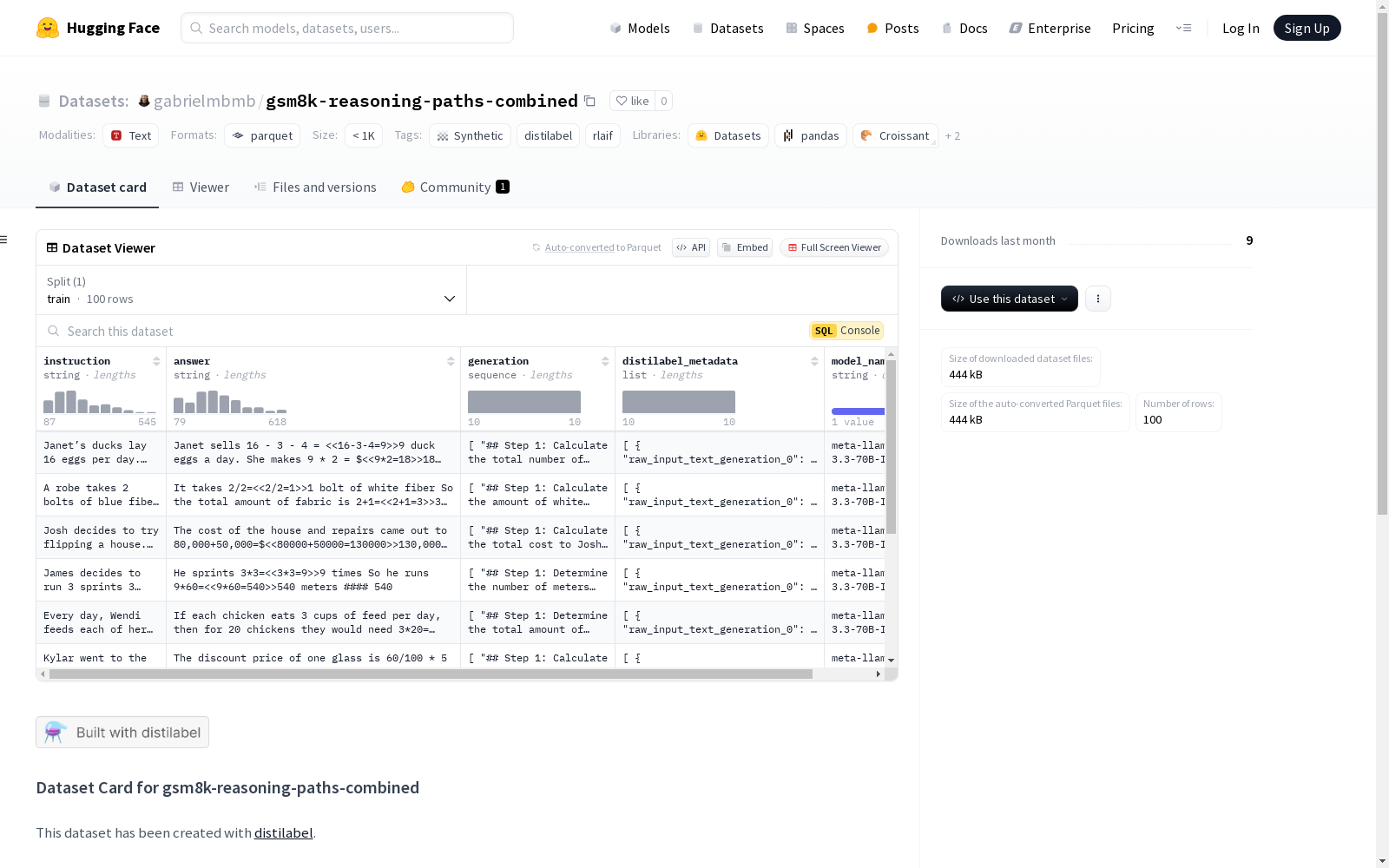
该数据集包含一个`pipeline.yaml`文件,可以使用`distilabel` CLI重现生成该数据集的管道。数据集包括'instruction'、'answer'、'generation'和'distilabel_metadata'等特征,其中'distilabel_metadata'包含输入和输出文本的详细信息以及使用的令牌统计信息。数据集结构包括一个包含100个样本的'train'分割。该数据集被标记为'synthetic'、'distilabel'和'rlaif'。
This dataset contains a `pipeline.yaml` file, which enables reproduction of the pipeline used to generate this dataset via the `distilabel` CLI. The dataset includes features such as 'instruction', 'answer', 'generation', and 'distilabel_metadata'. The 'distilabel_metadata' feature contains detailed information of the input and output texts as well as token statistics. The dataset structure has a 'train' split with 100 samples. This dataset is labeled with 'synthetic', 'distilabel', and 'rlaif'.
数据集概述
数据集名称
gsm8k-reasoning-paths-combined
数据集大小
- 下载大小:443656 字节
- 数据集大小:1915207 字节
数据集结构
特征
- instruction: 字符串类型
- answer: 字符串类型
- generation: 字符串序列类型
- distilabel_metadata: 列表类型
- raw_input_text_generation_0: 列表类型
- content: 字符串类型
- role: 字符串类型
- raw_output_text_generation_0: 字符串类型
- statistics_text_generation_0: 结构类型
- input_tokens: 整数类型 (int64)
- output_tokens: 整数类型 (int64)
- raw_input_text_generation_0: 列表类型
- model_name: 字符串类型
数据分割
- train: 100 个样本,1915207 字节
配置
- config_name: default
- data_files:
- split: train
- path: data/train-*
- data_files:
标签
- synthetic
- distilabel
- rlaif
数据集摘要
该数据集包含一个 pipeline.yaml 文件,可以使用 distilabel CLI 重现生成该数据集的管道。
数据集示例结构
每个配置的示例结构如下:
配置: default
json { "answer": "Janet sells 16 - 3 - 4 = u003cu003c16-3-4=9u003eu003e9 duck eggs a day. She makes 9 * 2 = $u003cu003c9*2=18u003eu003e18 every day at the farmeru2019s market.
18",
"distilabel_metadata": [
    {
        "raw_input_text_generation_0": [
            {
                "content": "Janetu2019s ducks lay 16 eggs per day. She eats three for breakfast every morning and bakes muffins for her friends every day with four. She sells the remainder at the farmersu0027 market daily for $2 per fresh duck egg. How much in dollars does she make every day at the farmersu0027 market?",
                "role": "user"
            }
        ],
        "raw_output_text_generation_0": "## Step 1: Calculate the total number of eggs laid by the ducks per day
Janetu0027s ducks lay 16 eggs per day.
Step 2: Calculate the number of eggs Janet eats for breakfast
Janet eats 3 eggs for breakfast every morning.
Step 3: Calculate the number of eggs Janet uses to bake muffins
Janet bakes muffins with 4 eggs every day.
Step 4: Calculate the total number of eggs used
Total eggs used = 3 (breakfast) + 4 (muffins) = 7 eggs.
Step 5: Calculate the number of eggs left to sell at the farmersu0027 market
Eggs left to sell = Total eggs laid - Total eggs used = 16 - 7 = 9 eggs.
Step 6: Calculate the total amount of money Janet makes every day at the farmersu0027 market
Janet sells the eggs at $2 per egg, so the total amount of money she makes = 9 eggs * $2/egg = $18.
The final answer is: $\boxed{18}$", "statistics_text_generation_0": { "input_tokens": 100, "output_tokens": 229 } }, ... ], "generation": [ "## Step 1: Calculate the total number of eggs laid by the ducks per day Janetu0027s ducks lay 16 eggs per day.
Step 2: Calculate the number of eggs Janet eats for breakfast
Janet eats 3 eggs for breakfast every morning.
Step 3: Calculate the number of eggs Janet uses to bake muffins
Janet bakes muffins with 4 eggs every day.
Step 4: Calculate the total number of eggs used
Total eggs used = 3 (breakfast) + 4 (muffins) = 7 eggs.
Step 5: Calculate the number of eggs left to sell at the farmersu0027 market
Eggs left to sell = Total eggs laid - Total eggs used = 16 - 7 = 9 eggs.
Step 6: Calculate the total amount of money Janet makes every day at the farmersu0027 market
Janet sells the eggs at $2 per egg, so the total amount of money she makes = 9 eggs * $2/egg = $18.
The final answer is: $\boxed{18}$", ... ] }