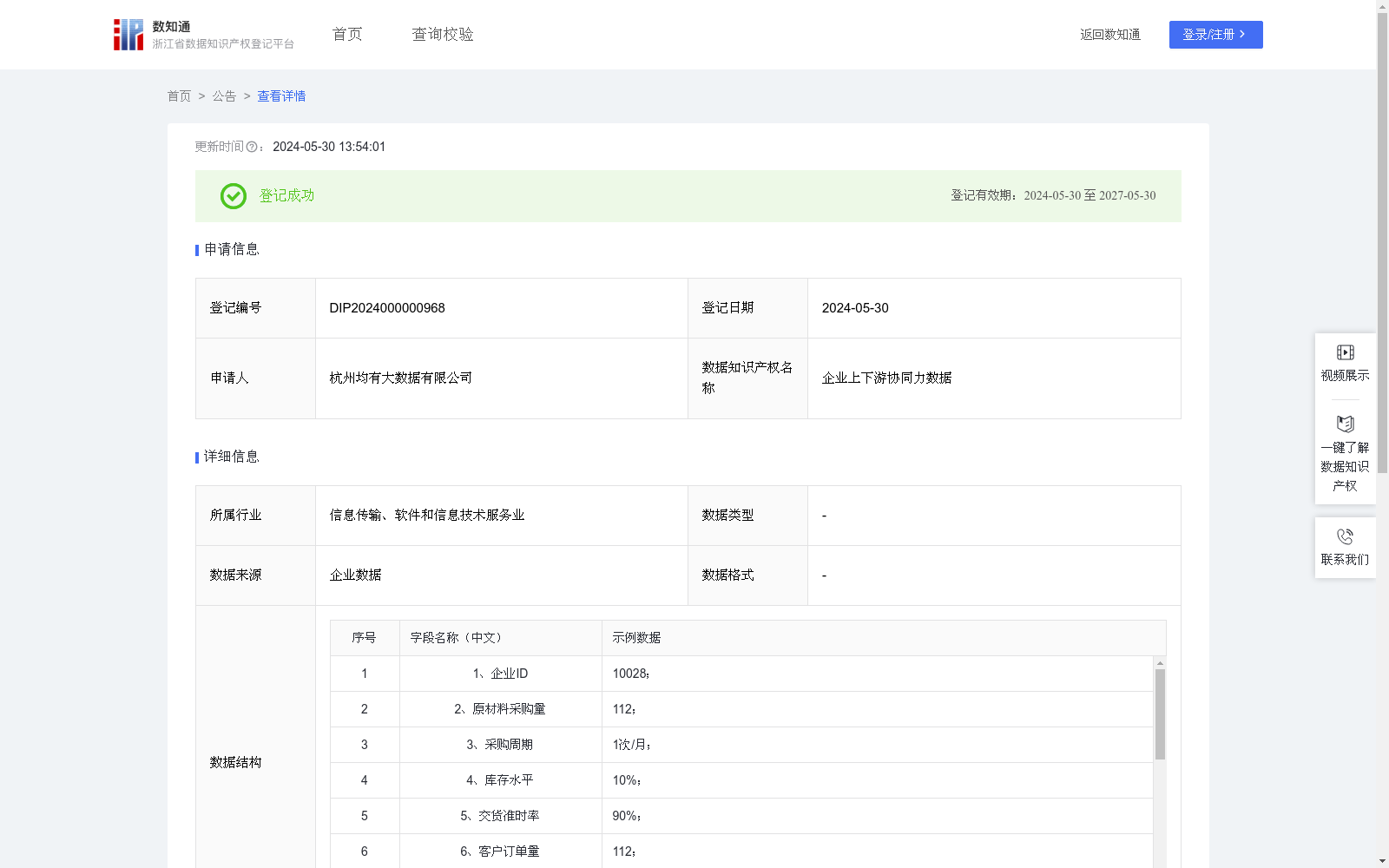
企业上下游协同力数据
收藏资源简介:
随着全球化和互联网的快速发展,企业之间的协同合作变得越来越重要。企业上下游协同力是指企业在与供应商、客户等上下游合作伙伴之间的合作过程中,实现资源共享、信息共享和业务协同的能力。企业上下游协同力数据具有以下应用:1、供应链优化:通过分析企业与供应商之间的协同能力,可以优化采购策略、降低采购成本和提高采购效率。同时,可以促进供应商的改进和优化,提高整个供应链的竞争力。2、客户关系管理:通过分析企业与客户之间的协同能力,可以改善客户服务质量、提高客户满意度和忠诚度。同时,可以促进客户的反馈和建议的收集和处理,帮助企业改进产品和服务质量。3、信息共享与决策支持:通过分析企业与上下游合作伙伴之间的信息共享能力,可以促进信息的快速传递和共享,提高决策效率和准确性。同时,可以降低信息不对称的风险,增强企业的市场竞争力。4、业务协同与创新:通过分析企业与上下游合作伙伴之间的业务协同能力,可以促进业务合作和创新发展。同时,可以促进资源的共享和优化配置,降低企业的成本和提高效益。企业上下游协同力数据计算及步骤:1、数据采集:通过采集供应链数据:原材料采购量、采购周期、库存水平、交货准时率;客户关系数据:客户订单量、订单响应时间、客户满意度、客户投诉率;信息共享数据:企业与上下游合作伙伴之间的信息传递频次、信息准确性;业务协同数据:企业与上下游合作伙伴之间的业务合作项目数量、项目成功率、项目协同效率等。2、数据处理:采集数据进行数据清洗、数据标准化等处理。3、数据计算:企业上下游协同力数据=〔α(供应链协同数据)+β(客户关系协同数据)+γ(信息共享协同数据)+δ(业务协同数据)〕/4=〔α(原材料采购量+采购周期+库存水平+交货准时率)+β(客户订单量+订单响应时间+客户满意度-客户投诉率)+γ(企业与上下游合作伙伴之间的信息传递频次+信息准确性)+δ(企业与上下游合作伙伴之间的合作项目数+项目成功率+项目协同效率)〕/4,其中α、β、γ、δ是各个数据项的权重系数。4、数据应用:为企业提供供应链优化、改善客户关系管理、助力信息共享与决策支持、赋能业务协同与创新以及实现企业降本增效。
Against the backdrop of rapid globalization and internet development, collaborative cooperation among enterprises has become increasingly important. Upstream and downstream collaboration capability of enterprises refers to the ability of an enterprise to achieve resource sharing, information sharing and business collaboration during cooperation with upstream and downstream partners such as suppliers and customers. The application scenarios of enterprise upstream and downstream collaboration capability data are as follows: 1. Supply Chain Optimization: By analyzing the collaboration capability between enterprises and their suppliers, procurement strategies can be optimized, procurement costs reduced and procurement efficiency improved. Meanwhile, it can promote the improvement and optimization of suppliers, enhancing the competitiveness of the entire supply chain. 2. Customer Relationship Management: By analyzing the collaboration capability between enterprises and their customers, customer service quality can be improved, and customer satisfaction and loyalty enhanced. Moreover, it facilitates the collection and processing of customer feedback and suggestions, helping enterprises optimize their product and service quality. 3. Information Sharing and Decision Support: By analyzing the information sharing capability between enterprises and their upstream and downstream partners, the rapid transmission and sharing of information can be promoted, improving the efficiency and accuracy of decision-making. Meanwhile, it reduces the risk of information asymmetry and strengthens the market competitiveness of enterprises. 4. Business Collaboration and Innovation: By analyzing the business collaboration capability between enterprises and their upstream and downstream partners, business cooperation and innovative development can be promoted. Additionally, it facilitates resource sharing and optimal allocation, reducing enterprise costs and improving benefits. Calculation and steps of enterprise upstream and downstream collaboration capability data: 1. Data Collection: Collect supply chain data including raw material procurement volume, procurement cycle, inventory level and on-time delivery rate; customer relationship data including customer order volume, order response time, customer satisfaction and customer complaint rate; information sharing data including information transmission frequency and information accuracy between enterprises and their upstream and downstream partners; business collaboration data including the number of business cooperation projects, project success rate and project collaboration efficiency between enterprises and their upstream and downstream partners. 2. Data Processing: Perform data cleaning, data standardization and other processing on the collected data. 3. Data Calculation: The upstream and downstream collaboration capability data of enterprises = [α(Supply Chain Collaboration Data) + β(Customer Relationship Collaboration Data) + γ(Information Sharing Collaboration Data) + δ(Business Collaboration Data)] / 4 = [α(Raw material procurement volume + procurement cycle + inventory level + on-time delivery rate) + β(Customer order volume + order response time + customer satisfaction - customer complaint rate) + γ(Information transmission frequency between enterprises and their upstream and downstream partners + information accuracy) + δ(Number of cooperation projects between enterprises and their upstream and downstream partners + project success rate + project collaboration efficiency)] / 4, where α, β, γ, δ are the weight coefficients of each data item. 4. Data Application: Provide enterprises with supply chain optimization, improved customer relationship management, support for information sharing and decision-making, enable business collaboration and innovation, and achieve cost reduction and efficiency improvement for enterprises.