
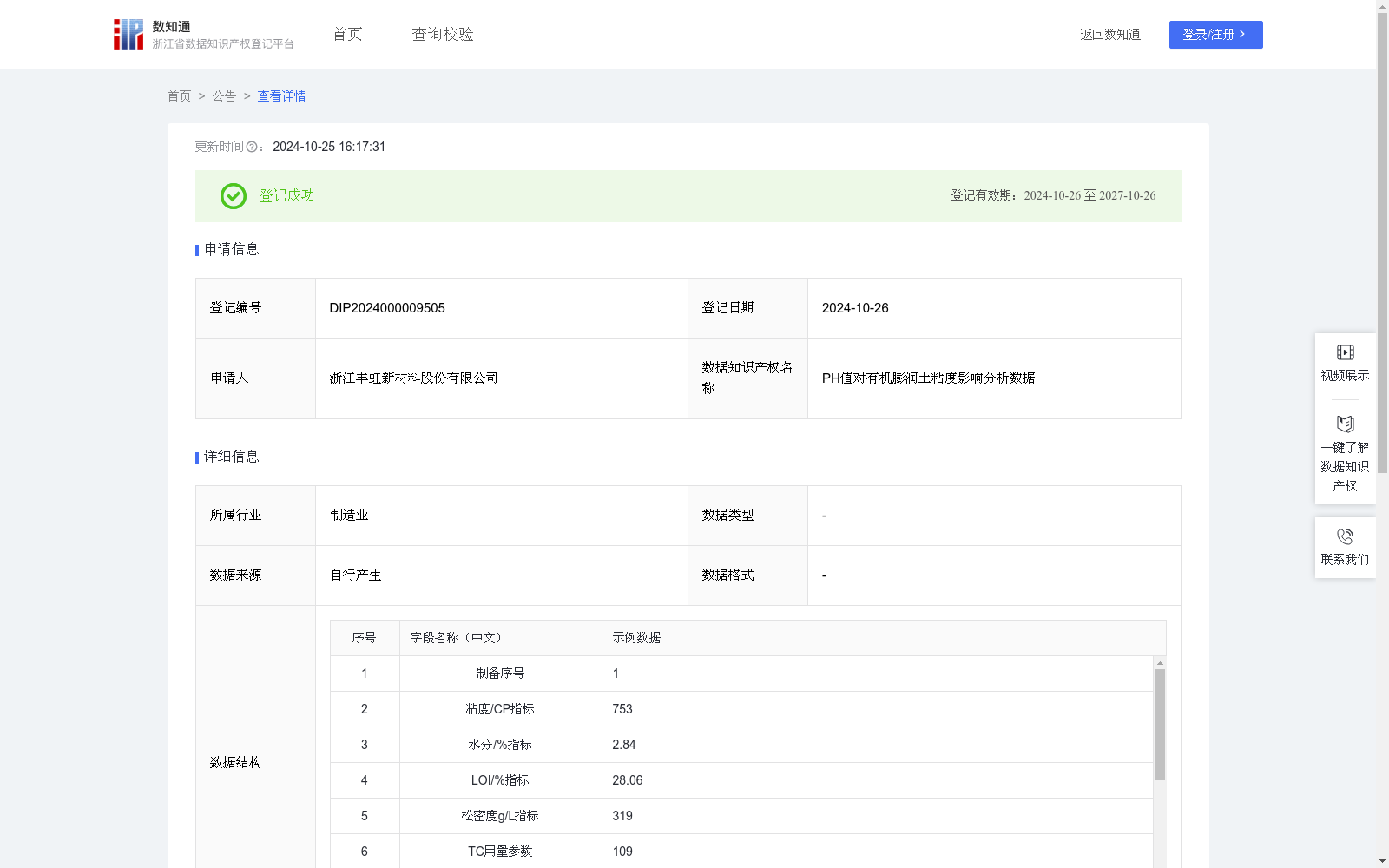
PH值对有机膨润土粘度影响分析数据
收藏浙江省数据知识产权登记平台2024-10-25 更新2024-10-26 收录
下载链接:
https://www.zjip.org.cn/home/announce/trends/75848
下载链接
链接失效反馈官方服务:
资源简介:
不同PH值条件下,有机膨润土的结构、电荷状态以及与其他物质的相互作用都会发生变化,进而影响其粘度等物理性质。在有机膨润土的生产和加工过程中,需要严格控制PH值条件,以确保产品的粘度符合应用要求。通过PH值对粘度的影响分析,可以了解有机膨润土的性能变化,为产品的生产和应用提供科学依据。对于提高产品质量和应用性能具有重要意义。在产品性能优化、质量控制、应用适应性评估、产品开发和创新以及经济效益分析等方面都具有重要作用。可以为全行业产业更新升级提供帮助和数据支撑,推动生产结构的优化。1:数据清洗与预处理。清洗异常或缺失数据,对数据进行标准化处理。2.输入参数:输入烘干前的各项参数:包括粘度、水分、LOI、松密度、TC用量参数,反应温度和反应时间。3.算法流程描述:将水分,LOI,松密度,TC用量参数,反应温度反应时间控制在合理区间内,该区间内数值的波动不会对产品的粘度产生影响,调节PH值,记录在不同PH值范围条件下膨润土的粘度变化,记录实测粘度,通过数值异变公式计算粘度变化值,即粘度变化值=(实测粘度-粘度)/粘度x100%。4.品质评价:将估算的烘干后粘度值与给定的品质标准进行比较,判断其属于优等品、合格品还是不合格品。划分标准如下:优等品:粘度在1000至1500之间(包含1000和1500)。合格品:粘度在500至1000之间(包含500,不包含1000)。不合格品:粘度小于500或大于1500。5.变化性评价:针对粘度变化值进行评价,0<变化值≤50%的,记为良,50%<变化值<100%的,记为优,其余数值均记为“异”。将品质评价与变化性评价相结合,筛选出双“优”的数据条目,进行升级提交,反馈给质量审核和生产部门,推动产品质量的升级进步。
Under different pH conditions, the structure, charge state and interactions with other substances of organobentonite will change, thereby affecting its physical properties such as viscosity. During the production and processing of organobentonite, pH conditions must be strictly controlled to ensure that the product viscosity meets application requirements. Analysis of the impact of pH on viscosity helps understand the performance changes of organobentonite, providing a scientific basis for product production and application, which is of great significance for improving product quality and application performance. It also plays an important role in product performance optimization, quality control, application adaptability assessment, product development and innovation, economic benefit analysis, etc. It can provide assistance and data support for the upgrading and renewal of the entire industry, and promote the optimization of production structure.
1. Data Cleaning and Preprocessing: Clean abnormal or missing data, and perform standardization processing on the dataset.
2. Input Parameters: Input various parameters before drying, including viscosity, moisture content, LOI (Loss on Ignition), bulk density, TC dosage, reaction temperature and reaction time.
3. Algorithm Flow Description: Control the parameters of moisture content, LOI, bulk density, TC dosage, reaction temperature and reaction time within a reasonable range, where fluctuations of values in this range will not affect the product viscosity. Adjust the pH value, record the viscosity changes of bentonite under different pH ranges, and record the measured viscosity. Calculate the viscosity change value through the numerical variation formula, that is, viscosity change value = [(measured viscosity - baseline viscosity) / baseline viscosity] × 100%.
4. Quality Evaluation: Compare the estimated post-drying viscosity value with the given quality standards to determine whether it belongs to superior product, qualified product or unqualified product. The classification criteria are as follows: Superior product: Viscosity ranges from 1000 to 1500 (including 1000 and 1500). Qualified product: Viscosity ranges from 500 to 1000 (including 500, excluding 1000). Unqualified product: Viscosity is less than 500 or greater than 1500.
5. Variability Evaluation: Evaluate the viscosity change value. A change value of 0 < change value ≤ 50% is marked as "good", 50% < change value < 100% is marked as "excellent", and all other values are marked as "abnormal". Combine the quality evaluation and variability evaluation, screen out the data entries with double "excellent" ratings, submit them for upgrading, and feed them back to the quality audit and production departments to promote the upgrading and improvement of product quality.
提供机构:
浙江丰虹新材料股份有限公司
创建时间:
2024-09-20
搜集汇总
数据集介绍
以上内容由遇见数据集搜集并总结生成


