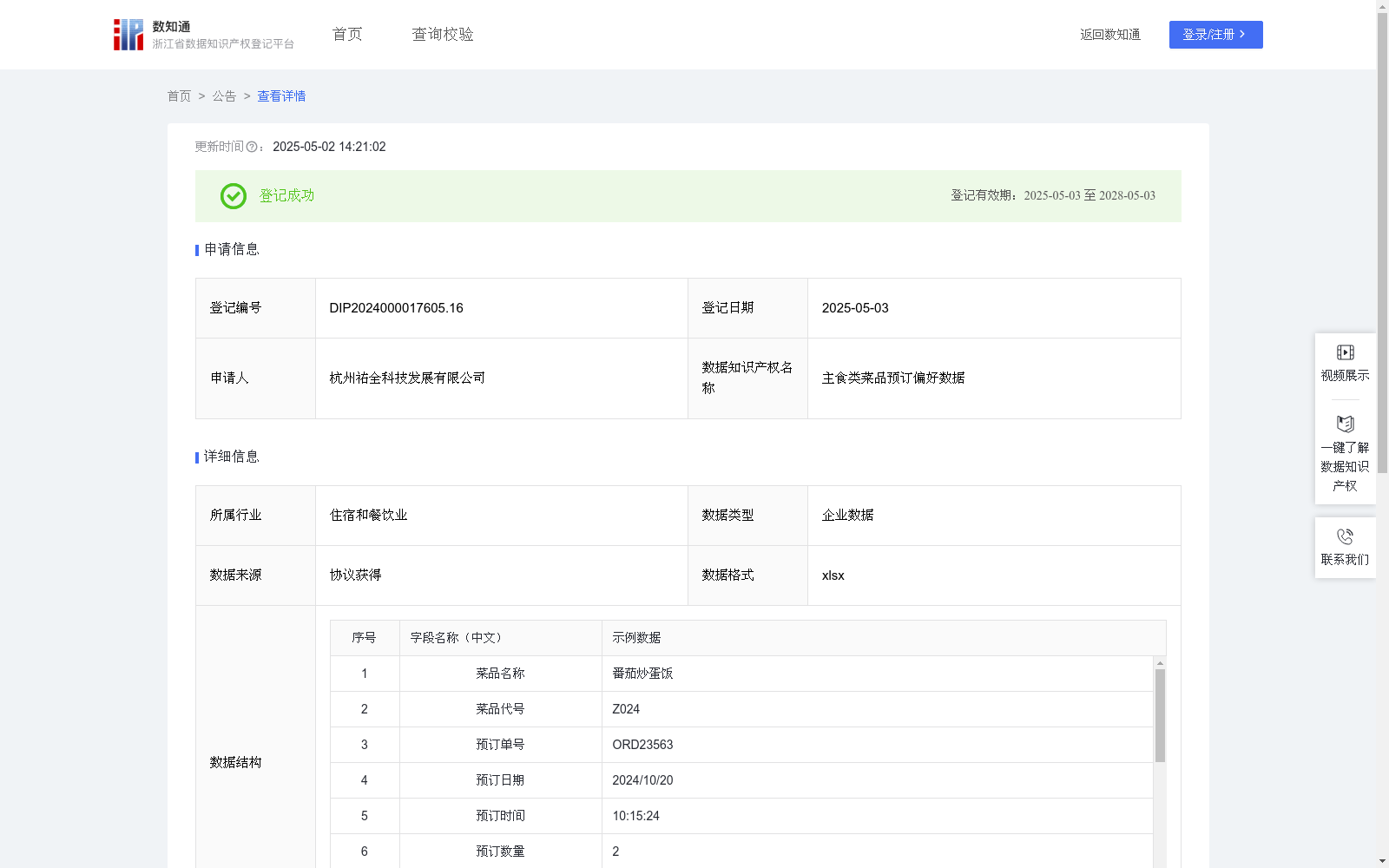
主食类菜品预订偏好数据
收藏资源简介:
主食类菜品预订偏好数据对于餐饮企业及其供应链管理至关重要。首先,这些数据使企业能够识别顾客对各类主食(如米饭、面食、杂粮等)的偏好,从而优化主食菜单设置,满足市场需求,提升顾客满意度。其次,通过分析预订率及其变化,企业能够预测主食食材的需求量,进而调整采购计划,减少库存积压和浪费,提高库存管理效率。此外,预订偏好数据还能为营销活动提供依据,比如通过推广高预订率的主食菜品来增加销量,或通过特价优惠来提升低预订率主食菜品的吸引力。1.数据抽取和预处理:(1)从公司众食光平台的订单系统抽取主食类菜品的预订数据,包括菜品名称、菜品代号、预订单号、预订日期、预订时间、预订数量。(2)通过数据清洗去除无效或错误记录,确保数据质量。 2.计算本菜品近30日及近30-60日间的预订率:(1)基于历史数据,利用SUM函数计算所有主食类菜品近30日及近30-60日间的预订总数量。(2)使用SUMIFS函数计算本菜品近30日及近30-60日间的预订总数量。(3)本菜品近30日预订率=本菜品近30日预订总数量/所有主食类菜品近30日预订总数量×100%;本菜品近30-60日间的预订率=本菜品近30-60日间的预订总数量/所有主食类菜品近30-60日间的预订总数量×100%。 3.输出近30日预订率排前三的主食类菜品:使用数据透视表对历史积累的预订率数据进行汇总和排序,使用RANK函数筛选出预订率最高的前三名菜品并进行可视化输出。 4.计算本菜品预订率变化值:本菜品预订率变化值=本菜品近30日预订率-本菜品近30-60日间的预订率。 6.本菜品预订偏好趋势判断:若变化值>0,则为“偏好提升”,若变化值<0,则为“偏好下降”,若变化值=0,则为“偏好不变”。
Booking preference data of staple food dishes is crucial for catering enterprises and their supply chain management. First, such data enables enterprises to identify customer preferences for various staple foods (such as rice, noodles, coarse grains, etc.), thereby optimizing the staple food menu settings, meeting market demand, and improving customer satisfaction. Second, by analyzing booking rates and their changes, enterprises can predict the demand for staple food ingredients, adjust procurement plans accordingly, reduce inventory overstock and waste, and improve inventory management efficiency. In addition, booking preference data can also provide a basis for marketing campaigns, such as increasing sales by promoting staple dishes with high booking rates, or enhancing the attractiveness of staple dishes with low booking rates through special offers. 1. Data Extraction and Preprocessing: (1) Extract booking data of staple food dishes from the order system of the company's Zhongshiguang Platform, including dish name, dish code, booking order number, booking date, booking time, and booking quantity. (2) Clean the data to remove invalid or erroneous records to ensure data quality. 2. Calculate the booking rate of the current dish in the past 30 days and during the period from 30 to 60 days ago: (1) Based on historical data, use the SUM function to calculate the total booking quantity of all staple food dishes in the past 30 days and during the period from 30 to 60 days ago. (2) Use the SUMIFS function to calculate the total booking quantity of the current dish in the past 30 days and during the period from 30 to 60 days ago. (3) Booking rate of the current dish in the past 30 days = (Total booking quantity of the current dish in the past 30 days / Total booking quantity of all staple food dishes in the past 30 days) × 100%; Booking rate of the current dish during the period from 30 to 60 days ago = (Total booking quantity of the current dish during the period from 30 to 60 days ago / Total booking quantity of all staple food dishes during the period from 30 to 60 days ago) × 100%. 3. Output the top 3 staple food dishes by booking rate in the past 30 days: Use a pivot table to summarize and sort the accumulated historical booking rate data, and use the RANK function to filter and visually output the top three dishes with the highest booking rates. 4. Calculate the booking rate change value of the current dish: Booking rate change value of the current dish = Booking rate of the current dish in the past 30 days - Booking rate of the current dish during the period from 30 to 60 days ago. 6. Judgment of the booking preference trend of the current dish: If the change value > 0, it is "Preference Improvement"; if the change value < 0, it is "Preference Decline"; if the change value = 0, it is "Preference Unchanged".