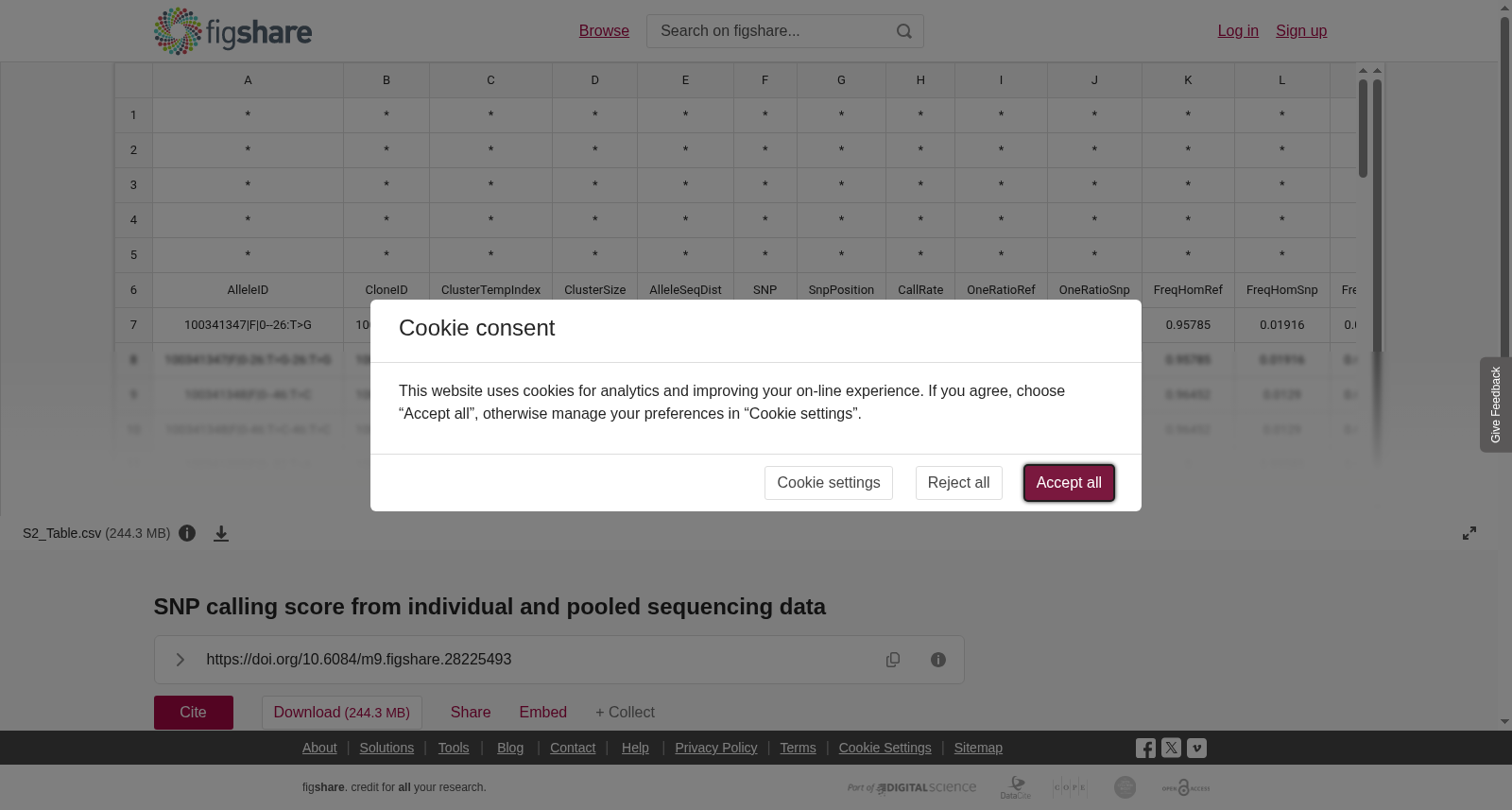
<b>SNP calling score from individual and pooled sequencing data</b>
收藏资源简介:
<i>Bromus auleticus</i>, a valuable forage grass native to the Pampa biome, is currently suffering genetic erosion. Therefore, it is central to assess the appropriate methodologies for developing population genomic studies and contributing to the conservation of this plant genetic resource. This study evaluated five accessions using two genotyping strategies: individual sequencing (ind-seq) and pooled sequencing (pool-seq). To compare their efficacy, was investigated the correlation between allele frequencies calculated using each approach. Geneticdiversity and population structure were also analyzed using both methods. These comparisons explicitly accounted for the potential effects of one or more of the following parameters: sample size, missing data, sequencing depth, and minor allele frequencies. Notably, the highest concordance and percentage of common SNPs between ind-seq and pool-seq was achieved using 30 to 60 plants per accession, with a maximum missing data threshold of 10% and a more tolerant minimum allele frequency threshold for pool-seq (0.01) compared to ind-seq (0.05). Reaching maximum similarity in allele frequencies also required a higher sequencing depth for pool-seq (4.8 million reads-Mr) than for ind-seq (0.9 Mr). Pools of 50 individuals yielded the highest number of polymorphic sites, averaging over 9,000 across all accessions at a sequencing depth of 4.8 Mr. Under these conditions, pool-seq consistently yielded a means across all accessions of 0.09 higher expected heterozygosity and 0.24 lower allelic richness compared to ind-seq across all accessions. The population structure detected with both methodologies showed agreement, aligning with the outcrossing nature of <i>B. auleticus</i> and the geographical origin of each accession. The average inbreeding coefficient of 0.2 indicates signs of inbreeding, highlighting the importance of conservation efforts of this valuable plant genetic resource. Based on these findings, two workflows were proposed to carry out population genomics studies of <i>Bromus auleticus</i>.
原产于潘帕斯生物群系的珍贵饲用禾草——草原雀麦(Bromus auleticus)目前正遭受遗传侵蚀。因此,评估适用于开展种群基因组学研究的方法体系,并为该植物遗传资源的保护提供支撑,具有核心重要性。本研究采用两种基因分型策略对5份种质材料进行了评估:个体测序(ind-seq)与混合池测序(pool-seq)。为比较二者的应用效能,本研究探究了两种方法计算得到的等位基因频率间的相关性。同时,采用两种方法分别分析了遗传多样性与种群结构。上述比较过程明确考量了以下一项或多项参数的潜在影响:样本量、缺失数据、测序深度以及次要等位基因频率(minor allele frequencies)。值得注意的是,当每份种质采用30~60株植株进行取样、最大缺失数据阈值设为10%,且混合池测序采用相较于个体测序更为宽松的最小等位基因频率阈值(混合池测序为0.01,个体测序为0.05)时,个体测序与混合池测序间的一致性最高,二者共有的单核苷酸多态性(Single Nucleotide Polymorphism, SNPs)占比也达到峰值。实现等位基因频率的最高相似性,同样需要混合池测序具备更高的测序深度:混合池测序需4.8百万读长(Mr),而个体测序仅需0.9 Mr。每份种质混合50个个体的样本,在测序深度为4.8 Mr时,可获得最多的多态性位点,所有种质的平均多态性位点数量超过9000个。在上述实验条件下,相较于个体测序,混合池测序在所有种质中的平均预期杂合度高出0.09,而等位基因丰富度则低0.24。两种方法检测得到的种群结构结果一致,与草原雀麦的异交特性及每份种质的地理起源相契合。平均近交系数为0.2,这表明该物种存在近交迹象,凸显了对这一珍贵植物遗传资源开展保护工作的必要性。基于上述研究结果,本研究提出了两套适用于草原雀麦种群基因组学研究的实验工作流程。