
建筑空调能耗预测模型训练数据
收藏浙江省数据知识产权登记平台2025-10-29 更新2025-10-30 收录
下载链接:
https://www.zjip.org.cn/home/announce/trends/6579798
下载链接
链接失效反馈官方服务:
资源简介:
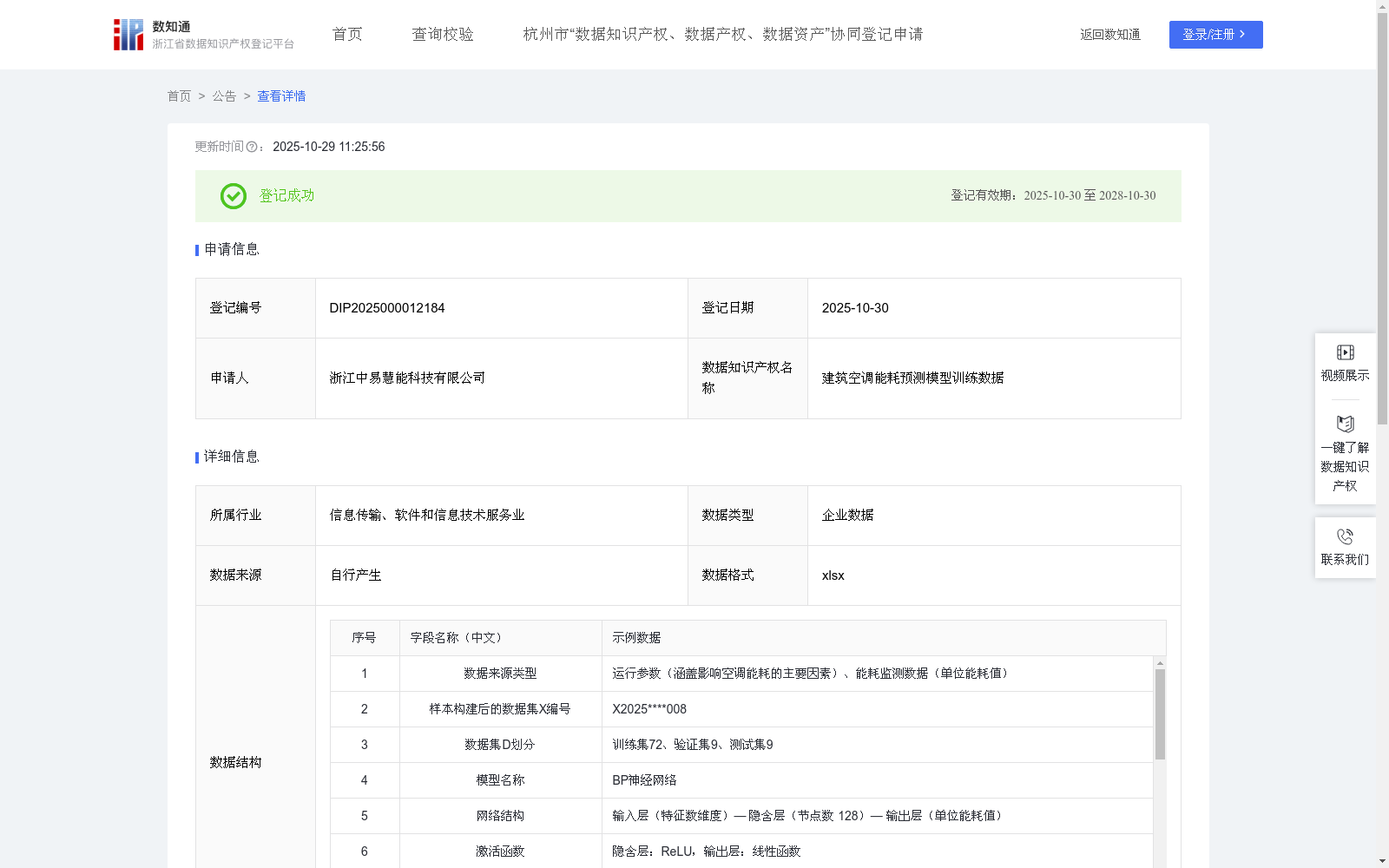
本建筑空调能耗预测模型训练数据可应用于建筑节能技术探索相关场景。数据通过整合建筑空调系统运行参数与能耗监测数据,构建运行参数-单位能耗值的监督学习样本对,形成训练数据集X并按8:1:1比例划分子集,保障不同建筑类型、季节区段及气象条件下数据均衡分布。其有助于模型学习运行参数与能耗值的关联规律,有利于提升模型对多元场景下能耗预测的准确性;同时,可为建筑节能领域技术经验的积累与方法优化提供参考性数据支撑。1.数据来源与样本构建:(1)原始数据为公司在研发及试验过程中形成的建筑空调系统的运行参数(涵盖影响空调能耗的主要因素)和能耗监测数据(单位能耗值)。(2)将建筑空调系统运行参数作为输入特征向量,单位能耗值作为输出标签,构成监督学习样本对,汇总形成后续训练用的数据集X;对数据集X赋予编号。
2.数据集划分:(1)对数据集X按8:1:1比例划分为训练集、验证集和测试集。(2)确保不同建筑类型、季节区段、气象条件在各子集中均衡分布,避免样本偏态。
3.模型训练与微调:(1)基准模型设置:采用BP神经网络(反向传播神经网络)作为主模型,构建输入层—隐含层—输出层结构。输入层维度与特征数一致,输出层为单位能耗值,激活函数使用ReLU(隐含层)与线性函数(输出层)。设置初始网络参数、训练轮次、学习率等。(2)使用训练集进行反向传播训练,采用梯度下降类优化器(Adam)。在每轮训练后,通过验证集实时监控损失函数值与泛化性能。(3)全流程记录每轮训练日志,包括损失变化、参数权重、训练时间与性能指标。
4.模型验证与参数调整:(1)在验证集上评估模型预测值与实际值的一致性,采用的指标包括MAE、MSE、R²、RMSE等。(2)结合自动评估与人工抽样审阅结果,调整模型参数。(3)记录每轮优化后的模型性能变化。
5.最终评估与效果分析:(1)在测试集上进行最终评估,使用多维指标综合判断模型能力,包括MAE、MSE、R²、RMSE等。(2)开展误差分析,识别常见错误模式,为后续优化提供依据。
6.模型优化建议:根据测试结果,给出模型优化建议,如调整学习率、增加正则化、改变网络结构等。
注:本算法规则涉及专利保护。
This training dataset for building air conditioning energy consumption prediction models is applicable to scenarios related to building energy conservation technology exploration.
The dataset is constructed by integrating the operating parameters of building air conditioning systems and energy consumption monitoring data, forming supervised learning sample pairs of operating parameters and unit energy consumption values, resulting in the training dataset X, which is split into subsets at a ratio of 8:1:1 to ensure balanced distribution of data across different building types, seasonal segments, and meteorological conditions.
It helps the model learn the correlation rules between operating parameters and energy consumption values, improving the accuracy of the model's energy consumption prediction in diverse scenarios; meanwhile, it provides reference data support for the accumulation of technical experience and method optimization in the building energy conservation field.
1. Data Source and Sample Construction:
(1) The original data consists of operating parameters of building air conditioning systems (covering the main factors affecting air conditioning energy consumption) and energy consumption monitoring data (unit energy consumption values) generated by the company during its R&D and testing processes.
(2) Take the operating parameters of the building air conditioning system as the input feature vector, and the unit energy consumption value as the output label to form supervised learning sample pairs, which are aggregated to form the training dataset X for subsequent use; assign serial numbers to dataset X.
2. Dataset Splitting:
(1) Split dataset X into training set, validation set, and test set at a ratio of 8:1:1.
(2) Ensure balanced distribution of different building types, seasonal segments, and meteorological conditions across each subset to avoid sample skewness.
3. Model Training and Fine-tuning:
(1) Baseline Model Setup: Adopt a BP neural network (Backpropagation Neural Network) as the main model, constructing an input layer - hidden layer - output layer structure. The dimension of the input layer matches the number of features, the output layer outputs unit energy consumption values, and ReLU (hidden layer) and linear function (output layer) are used as activation functions. Set initial network parameters, training epochs, learning rate, etc.
(2) Use the training set for backpropagation training, adopting a gradient descent-based optimizer (Adam). After each training epoch, monitor the loss function value and generalization performance in real-time via the validation set.
(3) Record training logs for each epoch throughout the entire process, including loss changes, parameter weights, training time, and performance metrics.
4. Model Validation and Parameter Adjustment:
(1) Evaluate the consistency between the model's predicted values and actual values on the validation set, using metrics including MAE, MSE, R², RMSE, etc.
(2) Adjust model parameters by combining automatic evaluation results and manual sampling reviews.
(3) Record the changes in model performance after each round of optimization.
5. Final Evaluation and Effect Analysis:
(1) Conduct final evaluation on the test set, comprehensively judge the model's capability using multi-dimensional metrics including MAE, MSE, R², RMSE, etc.
(2) Carry out error analysis to identify common error patterns, providing a basis for subsequent optimization.
6. Model Optimization Suggestions:
Provide model optimization suggestions based on the test results, such as adjusting the learning rate, adding regularization, changing the network structure, etc.
Note: This algorithm rule involves patent protection.
提供机构:
浙江中易慧能科技有限公司
创建时间:
2025-07-23
搜集汇总
数据集介绍
背景与挑战
背景概述
该数据集是用于建筑空调能耗预测的模型训练数据,包含525条企业自产的xlsx格式数据,涵盖运行参数和能耗监测值,按比例划分为训练、验证和测试子集以确保均衡。数据集支持BP神经网络模型训练,优化后测试集R²达0.88,适用于建筑节能场景,提升能耗预测准确性。
以上内容由遇见数据集搜集并总结生成


