
发票识别算法模型训练数据
收藏浙江省数据知识产权登记平台2025-10-24 更新2025-10-25 收录
下载链接:
https://www.zjip.org.cn/home/announce/trends/5087312
下载链接
链接失效反馈官方服务:
资源简介:
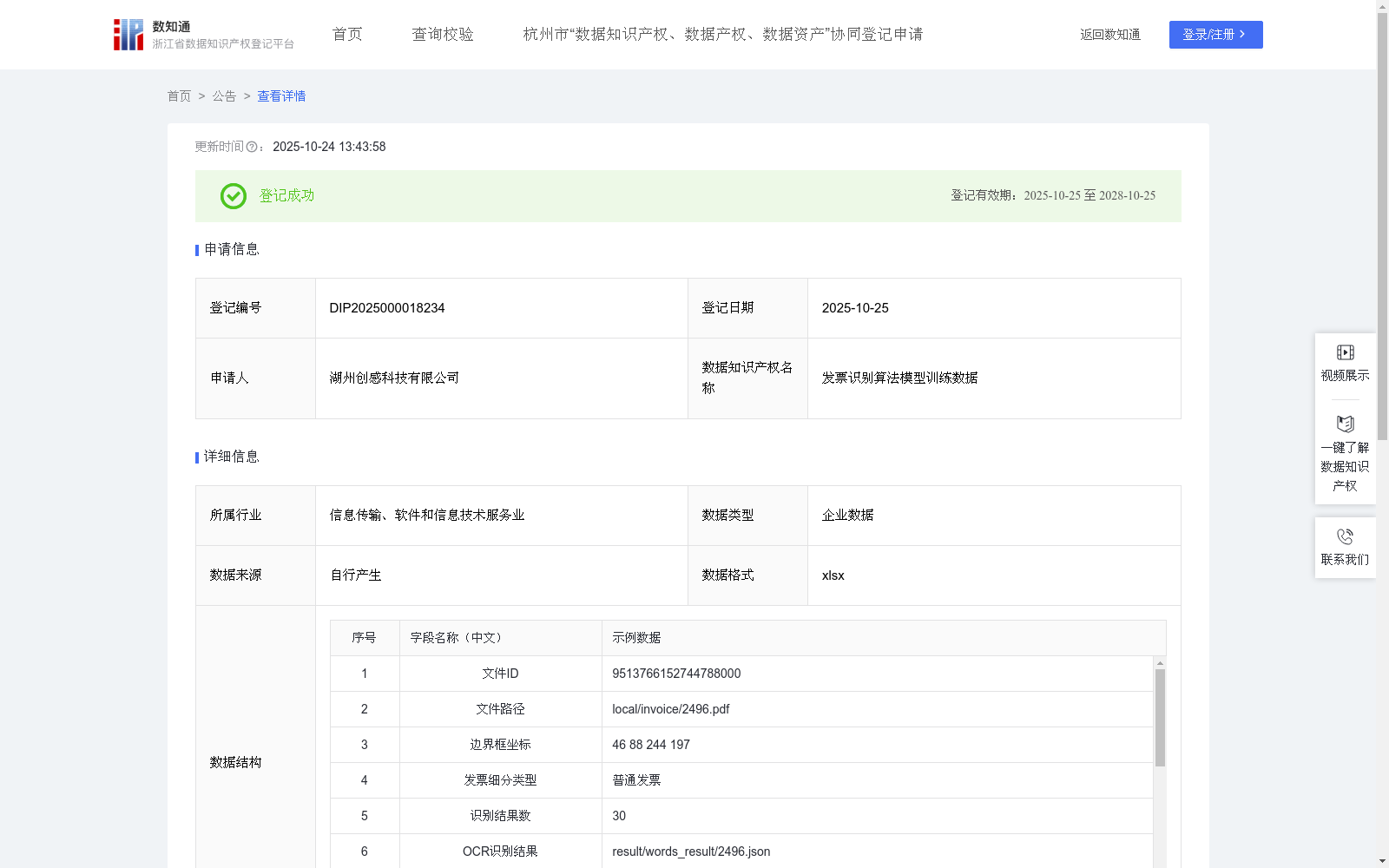
发票识别算法模型训练数据主要应用于企业运营、税务管理和金融服务等多个领域,是数字化转型的重要支撑。在企业财务核算场景中,这项技术解决了传统人工录入效率低、易出错的痛点。企业通过使用发票识别算法模型可自动提取发票的关键信息,直接缩短报销和入账等流程,显著降低财务人员的重复劳动。电商企业面对海量电子发票,借助该模型能快速完成进项税抵扣核对,避免因漏报、错报导致的税务风险。税务部门通过该智能识别模型对企业上传的发票数据进行批量校验,自动比对发票信息与申报数据的一致性,精准筛查违规行为。从日常报销到税务稽查,从企业管理到金融风控,发票识别模型扮演了重要的角色,提升各领域的工作效率与合规水平。1、数据采集:通过企业现有发票和模拟发票等手段生成收集了大量发票文件,并利用技术手段获取各种票据样本,包括不同拍摄角度、不同布局和不同质量的票据,确保数据的多样性从而为提升模型的泛化能力做准备。生成每个文件的ID,记录发票的文件路径。
2、文件预处理:使用PyTorch进行文件预处理,初始化并设置合理参数、数据集训练集路径和测试集路径,再使用openCV进行轮廓检测,得到发票四个角的边界框坐标,对图片进行去噪、图像增强等步骤,进行透视变换重置图片坐标获得新的标准识别图片。
3、文件数据识别:识别区域个数,针对发票各个识别区域坐标、对标准识别图片各个信息区域使用PP-OCRv4进行文字识别,得到发票关键信息,对识别得到的信息再进行整合为json文件,保存文件至对应文件夹,字段信息为OCR识别结果。
4、模型训练:针对对应的YOLOv10模型训练过程中,将模型不断调整权重,固定学习率和批量大小的值,优化训练损失和验证损失,并且记录训练的训练时长。在训练过程中,模型的训练精度随着训练进度会逐步上升。
5、模型评估:使用测试集对模型进行评估,计算模型在不同的样本数据下识别的训练精度、召回率、F1值、以及实时性能评估等性能指标,确保了模型的准确性与适应性。
6、模型应用:将最终训练后得到的模型应用到实际具体的项目中。在实际应用中,再对模型的实时性能、检测的准确性和处理速度进行检测和评估,确保满足应用需求,以达到快速、准确识别的效果。
The training data for invoice recognition algorithm models is mainly applied in multiple fields such as enterprise operations, tax management, and financial services, and serves as an important support for digital transformation. In enterprise financial accounting scenarios, this technology addresses the pain points of low efficiency and high error rates in traditional manual entry. By utilizing invoice recognition algorithm models, enterprises can automatically extract key information from invoices, directly shorten processes such as reimbursement and bookkeeping, and significantly reduce the repetitive workload of financial personnel. Faced with massive volumes of electronic invoices, e-commerce enterprises can use this model to quickly complete input tax deduction verification, avoiding tax risks caused by missed or incorrect declarations. Tax authorities can use this intelligent recognition model to perform batch verification on invoice data uploaded by enterprises, automatically compare the consistency between invoice information and declaration data, and accurately screen out violations. From daily reimbursement to tax audits, from enterprise management to financial risk control, invoice recognition models play an important role in improving work efficiency and compliance levels across various fields.
1. Data Collection: A large number of invoice documents are generated and collected through existing enterprise invoices and simulated invoices, and various bill samples are obtained via technical means, including bills with different shooting angles, layouts, and quality, to ensure data diversity and prepare for improving the model's generalization ability. The ID of each file is generated, and the file path of the invoice is recorded.
2. Document Preprocessing: PyTorch is used for document preprocessing, where reasonable parameters, the training set path and test set path of the dataset are initialized and configured. Then, OpenCV is used for contour detection to obtain the bounding box coordinates of the four corners of the invoice. Steps such as denoising and image enhancement are performed on the image, and perspective transformation is applied to reset the image coordinates to obtain new standard recognition images.
3. Document Data Recognition: The number of recognition regions is identified. For each recognition region coordinate of the invoice, text recognition is performed on each information region of the standard recognition image using PP-OCRv4 to obtain the key information of the invoice. The recognized information is then integrated into a JSON file, which is saved to the corresponding folder, with the field information being the OCR recognition results.
4. Model Training: During the training process of the corresponding YOLOv10 model, the model's weights are continuously adjusted, the learning rate and batch size are fixed, the training loss and validation loss are optimized, and the training duration is recorded. During training, the model's training accuracy gradually increases as the training progresses.
5. Model Evaluation: The test set is used to evaluate the model. Performance indicators such as recognition accuracy, recall rate, F1-score, and real-time performance evaluation under different sample data are calculated to ensure the model's accuracy and adaptability.
6. Model Application: The finally trained model is applied to actual specific projects. In practical applications, the model's real-time performance, detection accuracy, and processing speed are further tested and evaluated to ensure that it meets application requirements and achieve fast and accurate recognition effects.
提供机构:
湖州创感科技有限公司
创建时间:
2025-08-28
搜集汇总
数据集介绍
背景与挑战
背景概述
该数据集是用于发票识别算法模型训练的企业数据,包含2632条记录,以xlsx格式存储,涵盖文件路径、边界框坐标、OCR识别结果和模型性能指标等关键字段。它应用于企业财务、税务和金融领域,通过YOLOv10模型和PP-OCRv4技术实现自动化发票信息提取,提升效率和合规水平。
以上内容由遇见数据集搜集并总结生成



