
电力系统效率计算数据集
收藏阿里云天池2026-06-09 更新2024-03-07 收录
下载链接:
https://tianchi.aliyun.com/dataset/149625
下载链接
链接失效反馈官方服务:
资源简介:
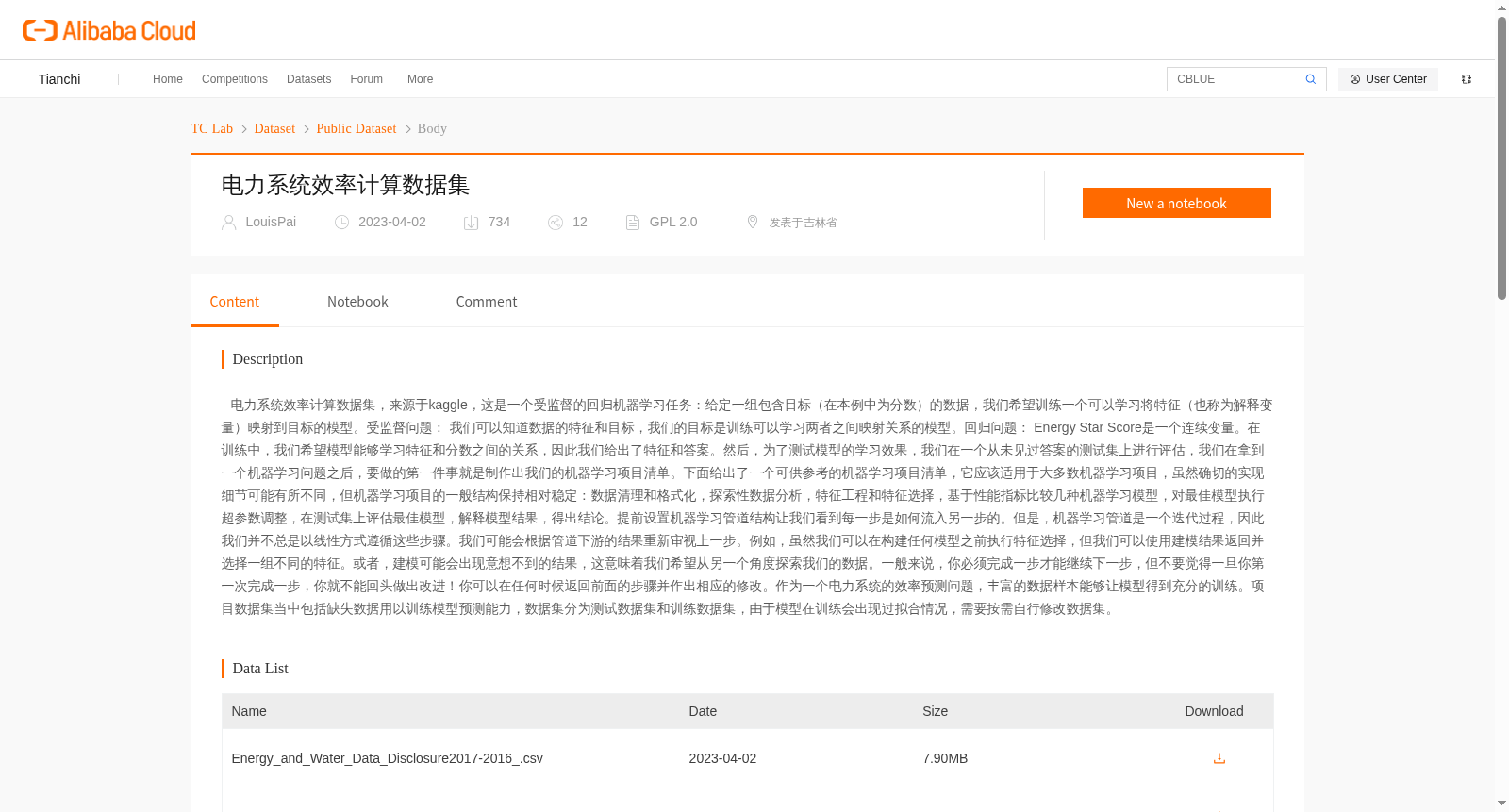
电力系统效率计算数据集,来源于kaggle,这是一个受监督的回归机器学习任务:给定一组包含目标(在本例中为分数)的数据,我们希望训练一个可以学习将特征(也称为解释变量)映射到目标的模型。受监督问题: 我们可以知道数据的特征和目标,我们的目标是训练可以学习两者之间映射关系的模型。回归问题: Energy Star Score是一个连续变量。在训练中,我们希望模型能够学习特征和分数之间的关系,因此我们给出了特征和答案。然后,为了测试模型的学习效果,我们在一个从未见过答案的测试集上进行评估,我们在拿到一个机器学习问题之后,要做的第一件事就是制作出我们的机器学习项目清单。下面给出了一个可供参考的机器学习项目清单,它应该适用于大多数机器学习项目,虽然确切的实现细节可能有所不同,但机器学习项目的一般结构保持相对稳定:数据清理和格式化,探索性数据分析,特征工程和特征选择,基于性能指标比较几种机器学习模型,对最佳模型执行超参数调整,在测试集上评估最佳模型,解释模型结果,得出结论。提前设置机器学习管道结构让我们看到每一步是如何流入另一步的。但是,机器学习管道是一个迭代过程,因此我们并不总是以线性方式遵循这些步骤。我们可能会根据管道下游的结果重新审视上一步。例如,虽然我们可以在构建任何模型之前执行特征选择,但我们可以使用建模结果返回并选择一组不同的特征。或者,建模可能会出现意想不到的结果,这意味着我们希望从另一个角度探索我们的数据。一般来说,你必须完成一步才能继续下一步,但不要觉得一旦你第一次完成一步,你就不能回头做出改进!你可以在任何时候返回前面的步骤并作出相应的修改。作为一个电力系统的效率预测问题,丰富的数据样本能够让模型得到充分的训练。项目数据集当中包括缺失数据用以训练模型预测能力,数据集分为测试数据集和训练数据集,由于模型在训练会出现过拟合情况,需要按需自行修改数据集。
This dataset for power system efficiency calculation is sourced from Kaggle, and it is a supervised regression machine learning task. Given a dataset containing the target (score in this case), we aim to train a model that learns to map features (also known as explanatory variables) to the target. Supervised problem: We have access to both the features and the target of the data, and our goal is to train a model that learns the mapping relationship between them. Regression problem: The Energy Star Score is a continuous variable. In training, we want the model to learn the relationship between features and scores, so we provide both the features and the corresponding ground truth. Then, to evaluate the model's learning performance, we test it on a test set where the ground truth is unseen. The first step when tackling a machine learning problem is to develop a machine learning project checklist. A reference machine learning project checklist is provided below, which applies to most machine learning projects. Although the exact implementation details may vary, the general structure of a machine learning project remains relatively stable: data cleaning and formatting, exploratory data analysis, feature engineering and feature selection, comparing multiple machine learning models based on performance metrics, performing hyperparameter tuning on the best-performing model, evaluating the best model on the test set, interpreting model results, and drawing conclusions. Pre-defining the machine learning pipeline structure allows us to visualize how each step flows into the next. However, a machine learning pipeline is an iterative process, so we do not always follow these steps in a linear fashion. We may revisit earlier steps based on the results from downstream stages of the pipeline. For example, while we can perform feature selection before building any models, we can use modeling results to go back and select a different set of features. Alternatively, modeling may yield unexpected results, meaning we wish to explore our data from another perspective. Generally, you must complete one step before proceeding to the next, but do not assume that you cannot revisit and refine a step after completing it once! You can return to any previous step and make corresponding modifications at any time. As a power system efficiency prediction problem, abundant data samples enable sufficient training of the model. The project dataset includes missing data to train the model's predictive capability. The dataset is split into a training set and a test set. Since models may suffer from overfitting during training, you can modify the dataset as needed.
提供机构:
阿里云天池
创建时间:
2023-04-02
搜集汇总
数据集介绍
背景与挑战
背景概述
该数据集是一个用于电力系统效率预测的监督学习回归任务数据集,包含训练和测试数据,旨在通过特征与目标(Energy Star Score)的映射关系训练模型。数据集来源于kaggle,提供了多个CSV文件和相关图像文件,适用于机器学习项目的数据清理、特征工程和模型评估等步骤。
以上内容由遇见数据集搜集并总结生成


