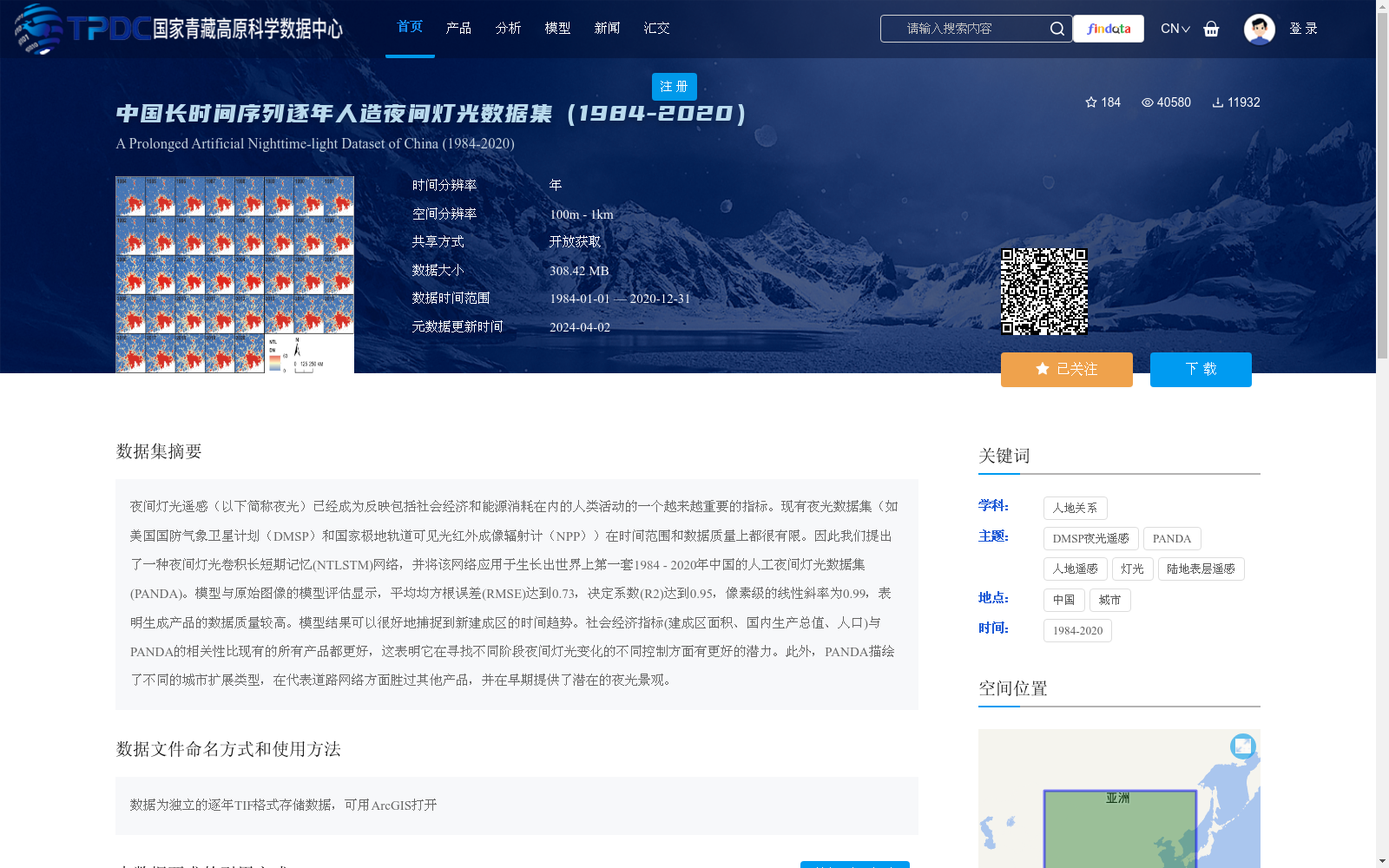
中国长时间序列逐年人造夜间灯光数据集(1984-2020)
收藏资源简介:
夜间灯光遥感(以下简称夜光)已经成为反映包括社会经济和能源消耗在内的人类活动的一个越来越重要的指标。现有夜光数据集(如美国国防气象卫星计划(DMSP)和国家极地轨道可见光红外成像辐射计(NPP))在时间范围和数据质量上都很有限。因此我们提出了一种夜间灯光卷积长短期记忆(NTLSTM)网络,并将该网络应用于生长出世界上第一套1984 - 2020年中国的人工夜间灯光数据集(PANDA)。模型与原始图像的模型评估显示,平均均方根误差(RMSE)达到0.73,决定系数(R2)达到0.95,像素级的线性斜率为0.99,表明生成产品的数据质量较高。模型结果可以很好地捕捉到新建成区的时间趋势。社会经济指标(建成区面积、国内生产总值、人口)与PANDA的相关性比现有的所有产品都更好,这表明它在寻找不同阶段夜间灯光变化的不同控制方面有更好的潜力。此外,PANDA描绘了不同的城市扩展类型,在代表道路网络方面胜过其他产品,并在早期提供了潜在的夜光景观。
Nighttime light (NTL) remote sensing has emerged as an increasingly critical indicator for reflecting human activities including socio-economic conditions and energy consumption. Existing NTL datasets, such as those from the Defense Meteorological Satellite Program (DMSP) and the National Polar-orbiting Visible Infrared Imaging Radiometer (NPP), suffer from limitations in both temporal coverage and data quality. Therefore, we propose a Nighttime Light Convolutional Long Short-Term Memory (NTLSTM) network, and apply it to generate the world's first artificial nighttime light dataset (PANDA) for China spanning from 1984 to 2020. Model evaluations against original imagery show that the average root mean square error (RMSE) reaches 0.73, the coefficient of determination (R²) reaches 0.95, and the pixel-level linear slope is 0.99, confirming the high data quality of the generated product. The model outputs can accurately capture the temporal trends of newly built-up areas. The correlations between socio-economic indicators (built-up area, gross domestic product, and population) and PANDA outperform those of all existing products, indicating its superior potential in identifying distinct controlling factors for nighttime light variations across different development stages. Furthermore, PANDA characterizes diverse urban expansion types, outperforms other products in representing road networks, and provides plausible nighttime light landscapes in early periods.