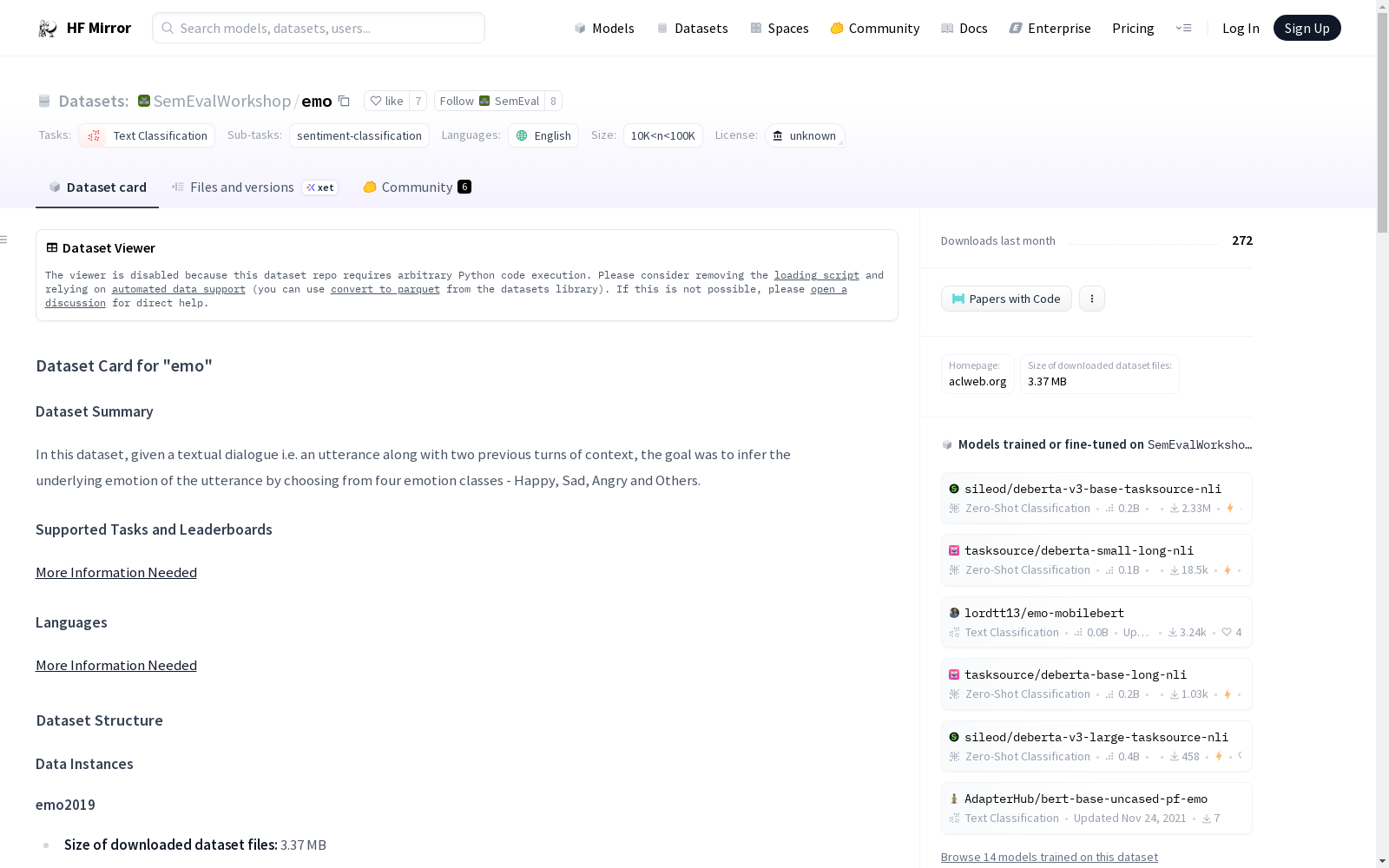
SemEvalWorkshop/emo
收藏数据集概述
数据集描述
数据集摘要
该数据集包含文本对话,即一个话语及其前两个上下文回合,目标是推断话语的潜在情绪,从四个情绪类别中选择:快乐、悲伤、愤怒和其他。
支持的任务和排行榜
该数据集支持的任务是情感分类。
语言
数据集使用的语言是英语。
数据集结构
数据实例
一个训练集的示例如下: json { "label": 0, "text": "dont worry im girl hmm how do i know if you are whats ur name" }
数据字段
数据字段在所有拆分中都是相同的。
emo2019
text: 一个字符串特征。label: 一个分类标签,可能的值包括others(0),happy(1),sad(2),angry(3)。
数据拆分
| name | train | test |
|---|---|---|
| emo2019 | 30160 | 5509 |
数据集创建
数据集创建理由
该数据集的创建旨在促进文本中情绪检测的研究。
源数据
源数据来自用户与对话代理的交互。
标注
标注由专家生成。
个人和敏感信息
数据集中不包含个人和敏感信息。
使用数据的注意事项
数据集的社会影响
该数据集可能对情绪分析和对话系统的发展产生积极影响。
偏见讨论
数据集可能存在情绪类别分布不均等偏见。
其他已知限制
数据集的许可证未知。
附加信息
数据集策展人
数据集由专家和众包方式创建。
许可信息
数据集的许可证未知。
引用信息
bibtex @inproceedings{chatterjee-etal-2019-semeval, title={SemEval-2019 Task 3: EmoContext Contextual Emotion Detection in Text}, author={Ankush Chatterjee and Kedhar Nath Narahari and Meghana Joshi and Puneet Agrawal}, booktitle={Proceedings of the 13th International Workshop on Semantic Evaluation}, year={2019}, address={Minneapolis, Minnesota, USA}, publisher={Association for Computational Linguistics}, url={https://www.aclweb.org/anthology/S19-2005}, doi={10.18653/v1/S19-2005}, pages={39--48}, abstract={In this paper, we present the SemEval-2019 Task 3 - EmoContext: Contextual Emotion Detection in Text. Lack of facial expressions and voice modulations make detecting emotions in text a challenging problem. For instance, as humans, on reading Why dont you ever text me! we can either interpret it as a sad or angry emotion and the same ambiguity exists for machines. However, the context of dialogue can prove helpful in detection of the emotion. In this task, given a textual dialogue i.e. an utterance along with two previous turns of context, the goal was to infer the underlying emotion of the utterance by choosing from four emotion classes - Happy, Sad, Angry and Others. To facilitate the participation in this task, textual dialogues from user interaction with a conversational agent were taken and annotated for emotion classes after several data processing steps. A training data set of 30160 dialogues, and two evaluation data sets, Test1 and Test2, containing 2755 and 5509 dialogues respectively were released to the participants. A total of 311 teams made submissions to this task. The final leader-board was evaluated on Test2 data set, and the highest ranked submission achieved 79.59 micro-averaged F1 score. Our analysis of systems submitted to the task indicate that Bi-directional LSTM was the most common choice of neural architecture used, and most of the systems had the best performance for the Sad emotion class, and the worst for the Happy emotion class} }
贡献