quantum-sensing-and-metrology
收藏资源简介:
Neura Parse — 量子传感与计量学数据集是一个专注于量子传感与计量学领域的高级垂直数据集,属于Neura Parse数据集集合的一部分。其核心主题围绕第二次量子革命中的传感支柱,深入探讨量子费希尔信息与克拉美-罗界如何设定终极精度极限,纠缠与压缩如何将传感器从标准量子极限推向海森堡极限,以及这些概念如何在光学原子钟、NV中心磁强计、原子干涉重力仪和压缩光引力波探测器等平台中实现。数据集内容基于2024-2026年的前沿技术(如NIST的5.5e-19 Al+钟、LIGO频率相关压缩、里德堡自旋压缩钟、IonQ于2025年收购Vector Atomic等),并考虑了真实的噪声和退相干因素。这是一个多格式数据集,包含212条记录,混合了指令/响应对、开放式问答、多项选择题问答、可运行代码任务以及百科全书式的概念条目,统一在一个模式之下。记录类型包括:qa_open(68条)、concept(61条)、qa_mcq(29条)、code(19条)、corpus(19条)和instruction(16条)。数据集内容按难度分为入门(2条)、本科(35条)、研究生(100条)和研究(75条)四个等级。其知识体系涵盖六大主题领域:计量学理论与基本极限、纠缠增强与非经典态协议、原子钟与时间/频率计量、固态自旋传感器与磁强计、干涉仪、原子与光子传感平台,以及噪声、退相干极限与纠错计量学。每条记录共享一个通用结构(包括ID、领域、记录类型、类别、主题、子主题、难度、语言、来源、许可证、标签、来源、质量、元数据等字段),并包含特定于其记录类型的字段。数据集采用混合来源生成,结合了专家策划的研究分类法和LLM合成技术,并经过严格的质量验证,包括物理和数学推导的逐行检查、代码运行验证、事实与数据来源核对、符号规范化和难度匹配等。该数据集旨在用于量子计算感知人工智能系统的研究与开发。需要注意的是,虽然经过验证,但合成记录可能包含错误,不应将其视为权威的科学参考文献,关键事实需对照原始来源进行核实。
Neura Parse — Quantum Sensing and Metrology Dataset is an advanced vertical dataset focused on the field of quantum sensing and metrology, and is part of the Neura Parse dataset collection. Its core theme revolves around the sensing pillar of the Second Quantum Revolution, in-depth exploring how Quantum Fisher Information and Cramér-Rao Bound set the ultimate precision limits, how entanglement and squeezing push sensors from the Standard Quantum Limit (SQL) to the Heisenberg Limit, and how these concepts are implemented in platforms such as optical atomic clocks, NV-center magnetometers, atom interferometric gravimeters, and squeezed-light gravitational wave detectors. The dataset content is based on cutting-edge technologies from 2024 to 2026 (e.g., NIST's 5.5e-19 Al+ clock, LIGO's frequency-dependent squeezing, Rydberg spin-squeezed clocks, IonQ's acquisition of Vector Atomic in 2025, etc.), and takes into account real noise and decoherence factors. This is a multi-format dataset containing 212 records, mixing instruction/response pairs, open-ended question-and-answer sets, multiple-choice question-and-answer tasks, runnable code tasks, and encyclopedic conceptual entries, all unified under a consistent schema. The record types include: qa_open (68 entries), concept (61 entries), qa_mcq (29 entries), code (19 entries), corpus (19 entries), and instruction (16 entries). The dataset content is categorized into four difficulty levels: Beginner (2 entries), Undergraduate (35 entries), Graduate (100 entries), and Research (75 entries). Its knowledge system covers six major thematic domains: metrology theory and fundamental limits, entanglement-enhanced and non-classical state protocols, atomic clocks and time/frequency metrology, solid-state spin sensors and magnetometers, interferometers, atomic and photonic sensing platforms, as well as noise, decoherence limits and error-corrected metrology. Each record shares a universal structure (including fields such as ID, domain, record type, category, topic, subtopic, difficulty, language, source, license, tags, provenance, quality, metadata, etc.), and also contains fields specific to its respective record type. The dataset is generated from mixed sources, combining expert-curated research taxonomies and LLM-based synthesis techniques, and has undergone strict quality validation, including line-by-line checks of physical and mathematical derivations, code execution verification, fact and data source cross-checking, symbol standardization, and difficulty matching, among others. This dataset is intended for research and development of quantum-aware artificial intelligence systems. It should be noted that although subjected to verification, synthetic records may contain errors and should not be treated as authoritative scientific references; key factual details should be cross-checked against original sources.
数据集:Neura Parse — Quantum Sensing & Metrology
基本信息
- 领域:量子传感与计量学 (quantum-sensing-and-metrology)
- 语言:英语 (en)
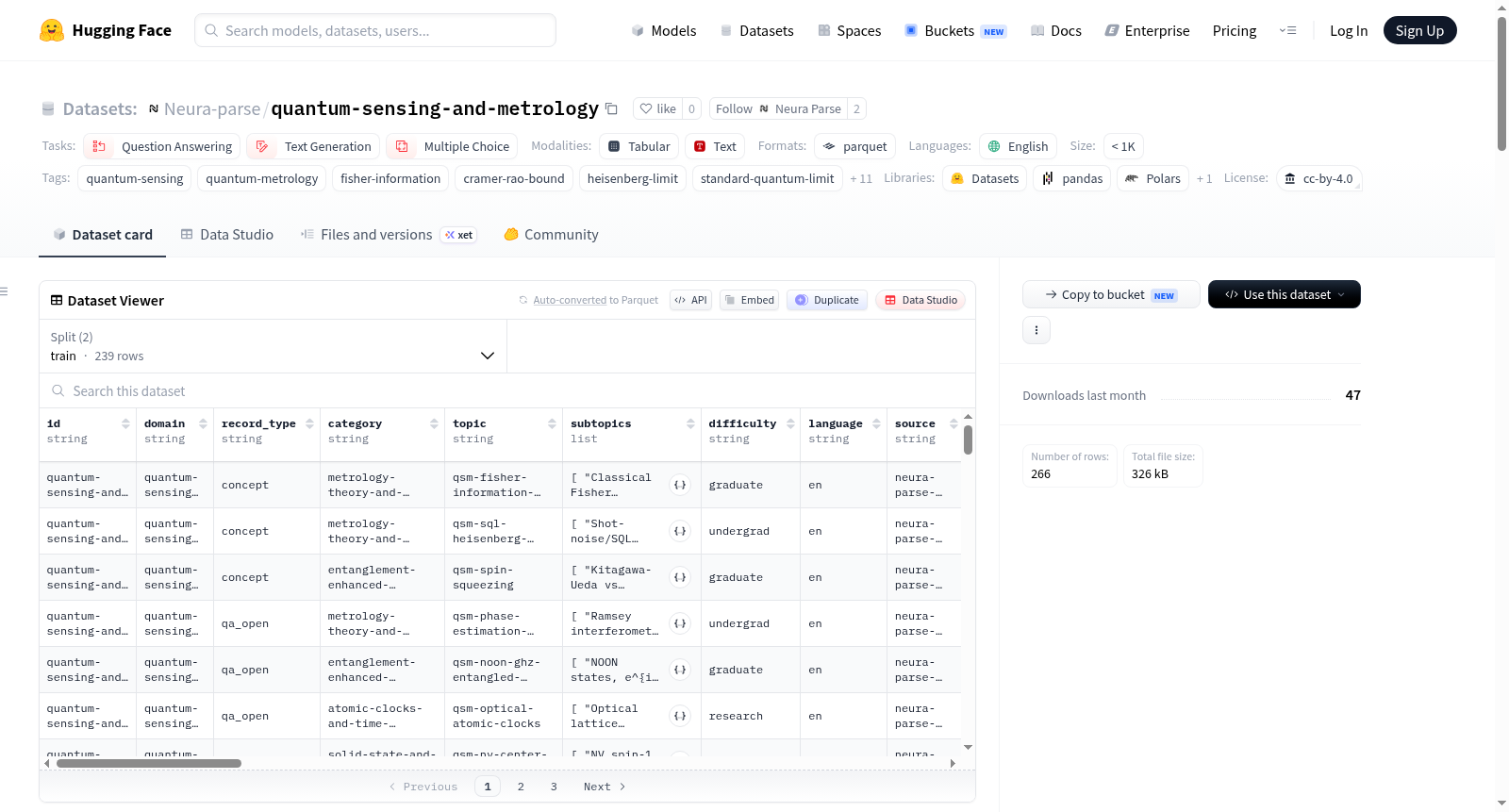
- 记录总数:266条
- 许可证:CC-BY-4.0
- 版本:0.7.0
记录类型分布
| 记录类型 | 数量 |
|---|---|
| 开放式问答 (qa_open) | 94 |
| 概念条目 (concept) | 71 |
| 多项选择问答 (qa_mcq) | 36 |
| 代码任务 (code) | 23 |
| 语料文本 (corpus) | 23 |
| 指令对 (instruction) | 19 |
| 总计 | 266 |
难度分布
| 难度级别 | 数量 |
|---|---|
| 入门 (intro) | 2 |
| 本科 (undergrad) | 38 |
| 研究生 (graduate) | 134 |
| 研究 (research) | 92 |
主题分类
- 计量学理论与基本极限 — 经典/量子Fisher信息与Cramér-Rao界、标准量子极限与海森堡极限、相位/多参数估计(4个主题)
- 纠缠增强与非经典态协议 — 自旋压缩、NOON/GHZ路径纠缠探针、压缩光及其产生、读出、增益与损耗/退相干脆弱性(3个主题)
- 原子钟与时间/频率计量学 — 光晶格与单离子钟、系统不确定度预算、时间域稳定性、纠缠增强钟与钟网络(2个主题)
- 固态自旋传感器与磁力测量 — 氮空位(NV)中心等室温量子磁力计:ODMR读出、DC/AC传感、动力学去耦光谱学、灵敏度工程与纳米尺度NMR(2个主题)
- 干涉测量、原子与光子传感平台 — 物质波与光学干涉传感器:原子干涉重力测量与惯性传感、压缩光引力波探测、量子成像/照明(2个主题)
- 噪声、退相干极限与纠错计量学 — 退相干对量子增强传感的限制、海森堡极限不可达性、量子纠错恢复海森堡标度(2个主题)
数据模式(Schema)
每条记录共有通用字段(id, domain, record_type, category, topic, subtopics, difficulty, language, source, source_url, license, tags, provenance, quality, metadata)以及依据 record_type 的特定字段。
数据来源与方法
- 来源:混合来源。v0.1 由专家策划的研究分类体系生成(方法:人工策划),结合策展与LLM合成进行扩展。
- 每条记录携带:
provenance对象(方法、生成器、管道版本)和可选的quality对象(事实性/清晰度评分)。
质量保证
- 每个
answer_sketch经过物理与数学验证:推导逐行检查,每个标度/精度声明标注其极限(SQL 1/√N 与 Heisenberg 1/N)及其噪声模型。 qa_mcq答案包含四个选项(A)-D))、一个正确选项标记及单行解释,同时说明每个干扰项错误原因。code代码在 Python 3.11 + numpy(及 QuTiP)下端到端运行,并包含至指定容差的数值断言。corpus段落为80-150词、自包含,不包含虚构或不可验证的定量声明。- 所有arXiv标识符均经arxiv.org验证;期刊/RMP引用为真实出版场所;时效性事实(5.5e-19 Al+钟、O4 LIGO压缩dB、Rydberg自旋压缩钟、IonQ-Vector Atomic 2025)经核查。
- 每条记录的
topic_id存在于分类体系中,超出范围的材料在审查中被剔除。 - 符号统一至术语表(F_Q, SLD L, xi_R^2, gamma_e, Delta theta, dB = -8.686 r)。
- 难度标签与内容深度匹配,整体分布保持在目标难度混合的+/-0.05以内。
预期用途与限制
- 用途:用于量子计算感知AI系统的研究与开发。
- 限制:合成记录由模型生成,虽经验证仍可能包含错误;请勿将此数据集视为权威科学参考,关键事实需核实原始来源。