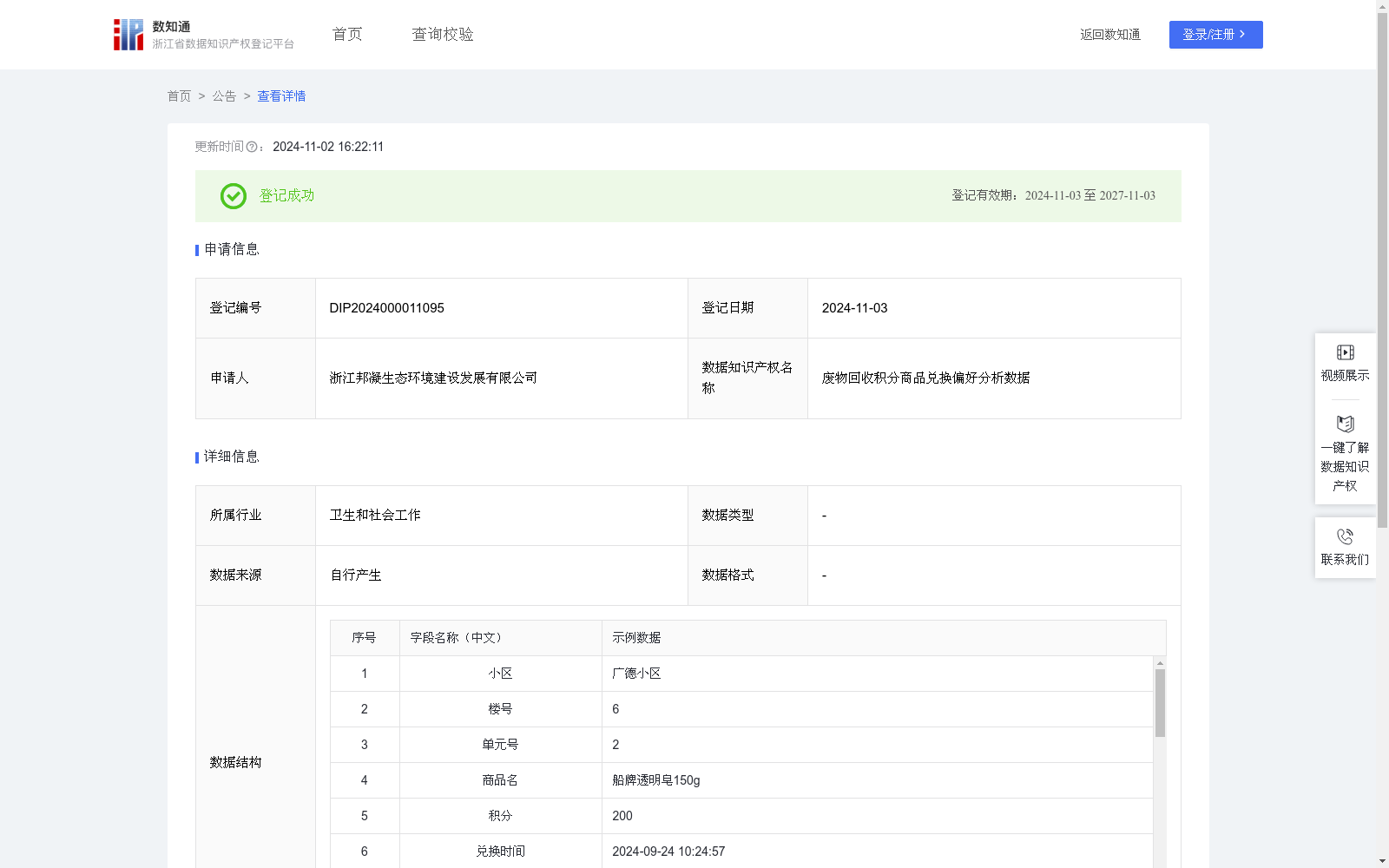
废物回收积分商品兑换偏好分析数据
收藏资源简介:
通过分析积分兑换商品的兑换数量和积分使用情况,可以了解用户对不同商品的偏好需求,辅助调节物品投放政策。2、用户行为分析:分析用户的兑换行为,了解哪些商品更受欢迎,哪些时间段兑换活动更活跃。提高废物回收率,增强了居民的环保意识和社区归属感。3推动积分政策优化:根据兑换数据和积分兑换商品热力值,调整积分政策,如积分获取、积分兑换门槛等。为环保相关政策制定者提供有价值的参考。1、数据采集:通过管理后台,收集数据内容包括地址信息(小区,楼号,单元号,门牌号),商品名,积分,兑换时间。2、数据处理:对收集到的数据进行清洗,去除无效或错误的数据记录,如重复的订单编号、不合理的兑换数量等。通过COUNTIF和SUMIF函数计算各种商品的使用积分总量,计算全部商品的兑换数量和使用积分总量;商品兑换热力值=(0.7*(本商品兑换数量/全部商品兑换数量+0.3*(本商品使用积分量/全部商品使用积分量))*100,热力值保留小数点后两位。4、将热力值反馈给管理员,进行后续的排序分析,统筹物品投放策略。
Analyzing the redemption volume and points usage of points-redeemable items can help understand users' preferences for different products and assist in adjusting item allocation policies. 2. User Behavior Analysis: Analyze users' redemption behaviors to identify which products are more popular and during which time periods redemption activities are more active. This helps improve waste recycling rates, enhance residents' environmental awareness and foster a stronger sense of community belonging. 3. Optimization of Points Policy: Adjust the points policy, such as points acquisition rules and redemption thresholds, based on redemption data and the heat value of points-redeemable items, providing valuable references for environmental protection policymakers. 1. Data Collection: Collect data via the management backend, including address information (residential community, building number, unit number, house number), product name, points required for redemption, and redemption time. 2. Data Processing: Clean the collected data to remove invalid or erroneous records, such as duplicate order numbers and unreasonable redemption quantities. Use the COUNTIF and SUMIF functions to calculate the total points used for each product, as well as the total redemption volume and total points used across all products. The product redemption heat value is calculated as: (0.7*(this product's redemption volume / total redemption volume of all products) + 0.3*(this product's total points used / total points used across all products)) * 100, with the heat value rounded to two decimal places. 4. Feed the heat values back to administrators for subsequent sorting analysis and overall coordination of item allocation strategies.