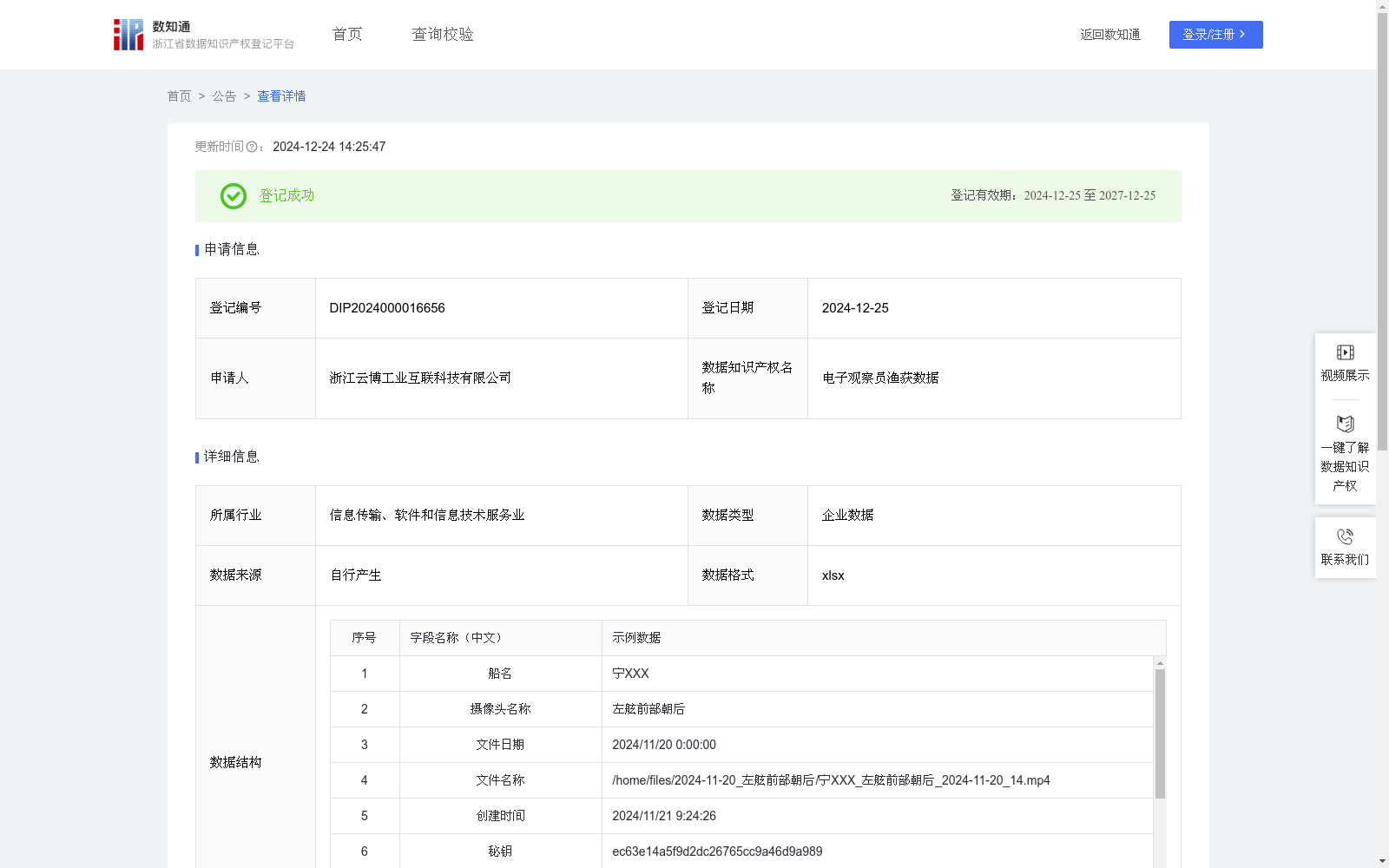
电子观察员渔获数据
收藏资源简介:
渔业监管部门需要对远洋船舶捕捞行为、鱼获数量等数据进行分析,形成分析性报表;船端按照要求存储相关录像,因录像数据量较大,分析数据耗费人力;平台通过AI识别捕捞行为形成数据并结合人为分析,形成捕捞分析报告,可作为渔业监管政策的数据支撑;使其更科学更规范的指定相关政策。1、数据采集:通过程序把NVR里的历史视频下载并存储到Nas存储模块里,按照日期和摄像头名称分类,并将数据保存至船端存储设备。 2、数据导入:将船端存储设备拿到岸端,连接到系统内网中,通过系统界面导入到文件服务器,电子监控岸端管理平台通过文件服务器读取文件。 3、数据加密:为了确保视频数据的安全性和完整性,系统首先通过对视频文件进行 MD5 哈希加密,生成唯一的加密密钥。然后,结合船舶的 MMSI 九位识别码加上该密钥对视频进行加密压缩处理,并将压缩后的文件存储至本地存储模块。接着,将加密后的视频信息上传至岸端存储系统。待本地存储模块达到容量限制后,系统会从岸端检索相应的密钥信息,并对上传的视频数据进行解密与解压,确保数据未被篡改或损坏。通过这一系列安全措施,确保了视频数据的机密性、完整性以及防篡改性。4、鱼获识别:在视频上传至岸端服务器后,视频处理系统按照预设的时间间隔对视频内容进行帧截图,并利用经过训练的人工智能模型对每一帧图像进行深度分析,以自动识别画面中的渔获物。通过该智能识别过程,系统能够精准定位视频中出现渔获的具体时间段,并提取出渔获的尺寸信息,最终将这些数据进行标注与记录,从而实现高效的渔获监测与管理。 5、数据应用:系统前端根据鱼获时间位置,跳转到对应时间点的视频中,从而过滤掉无效画面,提高工作效率
Fisheries regulatory authorities need to analyze data such as the fishing behaviors and catch volumes of deep-sea vessels to generate analytical reports. Vessels are required to store relevant surveillance footage, but the large volume of video data makes manual data analysis labor-intensive. The platform leverages AI to identify fishing behaviors and generates corresponding data, which is then combined with manual analysis to produce fishing analysis reports. These reports can serve as data support for formulating fisheries regulatory policies, enabling more scientific and standardized policy-making. 1. Data Collection: The system downloads historical video footage from Network Video Recorders (NVRs) and stores it in the Network-Attached Storage (NAS) module, categorized by date and camera name, before saving the data to the on-board storage devices of the vessels. 2. Data Import: The on-board storage devices are transported to the shore and connected to the system's internal network, then imported into the file server via the system interface. The shore-based electronic surveillance management platform reads the files through the file server. 3. Data Encryption: To ensure the security and integrity of video data, the system first generates a unique encryption key via MD5 hash encryption of the video files. It then encrypts and compresses the video files using the ship's 9-digit Maritime Mobile Service Identity (MMSI) code combined with this key, and stores the compressed files in the local storage module. Subsequently, the encrypted video information is uploaded to the shore-side storage system. When the local storage module reaches its capacity limit, the system retrieves the corresponding key information from the shore side, and decrypts and decompresses the uploaded video data to verify that the data has not been tampered with or corrupted. Through this series of security measures, the confidentiality, integrity and tamper-proof capability of the video data are ensured. 4. Catch Recognition: After the videos are uploaded to the shore-side server, the video processing system extracts frame screenshots at preset time intervals, and performs in-depth analysis on each frame image using a pre-trained AI model to automatically identify catches in the footage. Through this intelligent recognition process, the system can accurately locate the specific time periods when catches appear in the videos, extract the size information of the catches, and finally annotate and record these data, enabling efficient catch monitoring and management. 5. Data Application: The front-end of the system navigates to the corresponding timestamp in the video based on the catch time and location, thus filtering out invalid footage and improving work efficiency.