
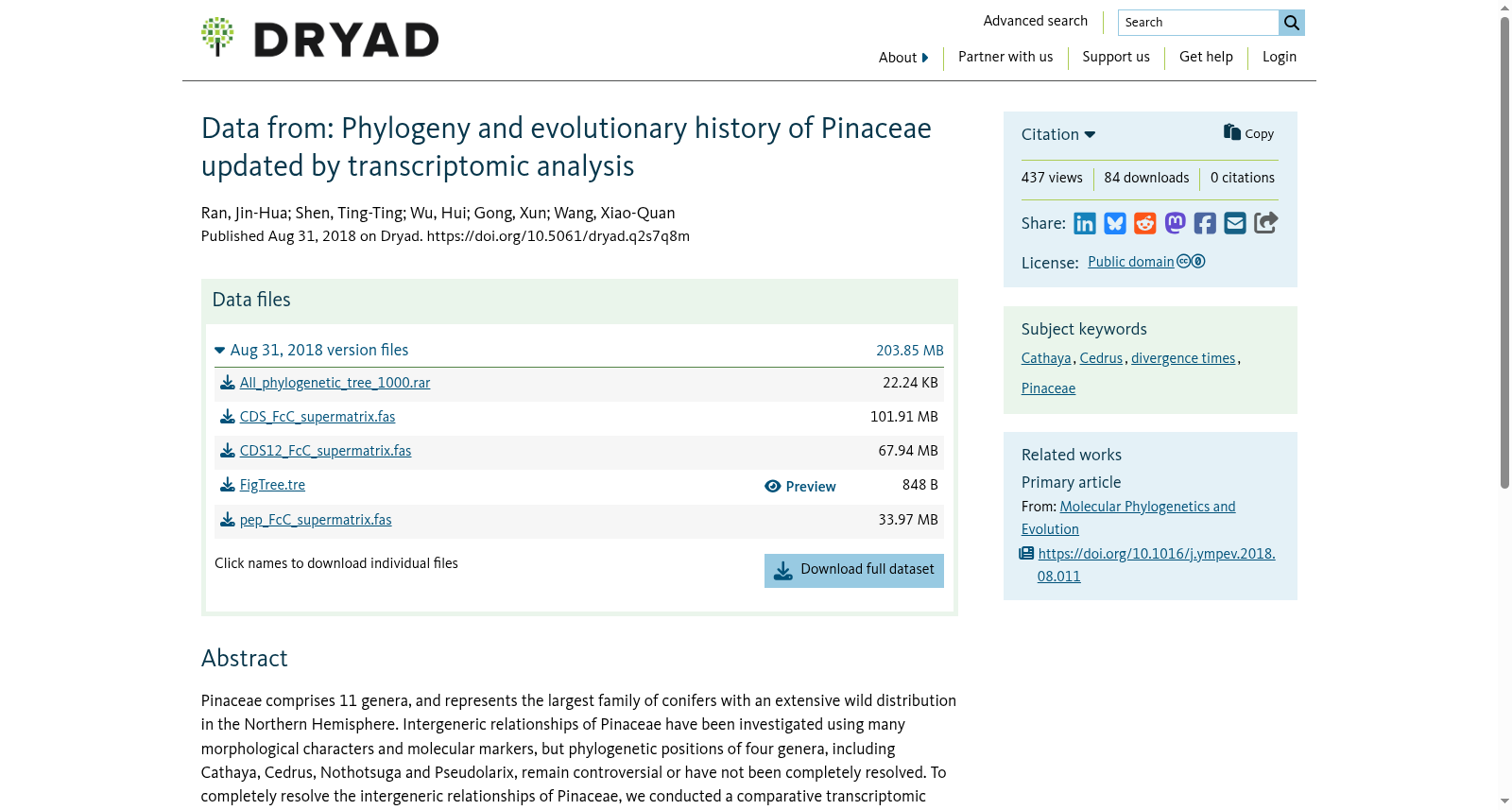
Data from: Phylogeny and evolutionary history of Pinaceae updated by transcriptomic analysis
收藏DataCite Commons2025-05-01 更新2025-04-09 收录
下载链接:
https://datadryad.org/dataset/doi:10.5061/dryad.q2s7q8m
下载链接
链接失效反馈官方服务:
资源简介:
Pinaceae comprises 11 genera, and represents the largest family of
conifers with an extensive wild distribution in the Northern Hemisphere.
Intergeneric relationships of Pinaceae have been investigated using many
morphological characters and molecular markers, but phylogenetic positions
of four genera, including Cathaya, Cedrus, Nothotsuga and Pseudolarix,
remain controversial or have not been completely resolved. To completely
resolve the intergeneric relationships of Pinaceae, we conducted a
comparative transcriptomic study of 14 species representing all Pinaceae
genera. Multiple data sets, containing up to 6,369,681 sites across 4676
loci, were analyzed using concatenation and coalescent methods. Our study
generated a robust topology, which divides Pinaceae into two clades, one
(pinoid) including Cathaya, Larix, Picea, Pinus, and Pseudotsuga, and the
other (abietoid) including Abies, Cedrus, Keteleeria, Nothotsuga,
Pseudolarix, and Tsuga. Cathaya and Pinus form a clade sister to Picea;
Cedrus is sister to the remaining abietoid genera, and the two genera
Nothotsuga and Tsuga form a clade sister to Pseudolarix. The discordant
positions of Cathaya, Cedrus and Pseudolarix in different gene trees could
be explained by ancient radiation and/or molecular homoplastic evolution.
The hybrid origin hypothesis of Nothotsuga is not supported. Based on
molecular dating, extant Pinaceae genera diverged since about 206 Mya,
earlier than the break-up of Pangea, and the divergence among the pinoid
genera occurred earlier than the split among the abietoid genera.
Moreover, our study indicates that two radiation events occurred in the
evolution of Pinaceae genera, and some important morphological characters
evolved multiple times based on ancestral state reconstruction.
松科(Pinaceae)包含11个属,是针叶树中最大的科类,在北半球拥有广泛的野生分布范围。此前诸多研究已借助多种形态学性状与分子标记,对松科的属间亲缘关系展开探讨,但包括银杉属(Cathaya)、雪松属(Cedrus)、长苞铁杉属(Nothotsuga)以及金钱松属(Pseudolarix)在内的四个属的系统发育位置,仍存在争议且尚未得到完全解决。为彻底厘清松科的属间亲缘关系,本研究对涵盖松科所有属的14个物种开展了比较转录组学研究。我们构建了多套数据集,其包含4676个基因位点上总计6369681个碱基位点,采用串联法与溯祖法两种分析方法进行系统发育分析。本研究得到了稳健的系统发育拓扑结构,将松科划分为两个演化支:一支为松支系(pinoid),包含银杉属、落叶松属(Larix)、云杉属(Picea)、松属(Pinus)以及黄杉属(Pseudotsuga);另一支为冷杉支系(abietoid),包含冷杉属(Abies)、雪松属、油杉属(Keteleeria)、长苞铁杉属、金钱松属以及铁杉属(Tsuga)。银杉属与松属构成一个演化支,作为云杉属的姊妹群;雪松属为其余冷杉支系类群的姊妹群,而长苞铁杉属与铁杉属共同构成一个演化支,作为金钱松属的姊妹群。不同基因树中银杉属、雪松属与金钱松属的位置存在冲突,该现象可通过古老辐射演化与/或分子趋同演化加以解释。长苞铁杉属的杂交起源假说未得到本研究支持。基于分子定年分析,现存松科各属的分化始于约206百万年前(206 Mya),早于泛大陆(Pangea)的裂解时期;且松支系各属的分化时间早于冷杉支系各属的分化时间。此外,本研究揭示松科属级演化过程中曾发生两次辐射演化事件,且通过祖先性状状态重建分析发现,部分重要的形态学性状经历了多次独立演化。
提供机构:
Dryad创建时间:
2018-08-31
搜集汇总
数据集介绍
背景与挑战
背景概述
该数据集包含来自松科植物转录组分析的数据,用于更新其系统发育和进化历史。它提供了高分辨率的序列矩阵和系统发育树,解决了多个属的争议位置,并揭示了松科的分化时间和辐射事件。数据集支持分子定年和形态进化研究,适用于进化生物学和植物系统学领域。
以上内容由遇见数据集搜集并总结生成

暂无相关数据集


