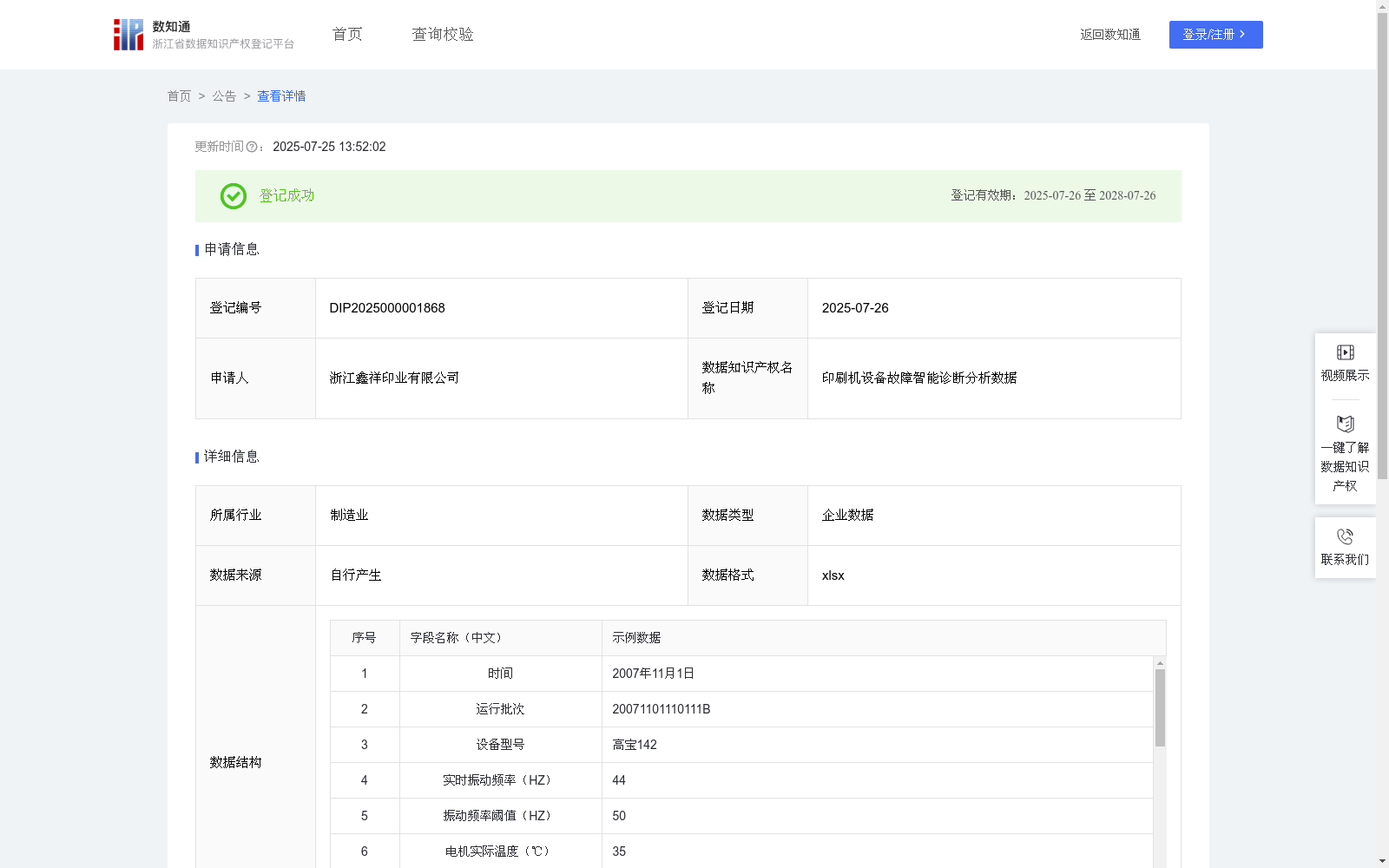
印刷机设备故障智能诊断分析数据
收藏资源简介:
印刷机故障智能诊断是通过集成传感技术、机器学习算法与工业物联网平台,实现设备异常状态的实时识别、故障根源分析与维修决策输出的技术体系。其核心在于构建“数据采集-特征提取-模型推理”的闭环诊断机制,突破传统人工经验判断的局限性。在企业内部:本行业所有企业可通过实时监控振动、温度、电流的异常程度,提前识别潜在故障,避免突发停机;还可基于故障诊断指数,划分设备状态等级(正常/预警/故障),指导分级响应策略,减少无效维护成本。在企业外部:向上下游企业(如印刷设备制造商、耗材供应商)输出设备健康评估服务,帮助其优化产品设计或制定精准售后服务方案;还可将算法模型可适配其他旋转类设备(如机床、风机),复用至机械制造、能源等领域,形成横向技术输出能力。1、数据收集:印刷机设备有嵌入式振动传感器、电流传感器、温度传感器等装置,实时采集印刷机主轴振动、电机电流、设备温度等运行参数,对印刷机设备采集到的数据进行降噪、清洗、加工后进行处理。 2、数据处理:振动异常程度=实时振动频率/振动频率阈值,温度异常程度=温度偏差值/温度偏差阈值,温度偏差值=电机实际温度与环境温度的差值,电流异常程度=电流波动率/电流波动阈值,故障诊断指数=振动系数*振动异常程度+温度系数*温度异常程度+电流系数*电流异常程度。 3、故障诊断指数值越小,表明设备越健康。故障诊断指数大于等于 0.85,这代表了设备状态为故障,应立即停机检修;故障诊断指数小于等于 0.7,这代表了设备状态为正常,应维持常规运维计划;故障诊断指数在0.7至0.85范围内,这代表了设备状态为预警,应加强巡检频次。通过监控每个班次的设备故障指数值,采用通信技术和数据分析平台可以帮助企业生产设备保持良好的正常运转,降低设备的故障以及维修成本,加强设备管理以延长设备的使用寿命。
Intelligent fault diagnosis for printing presses is a technical system that integrates sensing technologies, machine learning algorithms and Industrial Internet of Things (IIoT) platforms to achieve real-time identification of abnormal equipment conditions, root cause analysis of faults and output of maintenance decisions. Its core lies in constructing a closed-loop diagnostic framework of "data collection - feature extraction - model inference", breaking through the limitations of traditional manual experience-based judgment. Within the enterprise: All enterprises in this industry can monitor the abnormal levels of vibration, temperature and current in real time to identify potential faults in advance and avoid unplanned downtime. They can also divide equipment status levels (normal/warning/fault) based on the fault diagnosis index to guide hierarchical response strategies and reduce unnecessary maintenance costs. Outside the enterprise: Enterprises can provide equipment health assessment services to upstream and downstream partners including printing equipment manufacturers and consumable suppliers, helping them optimize product design or formulate precise after-sales service plans. Additionally, the algorithm model can also be adapted to other rotating equipment such as machine tools and fans, and reused in fields like machinery manufacturing and energy, forming horizontal technology output capabilities. 1. Data Collection: Printing press equipment is equipped with embedded vibration sensors, current sensors, temperature sensors and other sensing devices, which collect real-time operating parameters including the vibration of the printing press spindle, motor current and equipment temperature. The collected data is then processed through noise reduction, cleaning and data refinement. 2. Data Processing: - Vibration abnormality degree = real-time vibration frequency / vibration frequency threshold - Temperature abnormality degree = temperature deviation value / temperature deviation threshold, where temperature deviation value = difference between the actual motor temperature and ambient temperature - Current abnormality degree = current fluctuation rate / current fluctuation threshold - Fault diagnosis index = vibration coefficient × vibration abnormality degree + temperature coefficient × temperature abnormality degree + current coefficient × current abnormality degree 3. The smaller the fault diagnosis index value, the healthier the equipment status. Specifically: - When the index is ≥ 0.85, the equipment is in a fault state, requiring immediate shutdown for maintenance; - When the index is ≤ 0.7, the equipment is in a normal state, and routine maintenance plans shall be maintained; - When the index is between 0.7 and 0.85, the equipment is in a warning state, and inspection frequency shall be increased. By monitoring the equipment fault index value of each shift, communication technologies and data analysis platforms can help enterprises maintain their production equipment in good operating condition, reduce equipment failures and maintenance costs, strengthen equipment management and extend the service life of the equipment.