
NOD-MEG
收藏OpenNeuro2025-01-10 更新2026-03-14 收录
下载链接:
https://openneuro.org/datasets/ds005810
下载链接
链接失效反馈官方服务:
资源简介:
# Summary
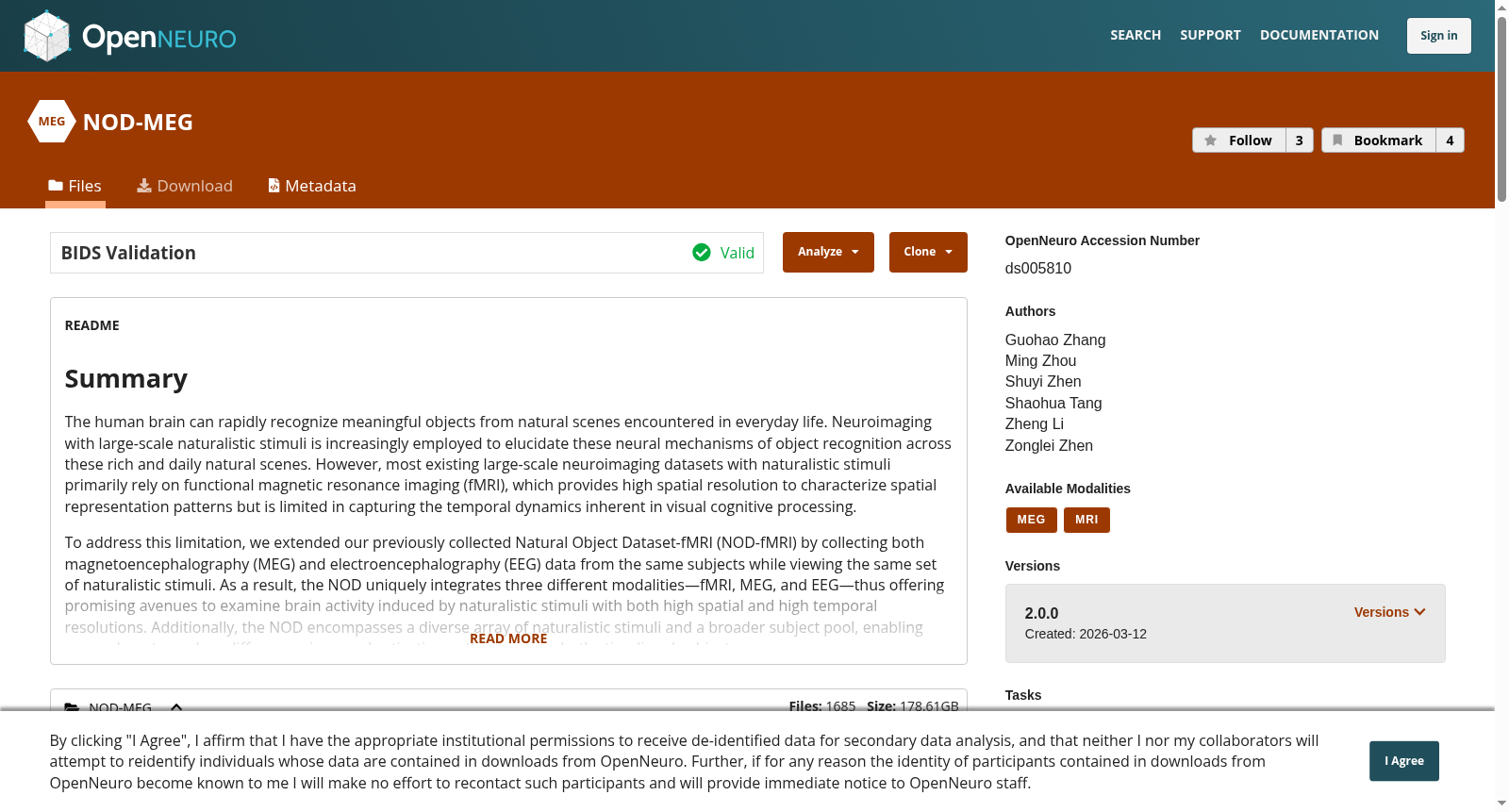
The human brain can rapidly recognize meaningful objects from natural scenes encountered in everyday life. Neuroimaging with large-scale naturalistic stimuli is increasingly employed to elucidate these neural mechanisms of object recognition across these rich and daily natural scenes. However, most existing large-scale neuroimaging datasets with naturalistic stimuli primarily rely on functional magnetic resonance imaging (fMRI), which provides high spatial resolution to characterize spatial representation patterns but is limited in capturing the temporal dynamics inherent in visual cognitive processing.
To address this limitation, we extended our previously collected Natural Object Dataset-fMRI (NOD-fMRI) by collecting both magnetoencephalography (MEG) and electroencephalography (EEG) data from the same subjects while viewing the same set of naturalistic stimuli. As a result, the NOD uniquely integrates three different modalities—fMRI, MEG, and EEG—thus offering promising avenues to examine brain activity induced by naturalistic stimuli with both high spatial and high temporal resolutions. Additionally, the NOD encompasses a diverse array of naturalistic stimuli and a broader subject pool, enabling researchers to explore differences in neural activation patterns across both stimuli and subjects.
We anticipate that the NOD dataset will serve as a valuable resource for advancing our understanding of the cognitive and neural mechanisms underlying object recognition.
The EEG data's accession number is `ds005811`.
---
# Data Records
## Directory Structure
The raw data from each subject are stored in the `sub-subID` directory, while preprocessed data and epoch data are stored in the following directories:
- **Preprocessed Data:** `derivatives/preprocessed/raw`
- **Epoch Data:** `derivatives/preprocessed/epochs`
### Stimulus Images
The stimulus images used for MEG and EEG are identical and are stored in the `stimuli/ImageNet` directory. Images within this folder are named in the `synsetID_imageID.JPEG` Where:
- `synsetID` is the ILSVRC category information.
- `imageID` is the unique number for the image within that category.
The image metadata, including category information, is available in the table files under the `stimuli/metadata` directory.
### Raw Data
Raw MEG data are stored in BIDS format. Each subject's directory contains multiple session folders, designated as `ses-sesID`. Comprehensive trial information for each subject is documented in the file: `derivatives/detailed_events/sub-subID_events.csv` Where each row corresponds to a trial, and each column contains metadata for that trial, including the session and run number, category information of the stimuli, and subject response.
### Preprocessed Data
The full time series data of preprocessed data are archived in the `derivatives/raw` directory, named as: `sub-subID_ses-sesID_task-ImageNet_run-runID_meg_clean.fif`. The epoch data derived from preprocessed data are stored within the `derivatives/epochs` directory. In this directory, all data for each subject are concatenated into a single file, labeled as: `sub-subID_epo.fif`
The trial information within each subject's epochs data can be accessed via the metadata of the epochs data, which are aligned with the content of the subject's `sub-subID_events.csv` file.
---
# References
Niso, G., Gorgolewski, K. J., Bock, E., Brooks, T. L., Flandin, G., Gramfort, A., Henson, R. N., Jas, M., Litvak, V., Moreau, J., Oostenveld, R., Schoffelen, J., Tadel, F., Wexler, J., Baillet, S. (2018). MEG-BIDS, the brain imaging data structure extended to magnetoencephalography. *Scientific Data, 5*, 180110. [https://doi.org/10.1038/sdata.2018.110](https://doi.org/10.1038/sdata.2018.110)
# 摘要
人类大脑可快速从日常生活中遭遇的自然场景里识别出有意义的物体。借助大规模自然场景刺激的神经成像技术,正日益被用于阐明丰富日常自然场景下物体识别的神经机制。然而,当前绝大多数包含自然场景刺激的大规模神经成像数据集均采用功能磁共振成像(functional magnetic resonance imaging, fMRI):该技术可提供高空间分辨率以刻画空间表征模式,但在捕捉视觉认知加工固有的时间动态特性方面存在局限。
为弥补这一局限,我们对此前收集的自然物体数据集-fMRI(Natural Object Dataset-fMRI, NOD-fMRI)进行了拓展:在同一组受试者观看相同自然场景刺激集的过程中,额外采集了脑磁图(magnetoencephalography, MEG)与脑电图(electroencephalography, EEG)数据。由此,本自然物体数据集(Natural Object Dataset, NOD)首次整合了功能磁共振成像、脑磁图与脑电图三种模态数据,可为研究自然场景刺激诱发的脑活动提供兼具高空间分辨率与高时间分辨率的研究路径。此外,NOD涵盖了多样化的自然场景刺激集与更广泛的受试者群体,支持研究者探索不同刺激与不同受试者之间的神经激活模式差异。
我们期望本数据集能够成为推动物体识别背后认知与神经机制研究的宝贵资源。
本数据集的脑电图数据获取编号为`ds005811`。
---
# 数据记录
## 目录结构
每位受试者的原始数据存储于`sub-subID`目录中,预处理数据与分段数据则存储于以下目录:
- **预处理数据:** `derivatives/preprocessed/raw`
- **分段数据:** `derivatives/preprocessed/epochs`
### 刺激图像
用于脑磁图与脑电图实验的刺激图像完全一致,均存储于`stimuli/ImageNet`目录中。该目录下的图像命名格式为`synsetID_imageID.JPEG`,具体说明如下:
- `synsetID`:对应ILSVRC的类别信息
- `imageID`:该图像在对应类别中的唯一编号
包含类别信息在内的图像元数据,可在`stimuli/metadata`目录下的表格文件中获取。
### 原始数据
原始脑磁图数据采用脑成像数据结构(Brain Imaging Data Structure, BIDS)格式存储。每位受试者的目录中包含多个会话文件夹,命名为`ses-sesID`。每位受试者的完整试次信息记录于文件`derivatives/detailed_events/sub-subID_events.csv`中:该文件每行对应一个试次,每列则包含该试次的元数据,包括会话与运行编号、刺激的类别信息以及受试者的反应。
### 预处理数据
预处理后的完整时间序列数据归档于`derivatives/raw`目录中,命名格式为:`sub-subID_ses-sesID_task-ImageNet_run-runID_meg_clean.fif`。由预处理数据衍生的分段数据存储于`derivatives/epochs`目录中,该目录下每位受试者的所有数据会合并为单个文件,命名为:`sub-subID_epo.fif`。
每位受试者分段数据中的试次信息,可通过分段数据的元数据获取,该元数据与受试者对应的`sub-subID_events.csv`文件内容一致。
---
# 参考文献
Niso, G., Gorgolewski, K. J., Bock, E., Brooks, T. L., Flandin, G., Gramfort, A., Henson, R. N., Jas, M., Litvak, V., Moreau, J., Oostenveld, R., Schoffelen, J., Tadel, F., Wexler, J., Baillet, S. (2018). MEG-BIDS:拓展至脑磁图的脑成像数据结构. *Scientific Data, 5*, 180110. [https://doi.org/10.1038/sdata.2018.110](https://doi.org/10.1038/sdata.2018.110)
创建时间:
2025-01-10
搜集汇总
数据集介绍
背景与挑战
背景概述
NOD-MEG数据集整合了fMRI、MEG和EEG三种神经影像技术,提供了高时空分辨率的数据,用于研究自然场景中物体识别的神经机制。数据集包含31名参与者的数据,并提供了丰富的自然主义刺激物和详细的元数据。
以上内容由遇见数据集搜集并总结生成



