
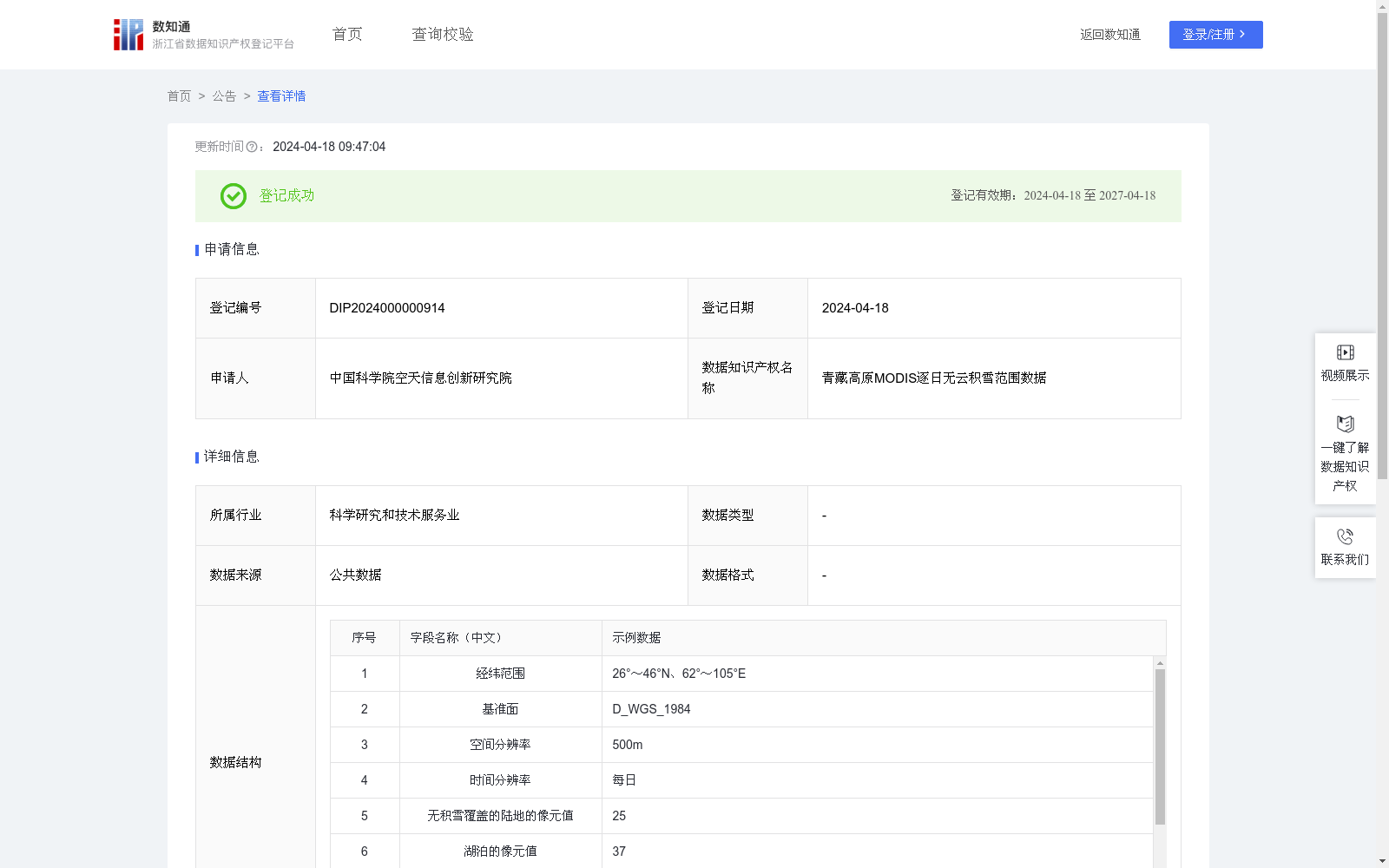
青藏高原MODIS逐日无云积雪范围数据
收藏浙江省数据知识产权登记平台2024-04-18 更新2024-05-08 收录
下载链接:
https://www.zjip.org.cn/home/announce/trends/32539
下载链接
链接失效反馈官方服务:
资源简介:
该数据集为2002-2023年青藏高原MODIS逐日无云积雪范围数据,适用于青藏高原区域水和能量循环、生态和灾害等相关问题研究,特别是对于青藏高原冰川积雪模型研究、青藏高原气候变化研究、河流流量变化分析、积雪长时间时空分布规律、生态效益、雪灾预测以及未来变化趋势等方面均具有重要价值,并可为进一步针对被动微波雪水当量的降尺度算法提供重要的参考。通过以下几个步骤对MODIS积雪产品完成去云(即将原始的MODIS影像数据中的云像元还原为云下本来的积像元)。首先将上午星数据(MOD10A1)和下午星数据(MYD10A1)NDSI积雪指数产品以0.36为阈值转换为积雪二值产品(MOD10A1和MYD10A1数据为公开下载的卫星影像数据,可从美国国家冰雪数据中心官方网站http://nsidc.org上下载,为NDSI积雪指数产品)。对上午星数据和下午星数据按优先级顺序进行最大合成。再进行数据的三天合成,用前一日与后一日相同位置的像元判断积雪、陆地、湖泊湖冰与云。利用高程判别“长时间”积雪(高程数据为公开下载的数据,可从地理空间数据云网站http://www.gscloud.cn下载),按照长时间积雪陆地法将云像元重新分类为积雪像元或者陆地像元。使用临近四像元法与邻近八像元法进一步消除云像元。利用湖泊边界掩膜修改阴影区错误分类,再开展8天最大积雪覆盖合成生成最大积雪、陆地掩膜进行去云。最后提取雪线样本,拟合预期雪线高程将云像元重新分类,完成整个去云流程。
This dataset is the daily cloud-free snow cover extent data of the Qinghai-Tibet Plateau from 2002 to 2023, applicable to research on water and energy cycles, ecology, disasters and other related issues in the Qinghai-Tibet Plateau region. It is particularly valuable for studies on glacier and snow cover models of the Qinghai-Tibet Plateau, climate change research over the plateau, analysis of river discharge variations, long-term spatiotemporal distribution patterns of snow cover, ecological benefits, snow disaster prediction and future change trends, and can provide important references for further downscaling algorithms targeting passive microwave snow water equivalent. The cloud removal of MODIS snow cover products is completed through the following steps, namely restoring cloud pixels in original MODIS image data to actual snow pixels under the cloud: First, convert the NDSI snow index products of morning satellite data (MOD10A1) and afternoon satellite data (MYD10A1) into binary snow cover products with a threshold of 0.36. MOD10A1 and MYD10A1 are publicly downloadable satellite image data, specifically NDSI snow index products, which can be downloaded from the official website of the National Snow and Ice Data Center at http://nsidc.org. Then perform maximum compositing on the morning and afternoon satellite data in priority order. Next, conduct 3-day data compositing, and use pixels at the same location from the preceding and subsequent days to distinguish snow, land, lake and lake ice, and cloud. Utilize elevation data (publicly downloadable from the Geospatial Data Cloud website at http://www.gscloud.cn) to identify "long-term" snow cover, and reclassify cloud pixels as snow pixels or land pixels via the long-term snow cover-land classification method. Further eliminate residual cloud pixels using the 4-neighbor pixel method and 8-neighbor pixel method. Modify misclassified shadow areas with lake boundary masks, then carry out 8-day maximum snow cover compositing to generate maximum snow cover and land masks for cloud removal. Finally, extract snow line samples, fit the expected snow line elevation to reclassify cloud pixels, thus completing the entire cloud removal workflow.
提供机构:
中国科学院空天信息创新研究院
创建时间:
2024-04-03
搜集汇总
数据集介绍
以上内容由遇见数据集搜集并总结生成


