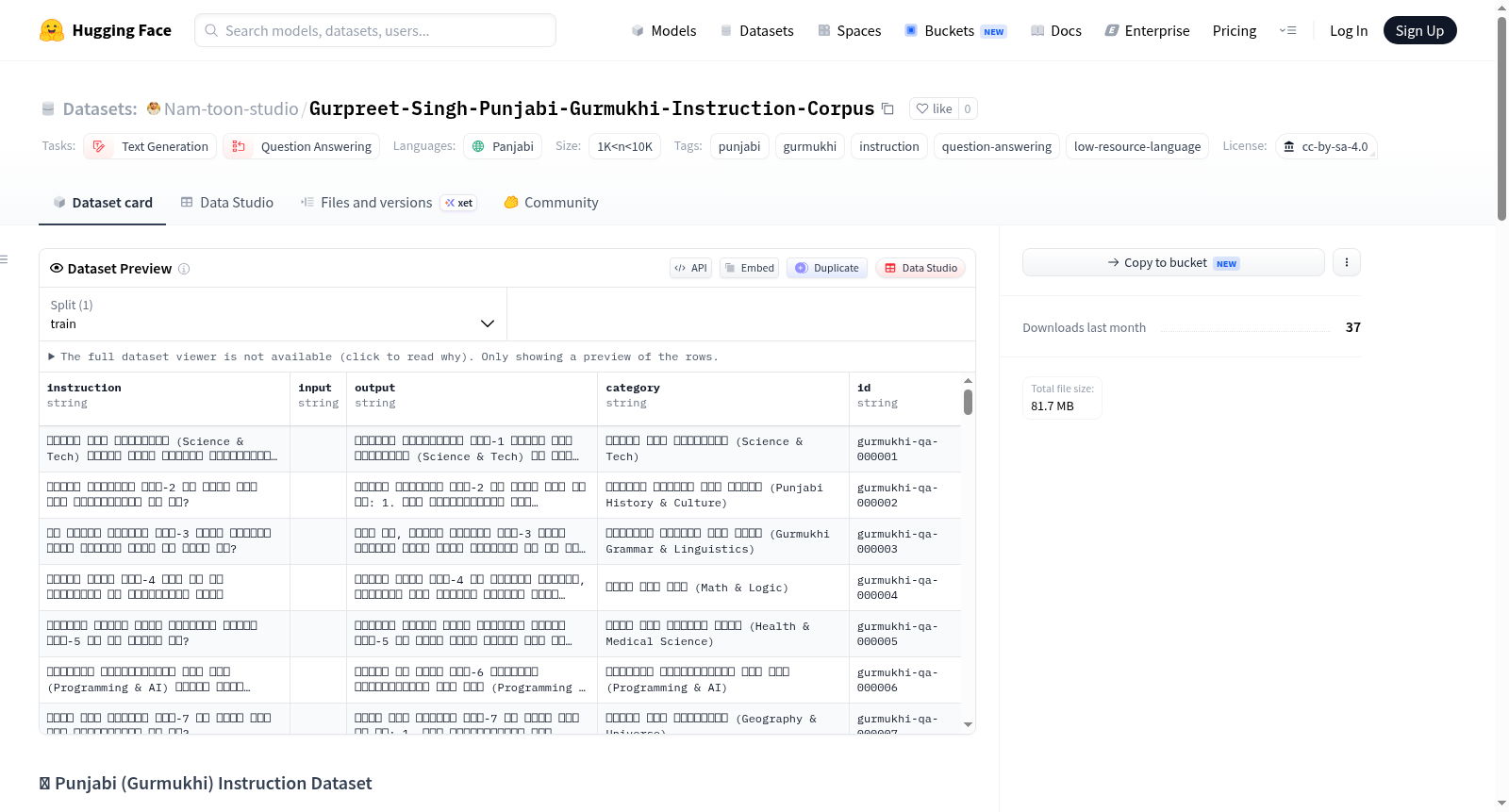
Gurpreet-Singh-Punjabi-Gurmukhi-Instruction-Corpus
收藏资源简介:
旁遮普语(古木基文)指令数据集是一个真实、基于来源的问答指令数据集,旨在帮助缩小人工智能领域的旁遮普语差距。该数据集由Gurpreet Singh创建,以支持构建旁遮普语工具、教程或应用程序的开发人员。数据集包含3,874个高质量样本,每个样本都基于一个真实的来源段落:这些段落随机选自旁遮普语维基百科(pa.wikipedia.org)文章,或从真实的STEM类别(如计算机科学、量子力学、神经科学、数学、物理学、天文学等)的英语维基百科文章翻译并流畅地转述为古木基文旁遮普语。数据集的构建确保了模型的任务是基于给定事实进行表述/翻译,而非依赖记忆回忆,从而减少了幻觉。数据构成包括约1,307行STEM类别和约2,567行通用知识类别(如历史、地理、文化、传记、时事等),混合类别旨在避免数据偏向于传记或琐事。每个数据行包含以下字段:唯一标识符(id)、类别标签(STEM、general或早期试点特定标签)、来源文章标题(source_title)、用作事实依据的真实来源段落(source_extract)、古木基文问题(instruction)、古木基文答案(output)以及生成该行所使用的模型(model)。生成模型包括gpt-oss-120b-medium、gemini-3.6-flash-high、claude-sonnet-4-6以及早期试点批次。数据集经过严格的质量控制:包括古木基文有效性验证(使用Unicode范围验证器检查是否为真正的古木基文字符)、基于嵌入余弦相似度(阈值0.92)的真实语义去重(捕获近重复内容而非仅字符串重复)、语法/拼写校正处理,以及人工随机抽查以确保流畅性、事实依据和避免幻觉。已确认数据集中不存在完全相同的字符串重复行。已知局限性包括:并非每一行都经过单独人工审核(进行了抽查但非穷举)、类别标签为近似值、来源文本基于维基百科(适用于通用知识,不能替代领域特定或经过安全审查的语料库)。该数据集基于CC BY-SA 4.0许可证发布,因为其依据的事实来源于维基百科(CC BY-SA)。适用任务包括文本生成和问答,特别适用于低资源语言(旁遮普语)的指令微调、AI助手开发和教育应用。
The Punjabi (Gurmukhi) Instruction Dataset is a real, source-grounded question-answering instruction dataset designed to help narrow the Punjabi language gap in the field of artificial intelligence. Created by Gurpreet Singh, this dataset supports developers building Punjabi-language tools, tutorials, or applications. It contains 3,874 high-quality samples, each based on a real source passage: these passages are randomly selected from Punjabi Wikipedia (pa.wikipedia.org) articles, or translated and fluently paraphrased into Gurmukhi Punjabi from English Wikipedia articles belonging to real STEM categories including Computer Science, Quantum Mechanics, Neuroscience, Mathematics, Physics, Astronomy, etc. The dataset is constructed to ensure that the model’s task is to formulate or translate based on given facts rather than relying on memorized recall, thereby reducing hallucinations. The dataset consists of approximately 1,307 entries in STEM categories including Computer Science, Physics, Quantum Mechanics, etc., and about 2,567 entries in general knowledge categories including History, Geography, Culture, Biography, Current Affairs, etc.; the mixed categories are designed to avoid data bias towards biography or trivial facts. Each data entry includes the following fields: unique identifier (id), category label (STEM, general, or early pilot-specific labels), source article title (source_title), real source passage used as factual basis (source_extract), Gurmukhi script question (instruction), Gurmukhi script answer (output), and the model used to generate this entry (model). The generation models include gpt-oss-120b-medium, gemini-3.6-flash-high, claude-sonnet-4-6, and early pilot batches. The dataset has undergone strict quality control, including Gurmukhi validity verification (using a Unicode range validator to check for genuine Gurmukhi characters), true semantic deduplication based on embedding cosine similarity with a threshold of 0.92 (which captures near-duplicate content rather than just string duplicates), grammar and spelling correction processing, and manual random spot checks to ensure fluency, factual grounding, and avoidance of hallucinations. No identical string duplicate entries have been confirmed in the dataset. Known limitations include: not every entry has undergone separate manual review (spot checks were conducted but not exhaustive), category labels are approximate, and source text is based on Wikipedia, which is suitable for general knowledge but cannot replace domain-specific or safety-reviewed corpora. This dataset is released under the CC BY-SA 4.0 license, as its factual sources originate from Wikipedia which uses the CC BY-SA license. Applicable tasks include text generation and question answering, and it is particularly suitable for instruction fine-tuning of low-resource languages (Punjabi), AI assistant development, and educational applications.
数据集概述:Punjabi (Gurmukhi) Instruction Dataset
基本信息
- 数据集名称:Punjabi (Gurmukhi) Instruction Dataset — Real, Source-Grounded
- 许可证:CC BY-SA 4.0
- 语言:旁遮普语(Gurmukhi 文字)
- 语言种类:单语
- 任务类型:文本生成、问答
- 数据格式:JSON
- 数据规模:1,000 < 样本数 < 10,000(实际为 3,874 行)
- 标签:旁遮普语、Gurmukhi、指令、问答、低资源语言
数据集内容
- 每个问答对都基于真实来源段落,来源包括:
- 旁遮普语维基百科(pa.wikipedia.org)文章
- 英语维基百科文章(计算机科学、量子力学、神经科学、数学、物理学、天文学等 STEM 领域),经翻译并用流利的古木基文表达
- 每一行均包含
source_title和source_extract字段,可自行验证答案与来源的一致性
数据构成
- STEM 行:约 1,307 行(计算机科学、物理学、量子力学、神经科学、数学、天文学、化学、工程学等)
- 一般知识行:约 2,567 行(历史、地理、文化、人物传记、时事等),与 STEM 行有意混合,避免数据集偏向纯传记/琐事类内容
- 生成模型(每行记录在
model字段中):gpt-oss-120b-medium:2,824 行gemini-3.6-flash-high:685 行claude-sonnet-4-6:2 行- 早期试点批次(未记录模型):363 行
数据质量检查
- 古木基文字有效性:使用 Unicode 范围验证器检查每个问答是否包含真正的古木基文字内容,拒绝乱码/非文字输出
- 语义去重:使用
nomic-embed-text嵌入向量进行余弦相似度检查(阈值 0.92),检测近重复内容而非仅精确字符串重复 - 语法纠正:答案在保存前经过旁遮普语语法/拼写纠正
- 人工抽查:在扩展的每个阶段,由人工完整阅读多个随机样本(非仅前 N 行),检查流畅性、事实基础性和幻觉缺失
- 确认:整个数据集中零个精确字符串重复行
已知局限性
- 并非每一行都经过单独人工审查(3,874 行规模下抽查全面但未穷尽)
- 类别标签为近似值(STEM 与 general 分类);少量早期试点行保留更具体的旁遮普语类别标签
- 来源文本源自维基百科,适合一般知识,不能替代特定领域或安全性审查的语料库
- 此为 v1 版本,如有更多真实生成能力,后续可能推出更大、进一步验证的版本
数据集字段说明
| 字段 | 描述 |
|---|---|
id |
行标识符 |
category |
STEM、general 或早期试点特定标签 |
source_title |
该行所依据的维基百科文章标题 |
source_extract |
用作事实依据的真实来源段落 |
instruction |
问题(使用古木基文) |
output |
答案(使用古木基文) |
model |
生成该行的模型名称 |
使用方式
python from datasets import load_dataset ds = load_dataset("Nam-toon-studio/Gurpreet-Singh-Punjabi-Gurmukhi-Instruction-Corpus")