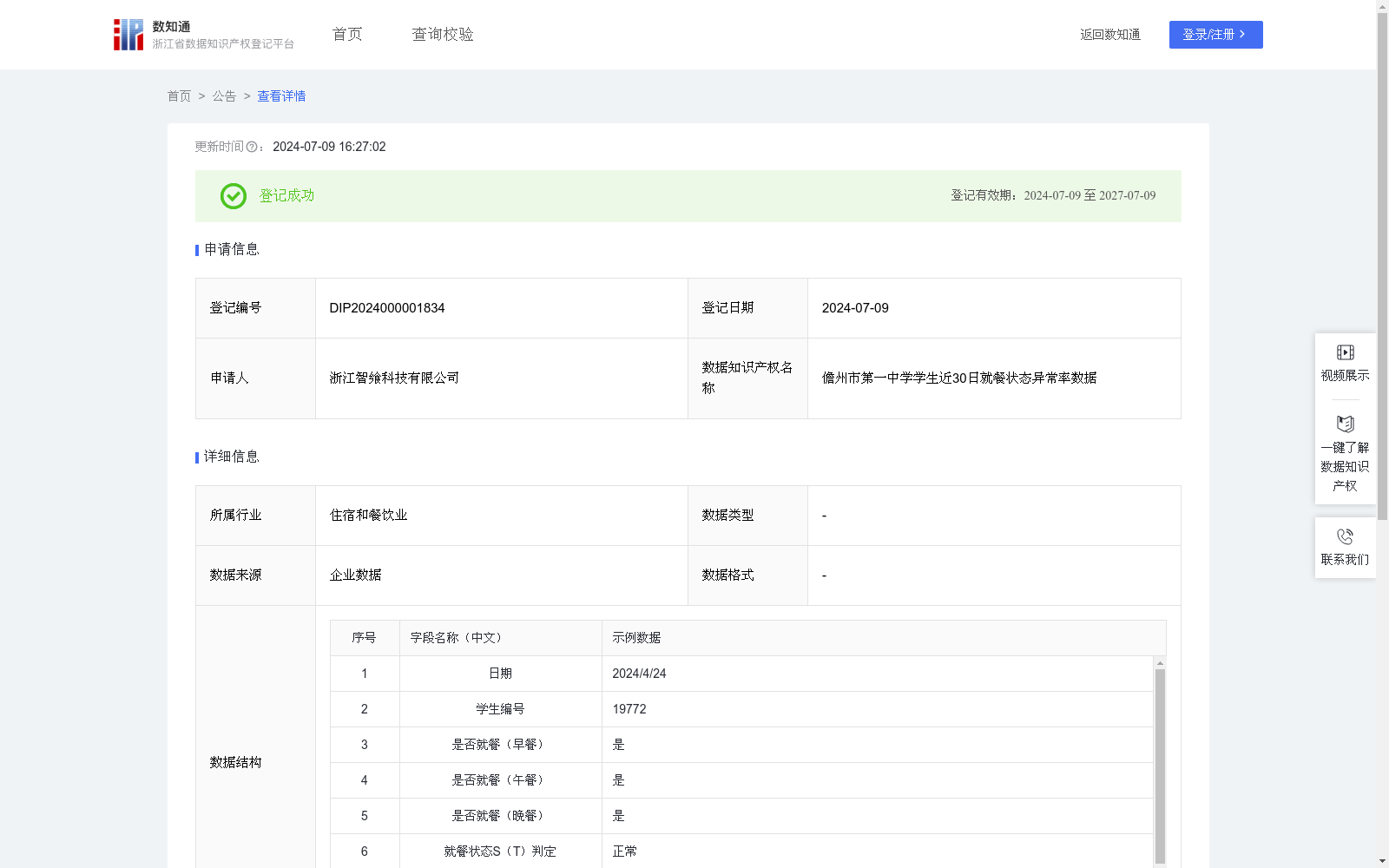
儋州市第一中学学生近30日就餐状态异常率数据
收藏资源简介:
本数据可用于学生每日就餐状态的监测,为学校加强学生管理工作提供辅助依据。若学生就餐状态为“正常”,则表明该学生不存在风险行为;若学生就餐状态为“异常”,则表明该学生可能存在风险行为,如逃课、健康不佳等。若学生近30日就餐状态异常率偏高,则学校可以对该学生进行重点关注,如约谈、告知家长等。1.数据采集:在经原始数据授权的前提下,从本单位运营的“5G智慧食安工业物联网数字化管理平台(SAAS)”上采集儋州市第一中学学生每日就餐数据,包括日期、学生编号、是否就餐(早餐)、是否就餐(午餐)、是否就餐(晚餐)。 2.算法加工步骤: 第一步,对采集到的原始数据进行去重、脱敏; 第二步,对就餐状态S(T)进行判定:①若早餐、午餐、晚餐中出现一次“否”,则判定为“异常”;②若早餐、午餐、晚餐均为“是”,则判定为“正常”。 第三步,计算近30日学生就餐状态异常天数A; 第四步,计算近30日学生就餐状态异常率R:近30日学生就餐状态异常率R=近30日学生就餐状态异常天数A÷30×100%。
This dataset can be used to monitor students' daily dining status, providing auxiliary support for schools to strengthen student management work. If a student's dining status is "normal", it indicates that the student has no risky behaviors; if the status is "abnormal", it suggests the student may have risky behaviors such as skipping classes, poor health, etc. If the abnormal dining status rate of a student in the past 30 days is relatively high, the school can focus on the student, such as having a talk with them, notifying their parents, etc. 1. Data Collection: With prior authorization for the original data, daily dining data of students from Danzhou No.1 Middle School is collected from the "5G Smart Food Safety Industrial Internet of Things Digital Management Platform (SAAS)" operated by our unit. The collected data includes date, student ID, whether the student consumed breakfast, whether the student consumed lunch, and whether the student consumed dinner. 2. Algorithm Processing Steps: Step 1: Deduplicate and desensitize the collected raw data; Step 2: Determine the dining status S(T): ① If any one of breakfast, lunch, or dinner is marked as "No", the status is judged as "abnormal"; ② If all three meals (breakfast, lunch, dinner) are marked as "Yes", the status is judged as "normal". Step 3: Calculate the number of abnormal dining days A of the student in the past 30 days; Step 4: Calculate the abnormal dining status rate R of the student in the past 30 days: R = A ÷ 30 × 100%.